
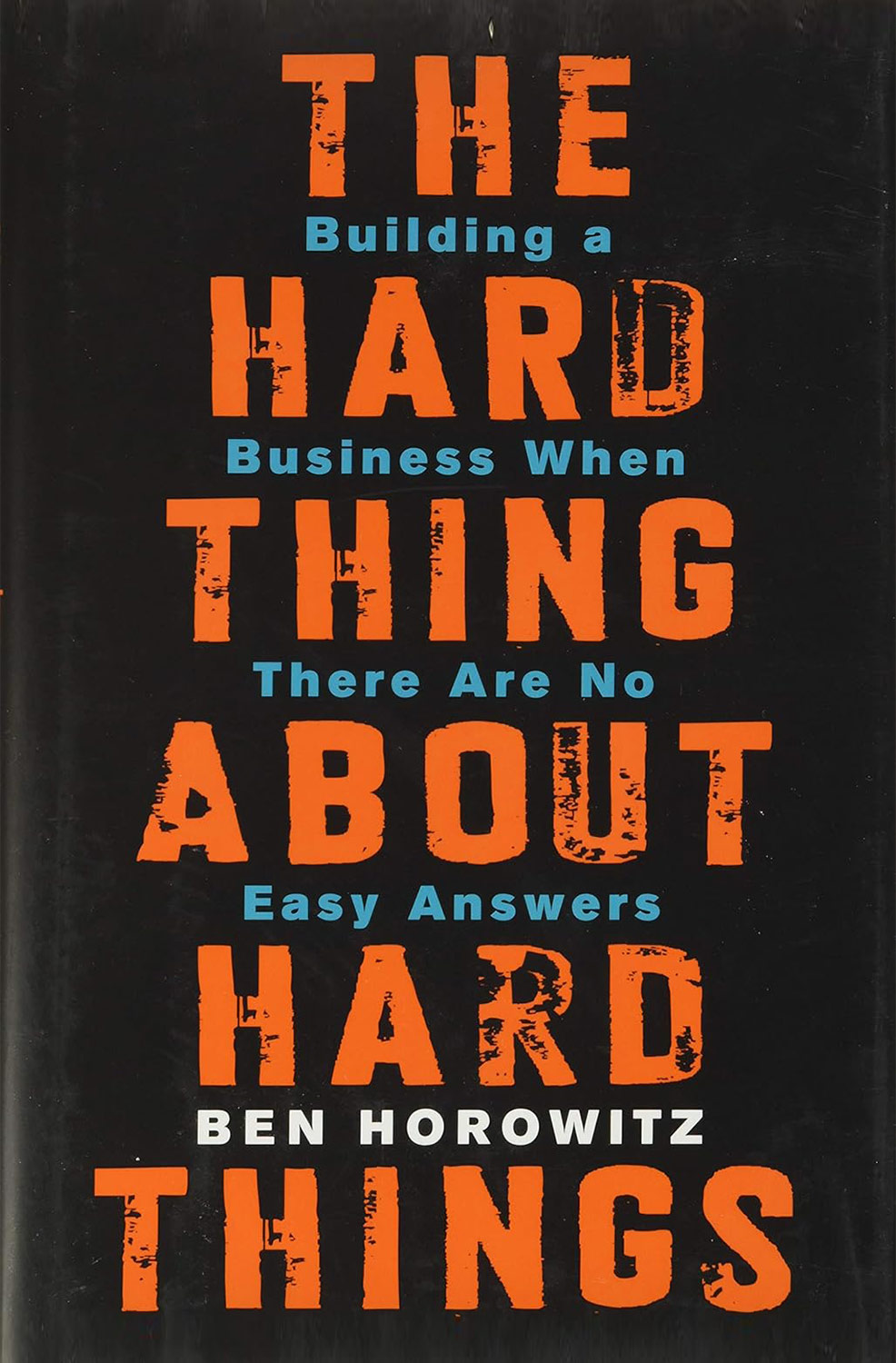
By Ben Horowitz
There is a persistent myth in entrepreneurship that success is primarily about vision, innovation, or brilliance. Founders are often portrayed as visionary architects who see around corners, make bold bets, and execute with clarity. In The Hard Thing About Hard Things, Ben Horowitz dismantles that narrative with precision and honesty. His central argument is simple but uncomfortable: the hardest problems in business are not the ones with clear answers. They are the ambiguous, emotionally draining, no-win situations where every option carries risk, and there is no playbook to follow.
BUY THIS BOOK
Horowitz writes not as a theorist, but as an operator who has lived through near-death business experiences, including running Loudcloud and Opsware through the dot-com crash. This book is not about how to start a company. It is about how to survive when things go wrong, which they inevitably will. The tone is raw, direct, and often unfiltered, reflecting the emotional and psychological weight of leadership under pressure.
The Struggle: What It Really Feels Like to Run a Company
At the core of the book is what Horowitz calls “The Struggle.” This is not a temporary setback or a bad quarter. The Struggle is the persistent, grinding reality of leadership when everything feels uncertain. It is waking up at 3 a.m. questioning every decision. It is knowing that people’s livelihoods depend on your choices, while you yourself feel unsure.
The Struggle is not something you escape. It is something you endure. Horowitz emphasizes that every great CEO experiences it, regardless of outward success. What separates successful leaders is not the absence of struggle, but their ability to continue making decisions in the face of it.
He challenges the idea that there is a formula for navigating these moments. Instead, he argues that leadership is fundamentally about judgment under uncertainty. There are no shortcuts, no frameworks that fully capture the complexity of real-world decisions. The job of a CEO is to make calls when there is insufficient information, conflicting advice, and significant downside risk.
The Myth of Easy Answers
One of the book’s most important contributions is its rejection of conventional business advice. Many leadership books present tidy frameworks, best practices, and step-by-step solutions. Horowitz views these as dangerously incomplete. In reality, the hardest decisions do not fit neatly into frameworks.
For example, when should you fire an executive who is underperforming but loyal? When should you pivot your company versus doubling down? When do you tell employees the full truth about the company’s struggles, and when do you shield them? These are not questions with universally correct answers.
Horowitz argues that leadership is situational. Context matters more than theory. The right decision depends on timing, people, market conditions, and the specific dynamics of your organization. This forces leaders to develop something deeper than knowledge, which is judgment. Judgment is built through experience, reflection, and often, failure.
Managing Through Crisis: Wartime vs Peacetime CEOs
One of the most well-known concepts in the book is the distinction between wartime and peacetime CEOs. A peacetime CEO operates in a stable environment, where growth is predictable, competition is manageable, and the focus is on optimization. In contrast, a wartime CEO leads during existential threats, when the company’s survival is at stake.
In wartime, the rules change. Efficiency takes a backseat to survival. Decisions must be made quickly, often with incomplete information. The leader must be decisive, even aggressive. There is less room for consensus and more emphasis on command.
Horowitz makes it clear that neither style is inherently better. The challenge is knowing which mode the situation demands. Many companies fail because leaders continue to operate in peacetime mode when the business is clearly in crisis. Conversely, leaders who remain in wartime mode during stable periods can create unnecessary tension and burnout.
The ability to shift between these modes is a defining trait of effective leadership. It requires situational awareness and the humility to adapt one’s style as circumstances change.
Building and Maintaining Culture
Culture is often discussed in abstract terms, but Horowitz brings it down to earth. He defines culture not as slogans or perks, but as the set of behaviors that are rewarded and tolerated within an organization. Culture is what people do when no one is watching.
He emphasizes that culture must be intentional. It does not emerge organically in a way that aligns with business goals. Leaders must actively shape it through their decisions, actions, and communication. This includes making tough calls about who stays and who goes.
One of the most difficult aspects of culture is maintaining it during periods of growth or crisis. As companies scale, the original values can become diluted. New hires bring different expectations, and processes begin to replace personal accountability. During crises, the pressure to survive can lead to compromises that erode trust.
Horowitz argues that leaders must be vigilant. Culture is not static. It requires constant reinforcement. Every decision sends a signal about what is truly valued.
The Challenge of Hiring and Managing Executives
Hiring executives is one of the most consequential decisions a CEO makes. A strong executive team can accelerate growth and execution. A weak one can create drag, confusion, and internal conflict.
Horowitz provides practical guidance on evaluating executives, emphasizing the importance of both competence and cultural fit. However, he also acknowledges that even the best hiring processes are imperfect. Leaders will inevitably make mistakes.
The harder part is managing executives once they are in place. This includes setting clear expectations, providing feedback, and making tough decisions when performance falls short. Horowitz stresses the importance of honesty. Avoiding difficult conversations only prolongs problems and undermines trust.
Firing executives is particularly challenging. It is emotionally taxing and can have ripple effects throughout the organization. Yet, delaying the decision often makes the situation worse. Horowitz encourages leaders to act decisively, while treating people with respect and dignity.
Communication: Saying the Hard Things
One of the recurring themes in the book is the importance of communication, especially during difficult times. Horowitz argues that leaders must tell the truth, even when it is uncomfortable. Employees can sense when something is wrong. Attempting to shield them with overly optimistic messaging can erode credibility.
At the same time, transparency must be balanced with responsibility. Leaders cannot simply offload anxiety onto their teams. The goal is to provide clarity without creating panic. This requires thoughtful communication, where problems are acknowledged but framed within a plan of action.
Horowitz also highlights the importance of one-on-one conversations. These are not just status updates, but opportunities to build trust, align expectations, and address concerns. Effective communication is not about broadcasting information. It is about ensuring understanding.
Scaling the Organization
As companies grow, the challenges shift. What worked in the early stages often becomes insufficient. Informal communication breaks down, decision-making slows, and coordination becomes more complex.
Horowitz emphasizes the need to build systems and processes that enable scale. This includes clear organizational structures, defined roles, and consistent performance management. However, he cautions against over-engineering. Too much process can stifle innovation and slow execution.
The key is balance. Leaders must introduce enough structure to support growth, while preserving the agility that made the company successful in the first place. This requires continuous adjustment as the organization evolves.
The Psychological Toll of Leadership
Perhaps the most distinctive aspect of the book is its focus on the emotional reality of leadership. Horowitz does not shy away from the psychological burden of being a CEO. The isolation, the self-doubt, and the constant pressure can be overwhelming.
He describes the loneliness of leadership, where there are few people who truly understand the weight of the decisions being made. Even trusted advisors may not have full visibility into the complexities of the situation. This can create a sense of isolation that is difficult to manage.
Horowitz encourages leaders to develop resilience. This does not mean suppressing emotions, but learning to operate effectively despite them. It involves building mental toughness, seeking perspective, and maintaining focus on the long-term mission.
Decision-Making Without Certainty
A central lesson of the book is that leadership is fundamentally about making decisions without certainty. Data is often incomplete. Outcomes are unpredictable. Yet, decisions must be made.
Horowitz argues that waiting for perfect information is a mistake. It leads to paralysis and missed opportunities. Instead, leaders must develop the ability to make informed bets, understanding that some will fail.
He also emphasizes the importance of accountability. Leaders must own their decisions, both the successes and the failures. Blaming external factors or shifting responsibility undermines credibility and learning.
Over time, this process builds judgment. Experience, both good and bad, becomes a source of insight that informs future decisions.
The Role of Persistence
If there is one underlying theme that runs through the book, it is persistence. Building a company is not a linear journey. It is a series of challenges, setbacks, and moments of doubt.
Horowitz makes it clear that there is no substitute for perseverance. Talent, strategy, and resources all matter, but they are insufficient without the willingness to endure. The ability to keep going, even when the path is unclear, is what ultimately separates successful leaders from those who give up.
This persistence is not blind optimism. It is grounded in a commitment to solving problems and adapting to changing circumstances. It requires both resilience and flexibility.
Conclusion: Embracing the Hard Things
The Hard Thing About Hard Things is not a comforting book. It does not offer easy answers or simple formulas. Instead, it provides a candid look at the realities of leadership, with all its complexity and uncertainty.
The central message is that the hardest challenges in business are unavoidable. They are part of the journey. The goal is not to eliminate them, but to navigate them effectively.
Horowitz encourages leaders to embrace these challenges as opportunities for growth. Each difficult decision, each moment of uncertainty, contributes to the development of judgment and resilience. Over time, these qualities become the foundation of effective leadership.
In the end, the book is a reminder that leadership is not about having all the answers. It is about having the courage to act when there are none.