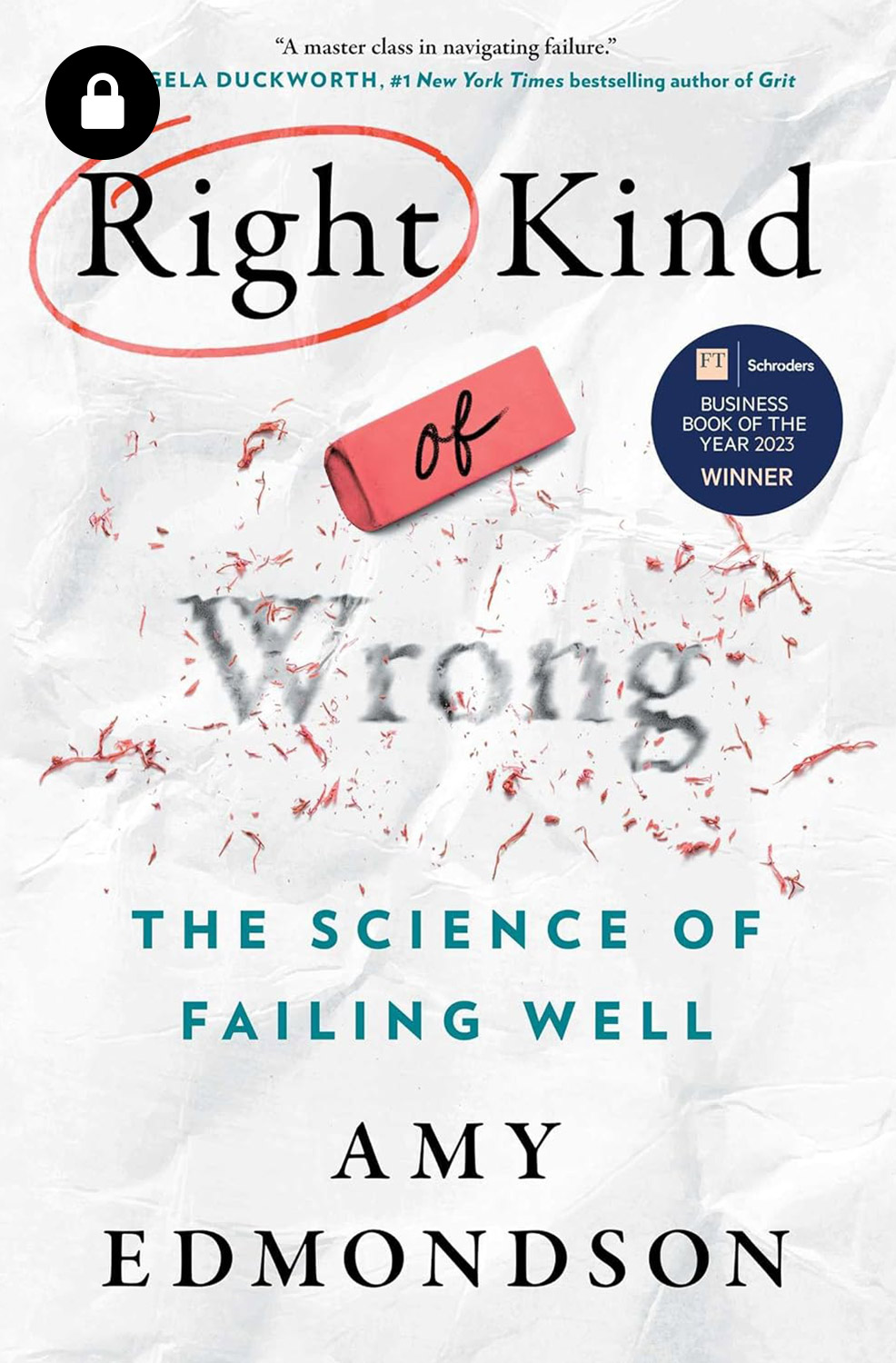
By Amy C. Edmonson
Amy C. Edmondson, the Harvard Business School professor best known for pioneering the concept of psychological safety, takes on one of leadership’s most misunderstood subjects — failure.
She argues that we’ve polarized failure into two extremes:
No. 1 — The perfectionist mindset — where mistakes equal incompetence and must be avoided at all costs.
Part No. 2 — The “fail fast, fail often” startup dogma — which celebrates every flop as progress.
Both are misguided. Most failures don’t teach us much at all, and not all are worth celebrating. But avoiding them entirely is equally dangerous. Edmondson’s thesis is that the key is to fail well — to recognize the type of failure you’re facing, learn from it quickly, and build systems that turn mistakes into insights rather than shame.
Her goal is to help individuals, teams, and organizations move from fear of failure to fluency in failure — understanding how to use it as a tool for innovation, trust, and long-term excellence.
Part No. 1 — Mapping the Failure Landscape
Why We Fear Failure
Failure threatens our identity. It makes us feel exposed, inadequate, and judged. Our brains treat it as a social threat — activating the same fight-or-flight circuits that light up under physical danger.
In the workplace, that fear multiplies. Even if a company preaches openness, most employees know that mistakes are punished implicitly: fewer opportunities, lower performance ratings, loss of credibility.
So, people hide errors. Teams cover them up. Leaders sugarcoat reality.
The result? Organizations learn less and repeat the same mistakes.
Edmondson calls this the “failure paradox”: the more we fear it, the more we guarantee it.
Three Types of Failure
To manage failure intelligently, we must first classify it. Edmondson introduces her signature Failure Framework:
Part No. 1 — Basic Failures. Preventable mistakes in routine, predictable work.
- Examples. A mislabeled sample in a lab, a missed safety check, a guest charge error.
- Root cause. Lack of attention, poor process, or negligence.
- Response. Prevention through training, systems, and accountability.
Part No. 2 — Complex Failures. Failures that arise in systems where multiple factors interact unpredictably.
- Examples. A hospital medication error caused by miscommunication across shifts; a project derailed by overlapping assumptions.
- Root cause. The system, not an individual.
- Response. Investigation and process redesign.
Part No. 3 — Intelligent Failures. The right kind of wrong. Failures that occur in pursuit of new knowledge, in uncertain territory, guided by a hypothesis, and kept small enough to learn from.
- Examples. An experiment that disproves a promising theory; a pilot program that reveals an unforeseen risk.
- Root cause. Exploration and curiosity.
- Response. Celebration and rapid learning.
This classification allows leaders to ask the right question after something goes wrong: Was this a preventable lapse, a system failure, or an intelligent experiment? Each requires a different reaction.
The Role of Context
Failure looks different depending on novelty and risk. Edmondson maps this on two axes:
- Novelty. How much of this territory is new or known?
- Risk. What’s the potential cost of being wrong?
Low-novelty, high-risk environments (e.g., surgery, aviation) require strict procedures and minimal tolerance for failure. High-novelty, low-risk environments (e.g., product R&D) require experimentation. The art of leadership is calibrating the response.
In short:
- Prevent basic failures.
- Manage complex ones.
- Encourage intelligent ones.
Part No. 2 — The Science of Failing Well
The Psychology Behind Failing Well
Failing well isn’t just a set of actions — it’s a mindset shift. Most people’s first instinct after failure is self-protection: blame, denial, or silence. Failing well demands self-reflection and curiosity instead.
Edmondson outlines three forms of awareness that enable this shift:
No. 1 — Self-Awareness. The courage to recognize your own biases and defenses.
- Ask. What assumptions led to this? What did I miss?
- Replace shame with curiosity.
- See failure as data, not identity.
No. 2 — Situational Awareness. The ability to recognize when you’re operating in predictable vs. experimental territory.
- Ask. Is this new ground or familiar ground?
- Adjust tolerance and preparation accordingly.
No. 3 — Systems Awareness. The habit of seeing failure as the product of a system, not a single person.
- Ask. How did our process contribute to this? Where did communication break down?
When individuals and teams cultivate these awarenesses, failure becomes a source of insight rather than insecurity.
Psychological Safety: The Prerequisite
Edmondson’s earlier research on psychological safety underpins everything in this book. It’s the shared belief that speaking up won’t result in punishment or humiliation. Without it, no one admits mistakes — which means failures stay hidden until they explode.
Teams with psychological safety exhibit three patterns:
No. 1 — They discuss problems openly, early, and without defensiveness.
No. 2 — They treat near-misses as valuable information.
No. 3 — They learn faster than competitors.
Leaders build psychological safety by:
- Admitting their own fallibility (“I may be wrong”).
- Asking genuine questions instead of rhetorical ones.
- Responding to bad news with gratitude, not anger.
When safety exists, failure becomes visible. And visibility is the first step toward learning.
Failing Well in Action
Edmondson offers practical routines for turning theory into daily habit:
- After-Action Reviews. A non-judgmental, structured reflection immediately after a project or event. Ask: What went as expected? What surprised us? What will we do differently next time?
- Failure Logs. Track and categorize failures. The goal isn’t blame — it’s pattern recognition.
- Small Bets. Run low-cost experiments designed to test assumptions quickly and safely.
- Debrief Rituals. Normalize talking about failure. Leaders can model this by sharing “my favorite recent mistake.”
Over time, these rituals build learning muscles across the organization.
Part No. 3 — Thriving as a Fallible Human
Embracing Fallibility
We are biologically wired to err. Pretending otherwise leads to anxiety and arrogance. Edmondson encourages readers to adopt fallibility as identity: a humble acceptance that being wrong is part of being human.
She cites research showing that admitting mistakes enhances credibility rather than eroding it — if done sincerely and paired with corrective action. In leadership, this humility is contagious: when leaders own their missteps, teams feel permission to take smart risks.
Designing for Learning
Organizations that “fail well” don’t leave learning to chance. They design for it.
They create mechanisms that make failures visible early, small, and recoverable — and ensure the lessons spread fast. Examples:
- Cross-functional “failure share” sessions.
- Transparent experiment repositories.
- Reward systems for surfacing problems.
The goal isn’t to glorify failure but to accelerate learning. Edmondson writes: “In a world that’s changing faster than our ability to predict it, learning is the only sustainable advantage.”
Intelligent Failure in Practice
Edmondson’s favorite kind of failure — intelligent failure — occurs under four conditions:
No. 1 — It takes place in new territory.
No. 2 — It’s driven by a hypothesis or informed guess.
No. 3 — It’s as small as possible to yield learning with minimal harm.
No. 4 — It yields insight that informs future decisions.
She contrasts this with recklessness — diving into risk without preparation or purpose. Intelligent failures are disciplined experiments, not chaos disguised as innovation.
For leaders, this means creating experimental zones — environments where teams can test ideas safely, learn fast, and scale what works. In these zones, the question isn’t “Did it succeed?” but “What did we learn?”
From Individual to Collective Learning
Failure can be personal or systemic, but learning from it must be collective. Edmondson explains that while one person’s insight may seem small, shared across a team it compounds.
She advocates for “failure transparency”: organizations should treat lessons learned as communal property. When only senior leaders know what went wrong, learning dies in the hierarchy.
Cultures that share failure stories — especially those involving leadership missteps — create psychological permission for everyone to improve.
Tools for Failing Well
Edmondson’s book includes several diagnostic tools for applying these ideas.
No. 1 — The Failure Spectrum
Visualize your team’s typical failures along a spectrum from preventable → complex → intelligent. Ask:
- Where are we spending most of our time?
- Where do we need tighter controls?
- Where do we need more freedom to experiment?
No. 2 — The Failure Checklist
Before launching a new project or initiative:
- Are we in familiar or novel territory?
- What’s the cost of being wrong?
- How will we detect early warning signs?
- How will we extract learning if it fails?
No. 3 — The Post-Failure Reflection
When something goes wrong:
- What happened versus what we expected?
- What factors contributed?
- What did we learn about our process?
- What will we do differently next time?
These tools move failure from emotional chaos to structured inquiry.
Part No. 4 — Culture Change — From Blame to Learning
The High Cost of Blame
Blame cultures punish the messenger, reward secrecy, and create toxic silence. People cover up small problems until they become catastrophic ones.
Edmondson cites healthcare as the most sobering example: hospitals that punish error reports have more patient deaths than those that openly discuss mistakes. Silence, she says, is the most dangerous organizational behavior of all.
The antidote is a Just Culture: a balance between accountability and forgiveness. In a Just Culture, negligence is addressed, but honest mistakes are treated as opportunities for improvement.
The Learning Organization
Organizations that master failure don’t focus on preventing all mistakes — they focus on learning faster than competitors.
Their hallmarks include:
- Leaders who model curiosity rather than certainty.
- Structures for capturing and sharing lessons.
- Rituals of reflection built into workflow.
- Reward systems that celebrate transparency, not perfection.
Edmondson calls this the “Fail-Well Cycle”:
No. 1 — Take smart risks.
No. 2 — Detect failure early.
No. 3 — Analyze without blame.
No. 4 — Share lessons quickly.
No. 5 — Apply insights systemically.
The faster you move through this cycle, the stronger your organization becomes.
Applications for Leadership
No. 1 — Normalize Imperfection
Leaders set the emotional tone. If you never admit mistakes, no one else will. Start meetings with micro-vulnerability: “Here’s something I misjudged last week.” It opens the door for candor.
No. 2 — Redefine Accountability
Accountability shouldn’t mean punishment — it should mean ownership. Ask not “Who messed up?” but “What can we learn, and who will own the fix?”
No. 3 — Separate Fault from Learning
Acknowledge that some failures are preventable and serious — but treat them with analysis, not shame. The goal is prevention, not persecution.
No. 4 — Reward Truth-Telling
When someone surfaces a problem early, treat it as an act of leadership. Recognition here is far more powerful than applause for perfection.
No. 5 — Measure Learning, Not Just Results
Track the number of experiments run, insights captured, or process improvements implemented — not just outputs and revenue. Learning metrics reinforce a culture of intelligent failure.
Human Lessons Beyond Work
Edmondson also applies her ideas to personal life. Failing well isn’t limited to corporate settings; it’s a philosophy of living.
- In relationships. Owning mistakes builds intimacy and trust.
- In parenting. Children learn resilience by watching how adults handle being wrong.
- In personal growth. Growth mindset is not about relentless self-improvement but about learning from imperfection without shame.
Failure handled with curiosity and courage becomes a bridge to authenticity.
Key Takeaways
No. 1 — Failure is not binary. It ranges from preventable to intelligent — and each type demands a different response.
No. 2 — Psychological safety precedes learning. Without it, people hide mistakes and organizations stagnate.
No. 3 — Intelligent failure requires design. Small, hypothesis-driven, purposeful experiments are the engine of progress.
No. 4 — Blame kills learning. Replace “Who did this?” with “What happened?”
No. 5 — Learning beats perfection. The organizations that win long-term are not the ones that never fail — but the ones that never stop learning from failure.
Implications for Modern Leadership
In today’s volatile world, the ability to fail well is a competitive advantage. Complexity and speed mean that no plan survives contact with reality; every strategy will face surprises. The most adaptive organizations are those that build learning velocity — the rate at which they can extract wisdom from error.
For leaders, Edmondson’s message is both humbling and liberating:
- You can’t prevent all failure.
- You can prevent the same failure twice.
- You can design systems that make failure less costly and more educational.
It’s not about lowering standards — it’s about elevating learning.
Closing Reflection
In Right Kind of Wrong, Amy Edmondson reframes failure as neither tragedy nor trophy, but teacher. She dismantles the toxic perfectionism that paralyzes teams and the reckless “fail fast” myth that trivializes mistakes.
Her message is simple: failures are data, not identity.
If we can learn to separate ego from error — to see each misstep as a clue rather than a condemnation — we can lead, create, and live with far greater freedom.
Failing well is not about celebrating collapse. It’s about cultivating resilience, honesty, and curiosity — the raw materials of innovation and trust.Because in the end, it’s not the absence of failure that defines great organizations or great people.
It’s what they do next.
If You Liked This Article, You May Also Like …
- Radical Candor: Be a Kick-Ass Boss Without Losing Your Humanity
- Leaders Eat Last: Why Some Teams Pull Together and Others Don’t
- Culture Matters: A Framework for Helping Your Team Grow, Thrive, and Be Unstoppable