
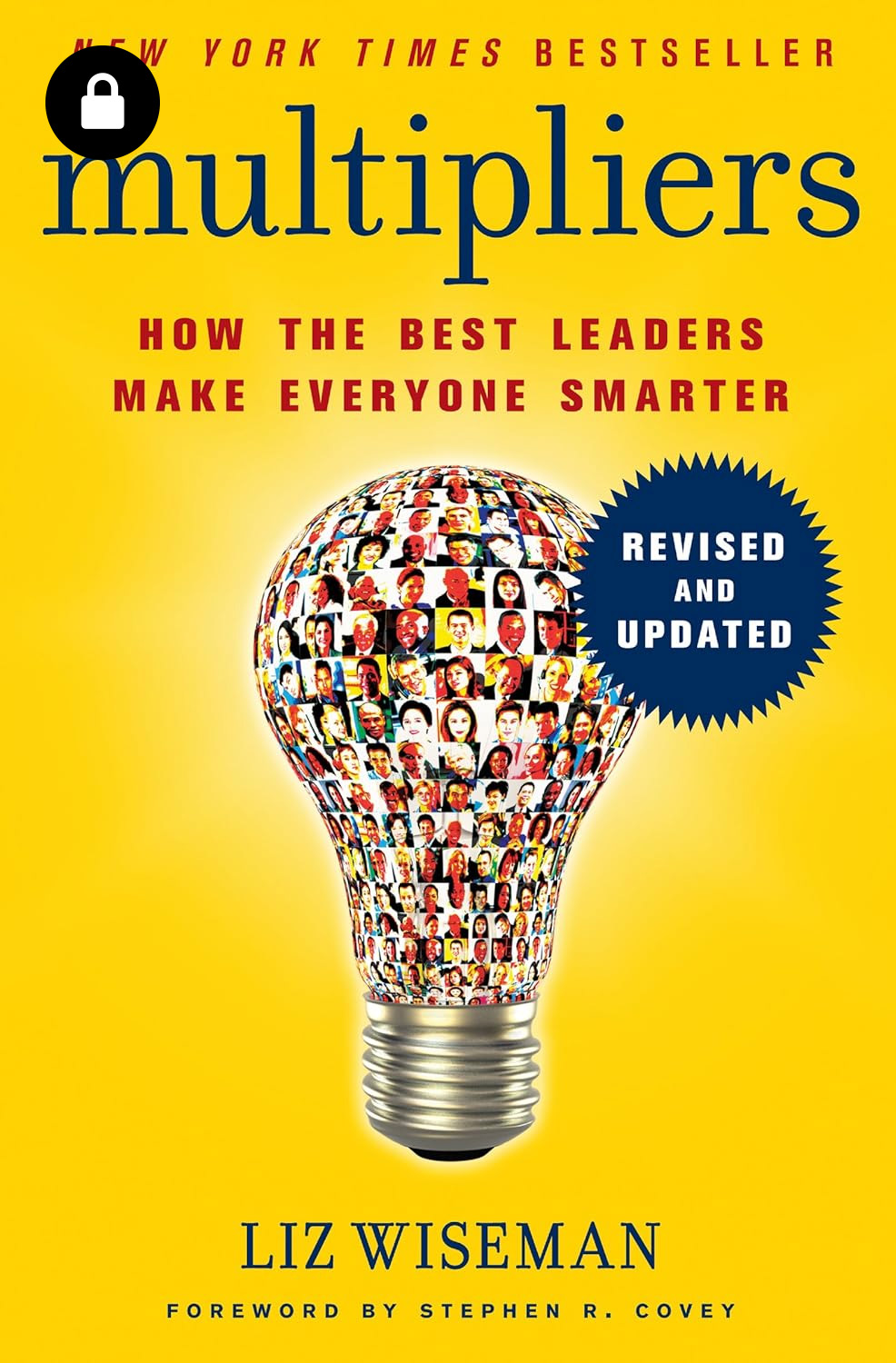
By Liz Wiseman (with Greg McKeown in the original research edition)
Some leaders drain intelligence from the room; others amplify it. Multipliers are the leaders who get more than 100% out of people’s capability — often 2× — by how they think and how they run the show.
No. 1 — The Core Premise: Two Kinds of Leaders
Liz Wiseman’s research—hundreds of executives across industries—surfaces a stark divide:
- Diminishers. Smart, driven leaders who unintentionally (or intentionally) make others smaller. Their intelligence looms so large that team IQ shrinks in their presence. People hold back, wait to be told, or play it safe. Results: dependency, mediocre effort, and a ceiling on innovation.
- Multipliers. Leaders who use their smarts to grow everyone else’s smarts. They create stretch, safety, and ownership. People bring their best ideas, and the organization compounds talent into outcomes.
Wiseman quantifies the impact: Multipliers get essentially 2× the capability from the same people. Not by overworking them, but by unlocking discretionary effort, creativity, and problem-solving that was already there.
No. 2 — The Assumptions That Drive Behavior
At the heart of the Multiplier vs. Diminisher split is a leader’s assumptions about others:
- Diminisher Assumption. “People won’t figure it out without me.”
This births behaviors like telling, rescuing, controlling decisions. - Multiplier Assumption. “People are smart and will figure it out.”
This leads to curiosity, invitation, rigorous debate, and ownership.
Shift the assumption and the behaviors follow.
No. 3 — The Five Disciplines of Multipliers
Wiseman distills Multiplier behavior into five repeatable disciplines. These are not personality traits; they’re trainable practices.
The Talent Magnet — Attract and Optimize Talent
What they do. Spot natural genius, draw it in, and deploy it where it creates the most value. People feel seen for their distinct strengths.
Practices
- Find the native genius. Identify what each person does naturally and exceptionally well, often without trying.
- Give 51/49 autonomy. Let talent own something meaningful; step back enough for them to stretch.
- Trade up roles. Move people toward work that amplifies their genius, even if it disrupts tidy org charts.
Diminisher contrast. The Empire Builder hoards talent to increase personal scope. People feel parked, underutilized, or reduced to headcount.
Try this tomorrow
- Ask each direct report. “When do you do your best thinking? What feels easy for you but hard for others?” Realign at least one responsibility accordingly.
The Liberator — Create Space Where People Do Their Best Thinking
What they do. They craft an environment that is simultaneously demanding and psychologically safe. People are free to think and expected to contribute.
Practices
- Safety + stretch. Make it safe to speak up, then expect rigorous reasoning and high standards.
- Pressure the issue, not the person. Be intense about the problem, calm with the people.
- Public learning. Normalize “I was wrong,” “You changed my mind,” and “Here’s what we learned.”
Diminisher contrast. The Tyrant uses fear, volatility, or perfectionism; brainpower goes into self-protection rather than problem-solving.
Try this tomorrow
- Open meetings with: “What am I missing?” and close with: “What did we learn, and what changes next week because of it?”
The Challenger — Extend and Stretch the Team
What they do: Define opportunities that are bigger than current capacity, invite people to figure out the “how,” and make the work consequential.
Practices
- Frame a noble, concrete challenge. Set a compelling target with real stakes.
- Ask the hard questions. Replace answers with inquiry that sharpens thinking.
- Resource the journey lightly. Provide just enough support to force ingenuity.
Diminisher contrast. The Know-It-All sets direction and prescribes solutions. People become order-takers instead of innovators.
Try this tomorrow
- Present a gnarly problem and ask, “What would have to be true for us to deliver this in half the time at 80% of the cost — without lowering quality?”
The Debate Maker — Make Better Decisions Through Rigorous Thought
What they do. Engineer high-quality debates. They get many minds on the problem, surface assumptions and data, and then decide cleanly.
Practices
- Frame the decision. What are we deciding? By when? With what criteria?
- Invite opposing views. Assign roles (advocate, skeptic, customer) to expand perspective.
- Decide and align. After debate, the leader decides (or delegates authority) and the team commits.
Diminisher contrast. The Decision Maker unilaterally decides or hosts faux debates with predetermined outcomes, teaching people to keep their powder dry.
Try this tomorrow
- Before a big call, run a 30-minute pro/con debate with success criteria visible. Timebox, then decide. Publish the rationale to reduce rumination.
The Investor — Give Ownership and Hold People Accountable
What they do. Hand over the pen. They transfer the ownership (not just tasks) and then hold people to high standards with coaching, not rescue.
Practices
- Define the sandbox. Clarify outcomes, constraints, and guardrails.
- Give back the pen. When work boomerangs, redirect: “It’s yours — what do you propose?”
- Coach through checkpoints. A few well-timed reviews beat daily hovering.
Diminisher contrast. The Micromanager (or Controller) snatches ownership at the first sign of wobble. People learn helplessness.
Try this tomorrow
- For any project you own that a direct report should own, write a short “intent memo” (desired outcomes, non-negotiables) and transfer ownership with a review cadence.
The Anatomy of Diminishers (and “Accidental Diminishers”)
Wiseman profiles five classic Diminishers:
No. 1 — Empire Builder. Collects resources, hoards talent.
No. 2 — Tyrant. Uses fear to get results.
No. 3 — Know-It-All. Dominates with answers.
No. 4 — Decision Maker. Makes fast unilateral calls.
No. 5 — Micromanager. Controls the “how,” not just the “what.”
Importantly, many leaders are Accidental Diminishers — their intent is good, but the effect is shrinking. Common accidental forms:
- Idea Guy/Gal. Rapid-fire ideas drown the team’s thinking.
- Always-On Leader. Constant energy leaves no room for others’ voices.
- Rescuer. Saves people too quickly; capability atrophies.
- Pacesetter. Outruns the team; they stop trying to keep up.
- Perfectionist. Raises the bar so high and so often that experimentation dies.
Wiseman’s counsel: spot your accidental habits and swap them for a Multiplier version (e.g., curate ideas instead of unloading them; coach instead of rescue).
No. 5 — How Multipliers Think: Mindsets and Moves
Beyond the five disciplines, Multipliers share a few mental models:
- Ownership Is the Oxygen. People do their best work when they own something real.
- Clarity Beats Certainty. Define the problem and criteria; let the team compute the path.
- Stretch Is a Gift. Capability grows when stakes are real and support is right-sized.
- Meritocracy of Ideas. Rank ideas by evidence and logic, not hierarchy.
- Learning Is the Currency. Misses are tuition — extract lessons and reinvest.
Micro-moves you’ll see
- Leaders wait a few beats before speaking, allowing others to enter.
- They ask “What do you think?”—and then listen.
- They publicly revise their own views when the team’s logic wins.
- They give credit granularly and specifically.
- They celebrate insight, not just outcomes.
No. 6 — The Multiplier ROI: Why This Delivers Hard Results
Wiseman’s research suggests Multipliers produce:
- Greater throughput with the same headcount (people give discretionary effort).
- Higher quality decisions (rigorous debate beats HiPPO).
- Faster learning loops (safety + stretch).
- Succession strength (leaders grow leaders).
- Higher engagement and retention (work is meaningful; people feel seen).
The kicker: Multipliers are not “nice bosses.” They’re demanding. But they direct that intensity at problems while dignifying people. That’s the alchemy.
No. 7 — Becoming a Multiplier: A Practical Playbook
You can build Multiplier muscle without changing your personality. Start with one discipline and layer in practices. A 90-day boot sequence:
Phase 1 (Weeks 1–3) — Diagnose & Disarm Diminishing Habits
- Self-audit. Ask five colleagues, “When do I accidentally diminish? What do I do that makes you hold back?”
- Pick one habit to retire (e.g., rescuing). Replace it with one Multiplier habit (e.g., coaching questions: What options do you see? What will you try first?).
Phase 2 (Weeks 4–6) — Liberate & Debate
- Meeting redesign. Add two norms — “If you’re quiet, we’ll invite you in,” and “Disagreeing with ideas is welcomed.”
- Frame decisions. For each big call, post the decision statement, criteria, and timebox. Run short, sharp debates with assigned roles.
Phase 3 (Weeks 7–9) — Stretch & Invest
- Challenger move. Launch a time-boxed, consequential challenge with visible stakes and light scaffolding.
- Investor move. Transfer ownership of one project with a one-page intent memo and pre-scheduled checkpoints.
Phase 4 (Weeks 10–12) — Institutionalize Talent Magnet Behaviors
- Native genius map. Catalog each team member’s native genius and align 10–20% more of their time to it.
- Tune recognition. Celebrate people for how they think and the insights they generate, not only outputs.
Metrics to watch
- Ownership distribution (how many initiatives are led below you).
- Engagement pulse (confidence to speak up; perceived autonomy).
- Throughput and error rates on key deliverables.
No. 8 — Multipliers in Common Leadership Scenarios
Scenario A — New Leader Inheriting a Team
- Week 1–2 — Listen tour; map native genius.
- Week 3 — Co-create 90-day outcomes; define decision rights.
- Week 4 onward — Introduce debate + investor cadence.
Scenario B — High-Stakes Crisis
- Narrow the aperture. Clarify the single most important outcome.
- Run daily stand-ups focused on constraints, not blame.
- Empower tiger teams with authority; timebox experiments; share learning.
Scenario C — Underperformer with Potential
- Re-scope work to their genius; set a specific stretch goal.
- Transition from rescuing to coaching with weekly micro-checkpoints.
- If performance doesn’t lift, be clear, kind, and decisive.
No. 9 — Multipliers for the “Second Chair” (COO/GM/Head of Function)
If you operate as #2 to a strong founder (or visionary), Multipliers is a survival guide:
- Translate vision into challenge. Frame it as a solvable, bounded problem with criteria.
- Throttle idea flow. Curate the founder’s ideas into a sequenced backlog; release at the org’s absorption rate.
- Build debate muscle. Create a forum where the best idea wins — founder included.
- Invest in owners. Push authority down; grow decision-makers, not task-doers.
No. 10 — The Culture Shift: From Star Power to Team Power
Organizations often worship genius at the top. Multipliers argues for a different religion: distributed intelligence. The cultural signals:
- Meetings that feel like thinking gyms, not status theater.
- Leaders who say “I was wrong” and get more credibility, not less.
- Promotions for those who elevate others’ performance, not just their own.
- Language upgrade: “What do you see?” “Convince me.” “What did we learn?”
When that becomes the norm, capability compounds. The organization gets smarter as a system.
No. 11 — Common Pitfalls and How to Avoid Them
- Mistaking niceness for multiplying. Multipliers are kind and exacting. If standards slip, you’re not liberating — you’re lowering the bar.
- Over-debating. Debate is a means to a decision, not an end. Timebox, decide, and move.
- Performing curiosity. Ask real questions you don’t already have an answer to. People smell theater.
- Rescuing in crunch times. Crises tempt micromanagement. Coach at higher frequency instead.
- Celebrating only outcomes. If insight isn’t reinforced, learning withers and risk-taking drops.
No. 12 — A Quick Reference: Diminisher → Multiplier Swaps
- Answering fast → Ask first, answer last.
- Owning every decision → Frame and delegate decision rights.
- Rescuing stuck people → Coach options; return the pen.
- Launching many priorities → Sequence; release work at the absorption rate.
- Protecting feelings with vagueness → Be direct, specific, and dignifying.
No. 13 — Why This Matters Now
Hybrid work, rapid change, and AI all reward leaders who create thinking organizations. The scarcest resource isn’t headcount; it’s collective intelligence fully turned on. Multipliers offers a field manual to do exactly that: use leadership as an amplifier, not a spotlight.
Closing Thought
You don’t need a new personality to be a Multiplier. You need new defaults: assume people are smart; design conditions for their best thinking; give them real problems and real ownership; demand great work while preserving dignity. Do that, and your team won’t just perform better — they’ll become smarter together.
One question to bring into your next meeting:
“What would it take for this group to produce twice the insight in half the time — without me supplying the answers?”