By Ethan Mollick
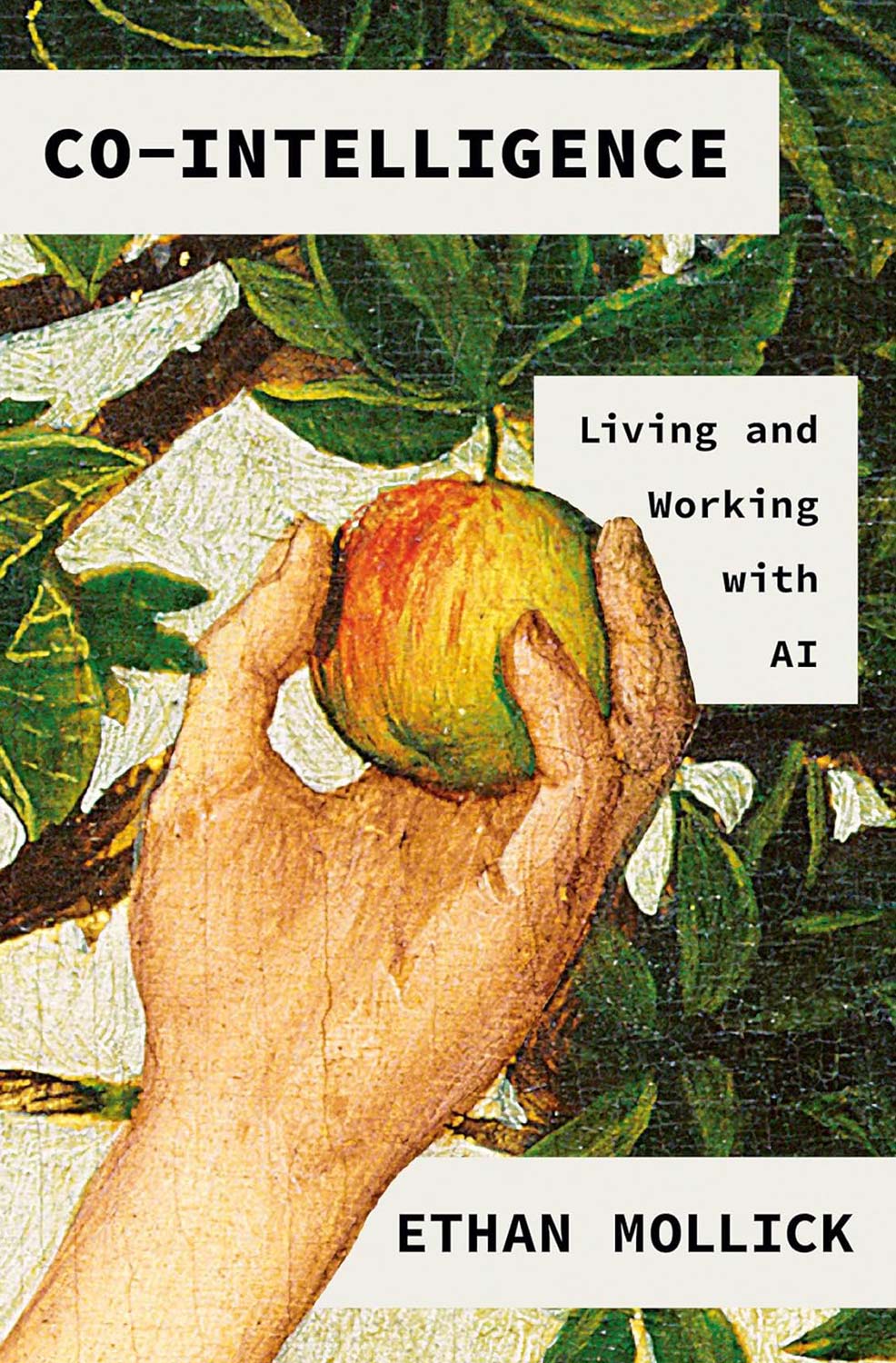
In Co-Intelligence: Living and Working with AI, Ethan Mollick presents one of the most practical and thought-provoking frameworks for understanding generative AI. His central thesis is simple but profound: artificial intelligence is not merely another productivity tool. Instead, it represents the emergence of a new kind of collaborator, one that works alongside humans in ways that fundamentally reshape how we think, create, learn, and lead.
BUY THIS BOOK
Mollick refers to this new paradigm as co-intelligence. The idea is that human intelligence and artificial intelligence are no longer separate domains. Instead, they increasingly function together as a combined system in which people and machines share cognitive work. The challenge facing individuals and organizations is not whether to use AI, but how to work with it effectively.
Unlike earlier waves of automation, generative AI systems can participate in tasks that were once considered uniquely human—writing, designing, brainstorming, coding, analyzing, and even offering strategic suggestions. This creates both enormous opportunities and profound uncertainty. Mollick’s book serves as a guide to navigating that transition.
The AI Revolution Happened Faster Than Anyone Expected
One of the book’s opening arguments is that the generative AI revolution arrived far more quickly than experts predicted.
For decades, artificial intelligence struggled with tasks that humans perform intuitively. Machines could beat grandmasters at chess or process massive datasets, but they struggled with natural language, creativity, and contextual reasoning. Many researchers assumed these challenges would take decades to solve.
Then, seemingly overnight, large language models changed the landscape.
Systems like ChatGPT demonstrated that machines could generate fluent text, solve problems, write code, summarize complex material, and even simulate conversation with surprising coherence. Millions of people began using these systems for daily work within months of their release.
Mollick emphasizes that the speed of adoption is unprecedented. Technologies like the internet or smartphones took years to reach widespread use. Generative AI reached hundreds of millions of users within months.
This rapid diffusion means society has little time to gradually adapt. Instead, individuals and organizations must learn how to operate in a world where AI is suddenly embedded in everyday knowledge work.
AI as a “Cognitive Co-Worker”
Mollick introduces one of the book’s most important ideas: AI should be thought of as a cognitive co-worker rather than a simple tool.
Traditional software follows explicit instructions. You tell it what to do, and it performs predictable operations.
Generative AI behaves differently. It produces outputs based on patterns learned from enormous datasets. Its responses can be creative, surprising, and sometimes unpredictable.
Because of this, working with AI feels less like using software and more like collaborating with a junior colleague. The system can:
- generate ideas
- propose solutions
- write drafts
- analyze information
- critique arguments
But like any junior colleague, it can also make mistakes, misunderstand instructions, or produce flawed conclusions.
Mollick suggests that the most productive approach is to treat AI as a thought partner. Humans provide direction, judgment, and expertise, while AI contributes speed, variation, and exploratory thinking.
The result is a hybrid form of intelligence that neither human nor machine could produce alone.
The Four Principles of Working With AI
Mollick offers four practical principles for interacting with AI systems effectively.
These principles provide a framework for individuals trying to integrate AI into their work.
No. 1 — Always Invite AI to the Table
The first rule is simple: always consider whether AI can contribute to the task you are performing.
Because generative AI can assist with such a wide range of activities, ignoring it can mean leaving significant productivity gains untapped.
Mollick suggests involving AI early in many processes, including:
- brainstorming ideas
- drafting documents
- analyzing data
- generating research questions
- exploring alternative perspectives
Even when the AI’s output is imperfect, it can still stimulate new thinking or reveal angles that might otherwise be overlooked.
In this sense, AI becomes a kind of perpetual brainstorming partner.
No. 2 — Be the Human in the Loop
Despite its impressive capabilities, AI still requires human oversight.
Large language models can produce confident answers that are incorrect, incomplete, or fabricated. Mollick refers to this phenomenon as hallucination.
Because of this limitation, humans must remain responsible for:
- verifying information
- evaluating reasoning
- making final decisions
AI can assist with thinking, but it cannot replace human judgment.
Mollick emphasizes that the human in the loop is essential. The best outcomes occur when people use AI as an assistant rather than an authority.
No. 3 — Treat AI as a Creative Collaborator
Generative AI excels at producing many possible variations of an idea quickly.
This makes it particularly valuable for creative tasks.
For example, AI can:
- generate multiple marketing slogans
- suggest alternative story structures
- propose product ideas
- create design concepts
Humans can then evaluate these options and refine the most promising ones.
Mollick argues that this capability transforms the creative process. Instead of beginning with a blank page, creators can start with a field of possibilities generated by AI.
The human role becomes one of selection, refinement, and synthesis.
No. 4 — Understand AI’s Limits
While AI can be remarkably capable, it also has important limitations.
Mollick emphasizes that users must understand these weaknesses to avoid over-reliance.
AI systems:
- lack true understanding of the world
- do not possess intentions or beliefs
- sometimes generate incorrect information
- may reflect biases present in training data
These limitations mean that AI should never be treated as an infallible source of truth.
The most effective users are those who combine skepticism with curiosity.
AI as a Force Multiplier for Knowledge Work
One of the most striking implications of generative AI is its ability to dramatically increase productivity in knowledge work.
Historically, productivity gains from technology have been concentrated in physical labor or manufacturing. Knowledge work remained relatively resistant to automation.
Generative AI changes this dynamic.
Studies cited by Mollick show that AI can significantly improve performance in tasks such as:
- writing
- coding
- research
- analysis
- content creation
Importantly, these improvements are often greatest for less experienced workers.
AI systems can provide guidance, suggestions, and examples that help individuals perform tasks they might otherwise struggle with.
This creates a leveling effect where individuals gain access to capabilities that previously required years of training.
However, Mollick also warns that AI can reduce the incentive to develop deep expertise if people rely too heavily on automated assistance.
This creates a tension between efficiency and mastery.
The Changing Nature of Expertise
One of the most profound questions raised in the book is how AI will reshape expertise.
In many fields, expertise has historically been defined by the ability to recall information and perform complex analytical tasks.
AI systems can now perform many of these functions instantly.
This does not eliminate the need for expertise, but it changes its nature.
Future experts will need to focus less on memorization and more on:
- framing problems effectively
- evaluating AI outputs
- integrating insights across domains
- exercising judgment
In other words, expertise becomes less about what you know and more about how you think.
Mollick argues that the most valuable professionals will be those who can orchestrate human and machine intelligence together.
AI in Education
Mollick, who teaches at the Wharton School, spends significant time discussing how AI will transform education.
Generative AI presents both challenges and opportunities for learning.
On one hand, students can use AI to generate essays or solve problems automatically, raising concerns about academic integrity.
On the other hand, AI can function as a powerful learning companion.
For example, AI can:
- explain complex concepts
- simulate tutoring conversations
- generate practice problems
- provide feedback on writing
In this sense, AI could democratize access to personalized education.
Mollick suggests that education systems must adapt by focusing less on rote assignments and more on critical thinking and problem framing.
Students must learn how to collaborate with AI rather than simply avoid it.
AI and Creativity
One of the most controversial topics surrounding generative AI is its relationship with creativity.
Many artists and writers worry that AI will replace human creativity.
Mollick argues that the reality is more nuanced.
AI can generate creative outputs, but these outputs are derived from patterns learned from existing material. The machine does not possess lived experience, emotional depth, or personal perspective.
Human creativity still plays a critical role in:
- defining the problem
- selecting meaningful ideas
- shaping narratives
- expressing authentic experience
Rather than replacing creativity, AI expands the creative process by generating new possibilities.
The future of creativity will likely involve humans curating and refining AI-generated ideas.
Organizational Transformation
Beyond individual productivity, Mollick explores how AI will reshape organizations.
Companies that successfully integrate AI will redesign workflows around human-AI collaboration.
This may involve:
- AI-assisted research
- automated content generation
- decision-support systems
- AI-enhanced customer interactions
However, the biggest challenge is not technological—it is cultural.
Organizations must develop new norms around:
- trust in AI systems
- accountability for AI decisions
- training employees to work with AI
Leaders must also recognize that AI can disrupt traditional hierarchies.
When individuals gain access to powerful AI tools, small teams—or even individuals—can perform tasks that previously required entire departments.
This could lead to leaner organizations with greater individual autonomy.
The Risks of AI
Mollick also addresses the potential dangers of generative AI.
These risks include:
- misinformation and fabricated content
- bias embedded in training data
- overreliance on automated systems
- economic disruption in certain professions
Another major concern is the erosion of human skills.
If individuals rely too heavily on AI for thinking, writing, and analysis, they may gradually lose the ability to perform those tasks independently.
Mollick suggests that maintaining human cognitive engagement is essential.
AI should augment thinking, not replace it.
The Future of Co-Intelligence
The book concludes by emphasizing that society is only at the beginning of the AI transition.
Generative AI will continue to improve rapidly.
Future systems may become more reliable, more specialized, and more deeply integrated into daily work.
But the central insight of the book remains constant:
The most powerful form of intelligence in the future will not be artificial intelligence alone.
It will be co-intelligence—the combination of human creativity, judgment, and empathy with machine speed, scale, and analytical power.
Individuals who learn how to collaborate with AI effectively will gain enormous advantages.
Those who ignore it may find themselves increasingly disadvantaged.
Conclusion: The Human Role in an AI World
Co-Intelligence ultimately delivers a hopeful message about the future of work.
While AI will undoubtedly disrupt many professions, it also opens the door to unprecedented forms of collaboration between humans and machines.
Rather than replacing human intelligence, AI can expand it.
Machines can generate ideas at incredible speed.
Humans can provide meaning, context, and wisdom.
Together, they create something greater than either could produce alone.
The challenge for individuals, organizations, and societies is learning how to harness this partnership responsibly.
In the age of co-intelligence, the most important skill may not be competing with machines.It may be learning how to think with them.
If You Liked This Article, You May Also Like …
- Human + Machine: Reimagining Work in the Age of AI
- The Coming Wave: Technology, Power, and the Twenty-first Century’s Greatest Dilemma
- A World Without Email: Reimagining Work in an Age of Communication Overload