By Paul Daugherty & James Wilson
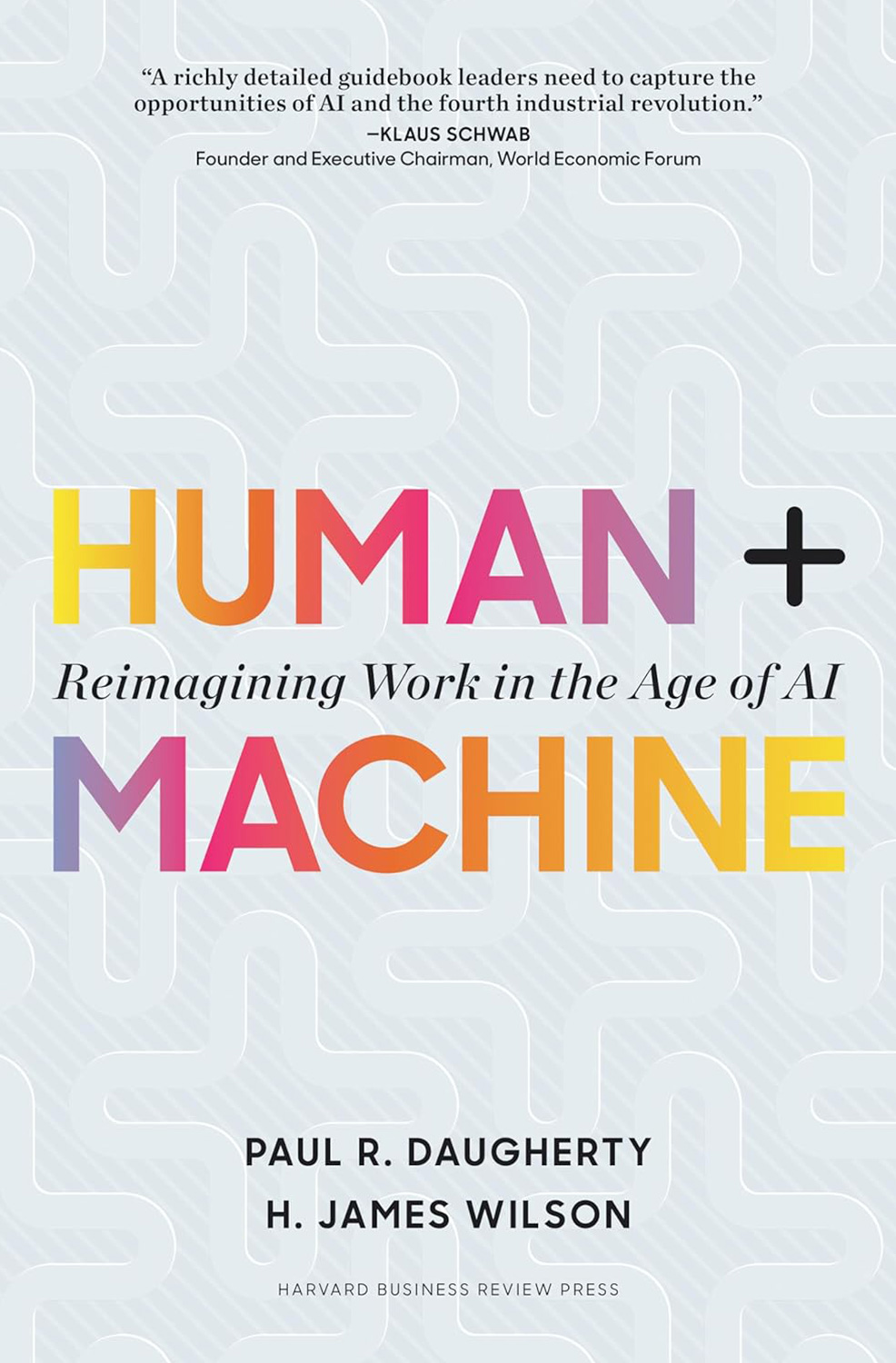
Paul Daugherty and James Wilson’s Human + Machine presents a powerful and optimistic argument about artificial intelligence: the future of work will not be defined by machines replacing humans, but by humans and intelligent systems working together in new forms of collaboration. Instead of framing AI as a job-destroying technology, the authors argue that its greatest economic value comes from augmenting human capability rather than eliminating it.
BUY THIS BOOK
For decades, technological progress has followed a familiar narrative. New tools automate tasks previously performed by people, which improves efficiency but often creates fear about job loss. The authors contend that AI represents a different kind of technological shift. While automation does play a role, the most transformative opportunities arise when humans and machines complement each other’s strengths.
Machines excel at speed, pattern recognition, and processing massive amounts of data. Humans excel at creativity, judgment, empathy, and ethical reasoning. When these capabilities are combined, organizations can produce outcomes that neither humans nor machines could achieve alone.
This new paradigm, which the authors call collaborative intelligence, fundamentally changes how work is designed, how companies operate, and how leaders must think about strategy.
The Core Idea: The “Missing Middle”
One of the most important ideas in the book is what the authors call the “missing middle.”
In discussions about AI, the debate usually falls into two simplistic camps:
No. 1 — Full automation. Machines replace humans.
No. 2 — Human-only work. People continue performing tasks with minimal automation.
But the authors argue that the real opportunity lies in the space between these extremes. This space is the missing middle: the vast range of activities where humans and machines collaborate in real time.
In this collaborative zone:
- AI generates insights and recommendations.
- Humans interpret those insights and make strategic decisions.
- Machines automate repetitive processes.
- Humans focus on creativity, empathy, and judgment.
For example:
A medical AI system might analyze millions of medical images and identify possible diagnoses. But the doctor integrates that information with context, patient history, and emotional sensitivity before making the final decision.
The result is not just efficiency. It is better outcomes.
Organizations that learn how to design work inside this missing middle will outperform competitors who use AI only for automation.
AI Is Transforming Business Processes
The authors argue that the most significant impact of AI will be the complete redesign of business processes.
AI does not merely automate existing tasks. Instead, it changes how entire workflows function across organizations, from customer service to product design to logistics.
Historically, companies optimized processes around human limitations. Tasks were broken into predictable steps that people could execute reliably.
AI changes those constraints.
When machines can analyze data instantly and operate continuously, companies can design processes that are:
- Faster
- More scalable
- More personalized
- More adaptive
Researchers associated with the book describe five characteristics of AI-enabled processes:
No. 1 — Flexibility. Processes adapt dynamically to new information
No. 2 — Speed. Decisions happen much faster
No. 3 — Scale. Systems handle far larger workloads
No. 4 — Improved decision-making. Algorithms surface insights humans miss.
No. 5 — Personalization. Experiences can be customized at scale
For example, AI-powered customer service systems can instantly analyze customer data, recommend responses, and allow human representatives to focus on complex interactions rather than routine questions.
The process itself becomes fluid and adaptive, rather than rigid and linear.
The New Roles Humans Play in an AI Economy
If machines handle increasing amounts of data analysis and routine work, what happens to human workers?
Daugherty and Wilson argue that human roles will evolve in three major directions.
No. 1 — Humans Train Machines
Many AI systems rely on training data and human input to improve performance.
People must label data, correct errors, and refine algorithms. These roles ensure that AI systems learn from real-world experience.
Examples include:
- Medical professionals training diagnostic systems
- Customer service agents improving chatbot responses
- Engineers refining machine-learning models
Humans essentially teach machines how to perform tasks effectively.
No. 2 — Humans Explain AI Decisions
Many AI systems produce outputs that are difficult to interpret.
Organizations increasingly need AI explainers, people who translate algorithmic results into language that leaders, customers, and regulators can understand.
This role becomes particularly important in fields such as:
- healthcare
- finance
- law
- public policy
As AI becomes embedded in decision-making, society will require human professionals who can ensure transparency, fairness, and accountability.
No. 3 — Humans Sustain Responsible AI
Another emerging role is the AI ethicist or AI overseer.
These professionals ensure that AI systems operate ethically and responsibly. They monitor algorithmic bias, privacy risks, and unintended consequences.
Because AI systems influence real-world outcomes, organizations must ensure they align with human values.
The authors emphasize that ethical oversight will become a critical leadership responsibility in the AI age.
The Eight “Fusion Skills”
One of the most practical contributions of the book is the concept of fusion skills.
Fusion skills are the abilities required for humans to work effectively alongside intelligent machines. The authors identify eight key skills that will become increasingly valuable in the workforce.
While the exact wording varies across summaries, these capabilities generally include:
No. 1 — Rehumanizing Time
Using automation to free humans for work that requires empathy, creativity, and complex judgment.
For example, AI may handle scheduling and data processing, allowing professionals to focus on meaningful interactions.
No. 2 — Responsible Normalizing
Helping organizations trust and adopt AI systems while ensuring ethical standards.
Workers must understand how algorithms operate and how to manage their impact.
No. 3 — Judgment Integration
Combining machine-generated insights with human intuition and experience.
Machines provide options; humans determine which ones make sense.
No. 4 — Intelligent Interrogation
Knowing how to ask the right questions of AI systems.
Instead of blindly accepting outputs, workers must challenge models and explore alternative scenarios.
No. 5 — Bot-Based Empowerment
Using intelligent agents and software robots to enhance productivity.
Rather than replacing workers, bots become digital collaborators.
No. 6 — Holistic Data Thinking
Understanding how data flows through organizations and how it shapes decisions.
Workers increasingly need data literacy.
No. 7 — Reciprocal Learning
Humans learn from machines while machines learn from humans.
This feedback loop accelerates improvement for both sides.
No. 8 — Relentless Reimagining
Continuously redesigning work processes to take advantage of new technological capabilities.
Companies that remain static will fall behind.
These fusion skills illustrate a crucial insight: AI does not reduce the importance of human capability; it changes which capabilities matter most.
The Five Principles for Building an AI-Powered Organization
The authors argue that companies cannot simply deploy AI tools and expect transformation. Instead, leaders must rethink how organizations operate.
They outline five strategic principles for building AI-driven enterprises.
No. 1 — Reimagine Business Processes
Rather than automating existing workflows, companies must redesign processes around human-machine collaboration.
The most successful organizations treat AI as a strategic capability, not just a technical upgrade.
No. 2 — Embrace Experimentation
AI adoption requires continuous experimentation.
Algorithms improve through data and feedback, meaning companies must create cultures that encourage testing, iteration, and learning.
Rigid organizations struggle with AI adoption because innovation requires flexibility.
No. 3 — Build Responsible AI Systems
Trust is essential for widespread AI adoption.
Organizations must ensure that algorithms are transparent, fair, and accountable. Responsible AI includes monitoring bias and protecting privacy.
Without trust, employees and customers will resist AI systems.
No. 4 — Invest in Workforce Transformation
Companies must retrain workers rather than simply replacing them.
Employees need new skills in:
- data literacy
- machine collaboration
- digital process design
- AI oversight
The future workforce will include hybrid professionals who combine domain expertise with technological fluency.
No. 5 — Lead with Human-Centered Strategy
Perhaps the most important principle in the book is that AI transformation must remain human-centered.
Technology should amplify human potential rather than undermine it.
Organizations that treat employees as replaceable will fail to unlock AI’s full potential.
Real-World Examples of Human + Machine Collaboration
Throughout the book, the authors present case studies from industries already experimenting with collaborative intelligence.
Examples include:
Healthcare
AI systems analyze medical images and identify potential abnormalities faster than human doctors. Physicians then interpret those findings, integrate them with patient history, and make treatment decisions.
The combination improves diagnostic accuracy and reduces workload.
Manufacturing
Smart machines monitor production equipment and predict failures before they occur.
Human technicians interpret these predictions and decide when to intervene.
This collaboration reduces downtime and improves operational efficiency.
Financial Services
AI systems analyze enormous volumes of financial data to detect fraud patterns.
Human analysts investigate suspicious cases and make final decisions.
The system combines algorithmic speed with human judgment.
Customer Experience
AI chatbots handle routine customer inquiries.
Human representatives step in when emotional intelligence, negotiation, or complex problem-solving is required.
This model allows organizations to scale service without sacrificing quality.
Leadership in the Age of Collaborative Intelligence
A major theme of the book is that leadership itself must evolve.
Traditional management approaches often focus on efficiency and control. But AI-driven organizations require leaders who can manage complex ecosystems of humans and machines.
Leaders must become:
- architects of collaborative systems
- stewards of ethical technology
- champions of continuous learning
They must also rethink how performance is measured.
Instead of evaluating individual workers alone, organizations must evaluate human-machine teams.
Success increasingly depends on how effectively people and intelligent systems interact.
The Economic Impact of AI Collaboration
Daugherty and Wilson argue that organizations that successfully implement collaborative intelligence will experience significant economic advantages.
Benefits include:
- higher productivity
- faster innovation
- improved customer experiences
- better decision-making
Companies that fail to adopt AI risk falling behind competitors who leverage these capabilities.
The authors emphasize that AI adoption is not optional.
It is becoming a fundamental component of competitive strategy.
The Future of Work
One of the most reassuring aspects of the book is its rejection of extreme automation narratives.
While AI will change many jobs, the authors believe it will also create new opportunities.
Historically, technological revolutions have always produced new forms of work even as they eliminated others.
The key difference with AI is that it will shift work toward more human-centric capabilities.
Future jobs will emphasize:
- creativity
- emotional intelligence
- complex problem-solving
- interdisciplinary thinking
- ethical decision-making
In other words, the skills that make us most human will become increasingly valuable.
Conclusion: The Human Advantage
The central message of Human + Machine is that the AI revolution is not about replacing people, it is about redefining the partnership between humans and technology.
The organizations that thrive in this new era will not simply deploy algorithms. They will design systems where machines enhance human intelligence and humans guide machine capabilities.
The future of work will be defined by collaboration.
Machines will provide:
- speed
- scale
- analytical power
Humans will provide:
- creativity
- empathy
- judgment
- ethical oversight
When these strengths combine, entirely new possibilities emerge.
Daugherty and Wilson argue that the real question facing leaders is not whether AI will transform work. That transformation is already underway.
The real question is whether organizations will embrace the human-machine partnership that makes the future possible.
Those that do will unlock extraordinary levels of innovation and productivity.
Those that do not risk being left behind.