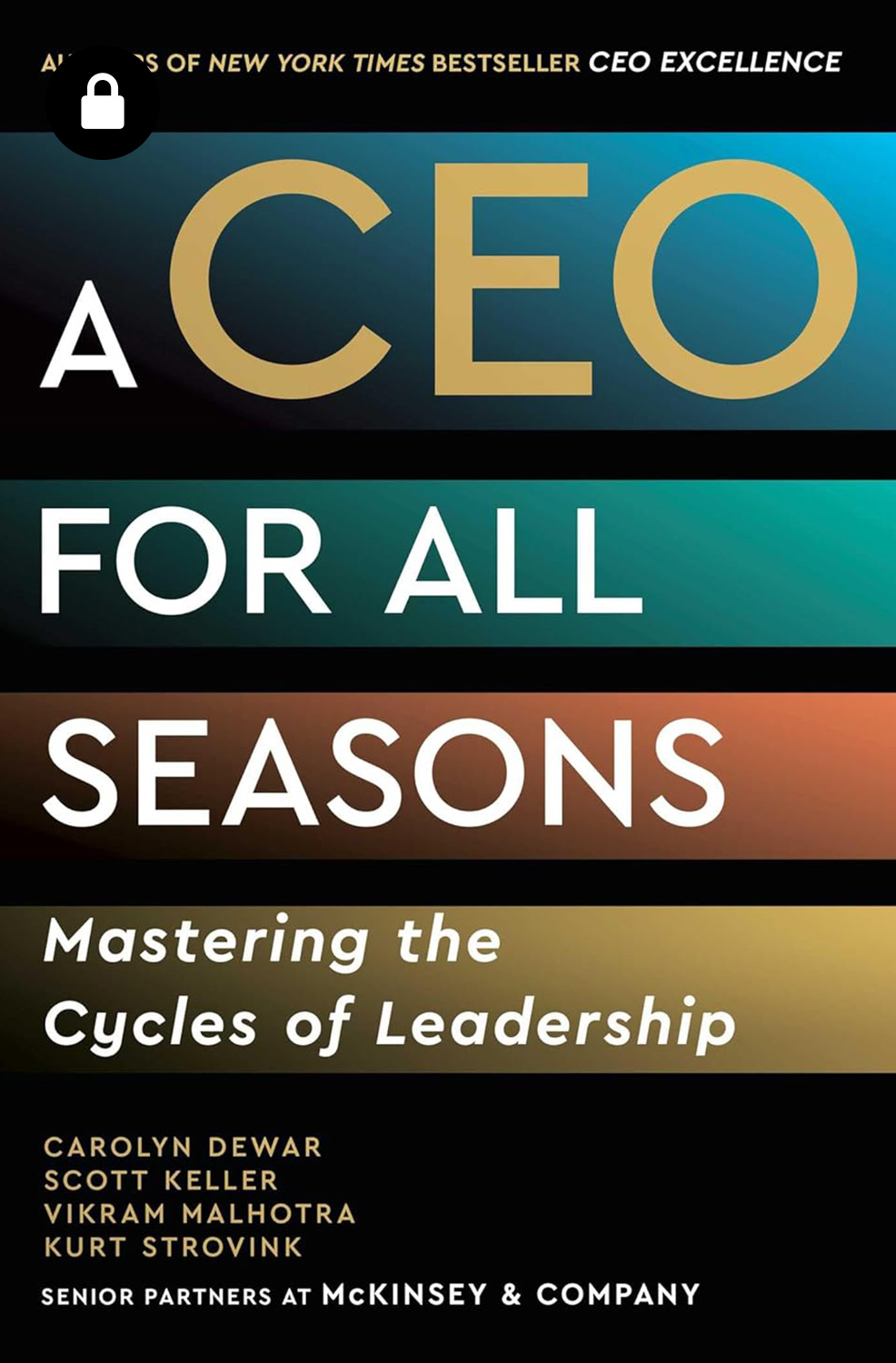
By Carolyn Dewar, Scott Keller, Vikram Malhotra, and Kurt Strovink
If CEO Excellence was about what the best CEOs do, A CEO for All Seasons is about when and how they do it. Think of it as the “lifecycle manual” for anyone sitting in — or preparing for — the corner office. The authors, all McKinsey veterans, argue that great leadership isn’t static. It’s seasonal.
The book is based on years of research and hundreds of conversations with top global CEOs. The authors noticed something simple but profound: even the most successful leaders struggle when they fail to recognize what season they’re in. A bold, visionary style might work at the beginning but wear thin in the middle. A turnaround mindset might save a company early but choke it years later. Each phase of a CEO’s journey demands a different kind of leadership.
And so, the framework: four seasons of leadership.
No. 1 — Stepping Up. When you’re preparing to become CEO.
No. 2 — Starting Strong. The critical first year in the role.
No. 3 — Staying Ahead. The long middle stretch where complacency creeps in.
No. 4 — Sending It Forward. Preparing to pass the baton with integrity and impact.
Each season comes with its own mindset, challenges, and blind spots. The book doesn’t romanticize the job — it exposes it for what it really is: relentless, lonely, and cyclical. But it also offers a hopeful message: when you know which season you’re in, you can lead with clarity, purpose, and rhythm.
BUY THIS BOOK
Season One — Stepping Up
Most leadership books start with “Day One” in the CEO chair. This one starts earlier — years earlier — because the authors argue that the habits, mindset, and reputation that make someone ready for the role are built long before the promotion.
Many senior leaders get trapped in what McKinsey calls the “busyness bubble.” They’re running a division, hitting targets, and mastering their craft — but they’re not preparing for enterprise-level leadership. The book’s first message is a jolt: You don’t get picked for CEO because you’re the best at your current job; you get picked because you already act like the CEO.
The great “pre-CEOs” in the study share a few traits:
- They zoom out. They stop seeing the world through their department’s lens and start thinking about the whole business. They ask questions like, “What’s best for the company, not just my team?”
- They show range. Instead of being one-dimensional experts, they seek experiences that test different muscles — strategy, operations, people leadership, crisis management.
- They develop self-awareness. The book makes an uncomfortable point: every leader has blind spots, but the best future CEOs are the ones who know theirs. They solicit feedback and don’t get defensive when it’s tough to hear.
And then there’s motivation. Why do you want to be CEO? It sounds simple, but this question divides those who rise sustainably from those who burn out. The role brings prestige, yes — but also relentless scrutiny and sacrifice. The best leaders see it not as a prize, but as a platform to serve.
Stepping up is less about climbing and more about evolving. It’s about shifting from “performer” to “steward” — from being known for what you achieve to being trusted for what you enable.
Season Two — Starting Strong
Then comes the baptism by fire — the first year in the CEO seat. Every new CEO walks in with the same invisible backpack: expectations, opinions, assumptions, and a clock already ticking.
The authors describe this season as the moment of “maximum attention and minimum knowledge.” Everyone’s watching you, but you don’t fully understand the terrain yet. It’s a dangerous combination.
The advice? Resist the urge to prove yourself too fast.
Too many new CEOs enter the role with what the authors call performative urgency — trying to make big, symbolic moves before they truly understand the system. The best leaders balance listening and action. They spend the early months listening deeply — to employees, customers, the board, and the market — but they also know that listening can’t last forever. At some point, you have to make a call.
In this season, several small moments carry outsized importance:
- The first town hall. This sets your tone and your authenticity bar. Are you humble? Confident? Human? People decide in minutes whether they’ll follow you.
- The first executive reshuffle. Every CEO faces tough personnel decisions early on. Do you promote loyalty or competence? Do you keep the old guard or bring in new blood? The authors’ research is clear: great CEOs move faster than they think they should. Delay sends a message of indecision.
- The first big decision. Whether it’s a strategy pivot, an acquisition, or a culture reset, this is where your values go from theory to practice. Employees will remember how you made it, not just what you decided.
One powerful phrase from the book is “play big ball.” Early on, CEOs can drown in small fires and inherited problems. The best use their fresh energy to swing at a few bold, high-impact moves that shape the company’s future.
But here’s the paradox: while you need to act boldly, you also need to not make it about you. The authors tell story after story of leaders who came in trying to prove their genius — and ended up alienating the very people whose buy-in they needed most.
The hallmark of a great first season? You set direction, create clarity, and start building trust — not around your personal charisma, but around shared conviction.
Season Three — Staying Ahead
This is the long middle stretch — the years after the excitement of “new” fades and before the final chapter of succession begins. It’s the season where many leaders quietly lose their edge.
The authors call this “the comfort trap.” The company is stable, earnings are up, the board is pleased — and that’s when the slow erosion begins. You stop questioning assumptions. You start defending decisions instead of re-examining them. You talk about growth more than you create it.
To avoid this trap, the best CEOs cultivate what the book calls constructive paranoia — a constant, healthy unease about the status quo.
In this season, excellence looks less like adrenaline and more like discipline. The key skills are learning, rethinking, and renewal.
The book outlines several survival practices for this middle stretch:
- Keep learning faster than the business is changing. The best CEOs stay deeply curious. They schedule learning into their routines — visiting customers, engaging with technologists, and spending time with people who see the world differently.
- Challenge your own orthodoxy. Great CEOs play “what if” games. What if we were a startup trying to kill ourselves? What would we do differently? They refuse to let their own past successes dictate the company’s future.
- Redefine your own role. The book notes that mid-tenure CEOs should start shifting from “deciding and directing” to “coaching and enabling.” By this point, your value isn’t how many decisions you make — it’s how many you empower others to make well.
- Build your next S-curve. Every company rides a growth curve that eventually plateaus. Great CEOs anticipate that and start building the next one early — through new markets, new technologies, or new business models.
- Renew the culture before it calcifies. In the middle years, culture can quietly harden. People start saying, “That’s how we do things here.” The authors encourage CEOs to periodically refresh rituals, symbols, and language to keep the organization agile.
“Staying ahead,” in other words, is about fighting stagnation through self-awareness and curiosity. The longer you lead, the more deliberate your growth has to be.
Season Four — Sending It Forward
This final season is about letting go — but in a way that multiplies your impact rather than diminishes it. It’s the part of the job few CEOs talk about publicly but every one of them feels privately: When and how do I step aside?
Most leaders fail at this season — not because of incompetence, but because of attachment. Their identity becomes fused with the company’s. The idea of “after” feels unbearable.
The book’s message is both sobering and freeing: you’re not the company’s hero; you’re its steward. Your true test isn’t how you run the business while you’re there — it’s how well it runs after you’ve left.
This season has three major plays:
No. 1 — Choose Your Exit Intentionally
Don’t wait for burnout, scandal, or a board revolt. The best CEOs decide in advance when it’s time to pass the baton — ideally when the company is strong and you’re still respected.
No. 2 — Develop Your Successor Like It’s Your Legacy Project
The authors are blunt here: too many CEOs treat succession as a threat instead of a responsibility. They hold onto power, control the process, and then act surprised when the transition fails. Great CEOs start grooming successors years ahead—testing them, stretching them, and exposing them to the board.
No. 3 — Leave Clean
That means clarity about authority. No “shadow CEO” behavior. No “advisory meddling.” The best CEOs make the successor the hero, not themselves. They speak publicly about the company’s future, not their own nostalgia.
And then there’s the deeply human part: Who are you without the title?
The book spends real time on this question. Many CEOs underestimate the identity shock that comes after leaving. The ones who handle it best are those who’ve already defined their next chapter—whether it’s mentoring, investing, writing, or simply resting.
In the end, “sending it forward” isn’t just about a clean handoff. It’s about recognizing that the company was never truly yours — it was entrusted to you for a season.
Timeless Themes Across Every Season
Though each season has its own dynamics, the book threads three principles through them all.
No. 1 — Humility as a Superpower
The best CEOs are confident enough to decide, but humble enough to listen. They treat every conversation as data. They know power can isolate, so they build structures that force them to stay grounded — mentors, truth-tellers, even critics.
The book quotes one CEO who said, “The higher I rose, the more feedback I had to invite — because it no longer arrived naturally.” That line captures the emotional intelligence that underpins every season.
No. 2 — Purpose as a Compass
Every CEO faces storms — market shocks, activist investors, internal crises. What separates the resilient from the reactive is a deep anchor in purpose. The best leaders continually connect business performance to human meaning: Why do we exist? Who do we serve? What kind of organization are we building for the next generation?
Purpose isn’t just moral — it’s strategic. It aligns teams, accelerates decision-making, and keeps the company centered through chaos.
No. 3 — Adaptability as the Real Edge
Across all four seasons, adaptability shows up as the defining trait of enduring leadership. The world shifts, the role shifts, the self must shift too. The best CEOs are “context chameleons”: they know when to be decisive and when to delegate, when to drive and when to listen, when to double down and when to reinvent.
That ability to sense and pivot — to lead differently as the context changes — is what allows them to remain relevant long after peers burn out.
A Conversation About Leadership, Not a Lecture
One of the things that makes A CEO for All Seasons stand out is its tone. It’s not preachy. It’s written in a calm, conversational way, as if the authors are talking to a CEO over coffee after a board meeting. They don’t idealize leadership; they humanize it.
They also point out that the role is lonely — not because people stop talking to you, but because they stop telling you the truth. The higher you go, the more distorted your reflection becomes. Every season, therefore, requires building deliberate mechanisms for reality to reach you — advisors, peer networks, even data dashboards that challenge intuition.
Why It Matters Now
The authors argue that the old model of the heroic, visionary CEO is outdated. In today’s environment — volatile, transparent, and emotionally complex — leadership is less about dominance and more about adaptation.
This book arrives at a time when many organizations are struggling with leadership fatigue. Boards are replacing CEOs faster than ever. The average tenure is shrinking. The message of A CEO for All Seasons is a kind of antidote: longevity comes from rhythm, not intensity. You don’t need to lead the same way forever — you just need to know how to evolve through the cycles.
Final Takeaway
A CEO for All Seasons reframes success not as a sprint to the top but as a series of sprints, recoveries, recalibrations, and handoffs. It’s about being self-aware enough to recognize your own season, smart enough to adapt, and humble enough to let go when the time comes.
It reminds leaders that every phase — ambition, achievement, mastery, and legacy — has its own weather patterns. If you can read them and adjust your sails, you’ll not only endure the journey — you’ll enjoy it.
Because in the end, being a great CEO isn’t about having all the answers. It’s about having the wisdom to evolve with the seasons — and the grace to know when it’s time to turn the page.
If You Liked This Article, You May Also Like …
- Emotional Bravery: How Brené Brown’s Wisdom Can Help You Master Emotional Intelligence
- The Heart of Leadership: Comparing 5 Iconic Leaders Through Emotional Intelligence
- How Emotionally Intelligent Leaders Use the 10-10-10 Rule to Make the Right Decisions