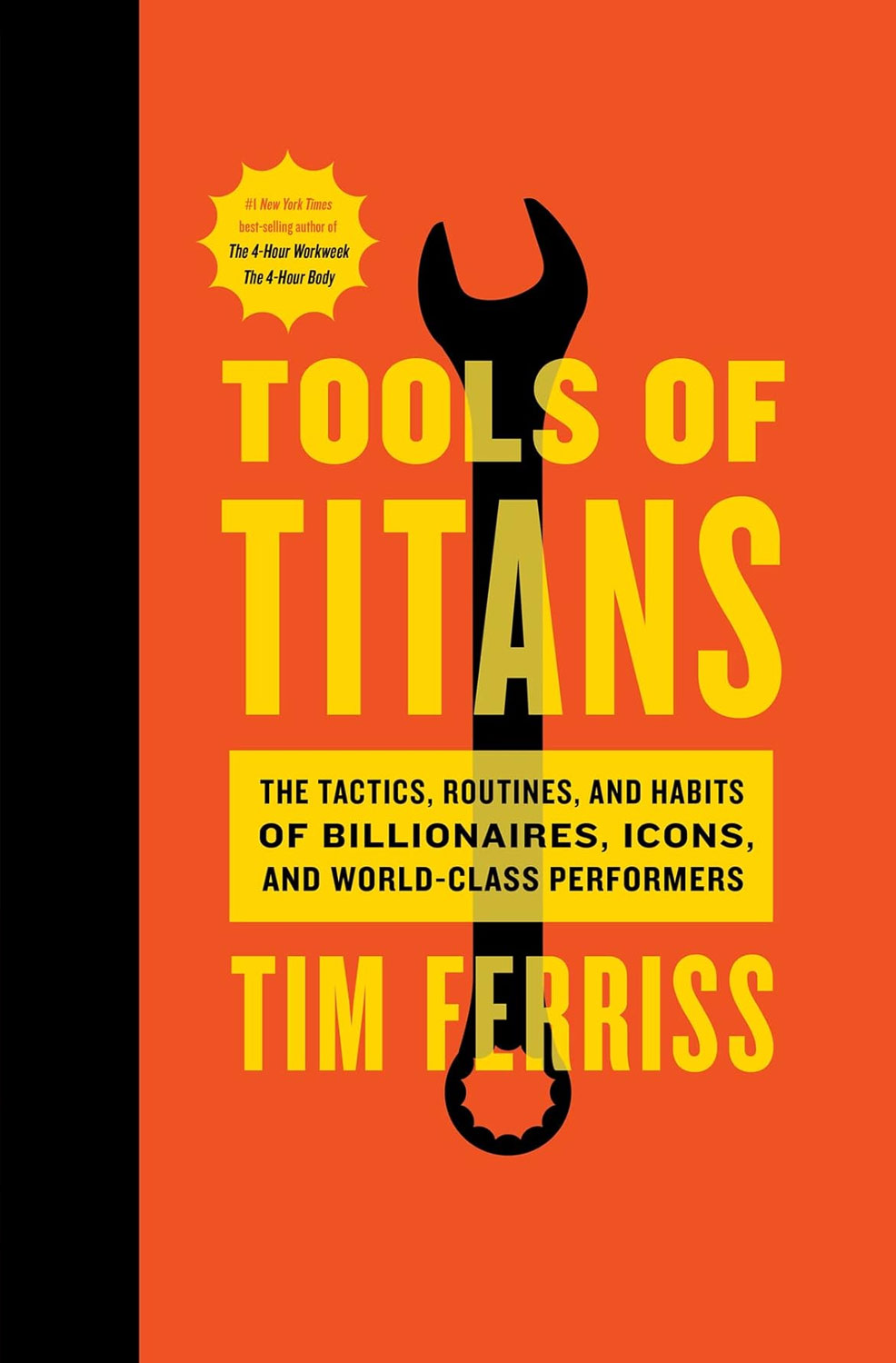
By Tim Ferriss
Tools of Titans is not a traditional book. It is not organized around a single thesis, nor does it attempt to present a unified philosophy. Instead, it is a curated collection of insights drawn from hundreds of high performers across disciplines, from athletes and investors to artists and military leaders.
What makes the book valuable is not the individual anecdotes, but the patterns that emerge across them. Ferriss operates less like an author and more like a collector of mental models. His role is to extract what works from people operating at the highest levels, then present those insights in a way that allows readers to experiment and adapt.
BUY THIS BOOK
The core premise is simple but powerful. Success leaves clues, but those clues are rarely obvious when viewed in isolation. When aggregated, however, they begin to reveal repeatable frameworks.
The book is divided into three broad sections, Healthy, Wealthy, and Wise, but the deeper lesson cuts across all three. High performance is less about talent and more about systems, habits, and the ability to think clearly under pressure.
Healthy: The Foundation of Performance
One of the most consistent themes throughout the book is that physical and mental performance are inseparable. Many of the individuals Ferriss interviews treat their health not as a side concern, but as a primary lever for success.
This is not framed in terms of aesthetics or general wellness. It is framed in terms of optimization.
Morning routines emerge as a recurring pattern. High performers are deliberate about how they start their day. Practices such as meditation, journaling, cold exposure, and light movement are used to create a baseline of clarity and control before external demands begin to intrude.
Meditation, in particular, is highlighted repeatedly. It is not positioned as a spiritual practice, but as a cognitive tool. By training attention and awareness, individuals improve their ability to manage stress, regulate emotions, and make better decisions.
Sleep is treated with similar seriousness. Many of the people featured in the book view sleep as a non-negotiable. They track it, optimize it, and protect it. The underlying belief is that recovery is not passive. It is an active component of performance.
There is also a focus on experimentation. Rather than following rigid protocols, many of these individuals adopt a scientific approach to their own bodies. They test diets, supplements, and routines, measuring outcomes and adjusting accordingly.
The broader takeaway is that health is not about maintaining a baseline. It is about creating a platform for sustained performance.
Wealthy: Systems, Leverage, and Decision-Making
The second section of the book shifts focus to wealth, but not in the conventional sense. It is less about accumulation and more about leverage.
A key insight is that successful individuals rarely trade time directly for money. Instead, they build systems that allow their efforts to scale. This can take many forms, investments, businesses, intellectual property, or networks.
Leverage is not just financial. It is also cognitive.
Many of the people Ferriss profiles emphasize the importance of thinking clearly about opportunities. They are selective. They say no frequently. They focus on high-impact decisions rather than constant activity.
This is where decision-making frameworks become critical.
One recurring concept is the idea of asymmetry. High performers look for opportunities where the potential upside significantly outweighs the downside. This does not eliminate risk, but it reframes it.
Another theme is the importance of simplicity. Complex strategies are often less effective than straightforward ones executed consistently. This applies to investing, business, and personal productivity.
There is also a strong emphasis on learning. Successful individuals are often voracious readers and continuous learners. However, they do not consume information passively. They apply it.
This creates a feedback loop. Learning leads to action, which leads to experience, which refines judgment.
Ultimately, the wealth section reinforces the idea that success is not about doing more. It is about doing the right things, at the right scale.
Wise: Mental Models and Philosophical Grounding
The final section of the book explores wisdom, a term that is often abstract but is made practical through the experiences of those featured.
Here, the focus shifts to how individuals think, rather than what they do.
One of the most prominent themes is the concept of fear. Many high performers actively engage with their fears rather than avoiding them. Ferriss himself popularizes the idea of “fear-setting,” a process of defining and analyzing worst-case scenarios.
By making fears explicit, they become more manageable. This reduces the tendency to avoid action due to vague or exaggerated concerns.
Another recurring idea is the importance of perspective. Many individuals emphasize the value of stepping back, whether through travel, reflection, or exposure to different environments. This helps prevent tunnel vision and encourages more balanced thinking.
Gratitude also appears frequently. It is not presented as a superficial practice, but as a way to recalibrate attention. By focusing on what is working, individuals create a more stable mental state, which supports better decision-making.
There is also a strong focus on resilience. Setbacks are treated as inevitable. What differentiates high performers is not the absence of failure, but their response to it. They analyze, adapt, and continue.
The wisdom section highlights that success is not purely external. It is also about internal alignment.
The Role of Habits and Rituals
Across all sections of the book, habits and rituals serve as a unifying thread.
High performers do not rely on motivation. They rely on structure.
Daily routines reduce decision fatigue. They create consistency. They allow individuals to focus their energy on higher-level thinking rather than repetitive choices.
These routines are often simple, but they are executed with discipline. Over time, they compound.
What is particularly notable is the level of personalization. There is no single “correct” routine. Each individual experiments to find what works for them.
This reinforces a broader principle. Success is not about copying others exactly. It is about extracting principles and adapting them to your own context.
The Power of Questions
Another recurring element in Tools of Titans is the use of questions.
Ferriss frequently asks his guests about their favorite failures, their most important habits, and the advice they would give their younger selves. These questions are not arbitrary. They are designed to uncover underlying patterns.
For readers, this highlights the importance of asking better questions.
Questions shape thinking. They direct attention. They influence decisions.
High performers tend to ask questions that challenge assumptions, clarify priorities, and explore possibilities.
For example, instead of asking, “How can I do more?” they might ask, “What can I eliminate?” Instead of asking, “What is the safest option?” they might ask, “What is the most asymmetric opportunity?”
These shifts in perspective can have a significant impact on outcomes.
Experimentation as a Way of Life
One of the most practical takeaways from the book is the emphasis on experimentation.
Rather than seeking perfect answers, many of the individuals featured adopt a trial-and-error approach. They test ideas, observe results, and iterate.
This reduces the pressure to get everything right the first time. It also accelerates learning.
Experimentation applies to all areas of life. Health, business, relationships, and personal development are all treated as domains where hypotheses can be tested.
This mindset is particularly valuable in uncertain environments. It allows individuals to adapt quickly and make progress without needing complete information.
The Importance of Constraints
Interestingly, many high performers intentionally introduce constraints into their lives.
This may seem counterintuitive. Why limit options when more flexibility is available?
The answer lies in focus.
Constraints reduce complexity. They force prioritization. They eliminate distractions.
For example, limiting the number of projects undertaken at any given time can lead to higher quality outcomes. Restricting decision options can reduce cognitive load.
In this way, constraints become a tool for enhancing performance rather than restricting it.
Relationships and Influence
While much of the book focuses on individual performance, there is also a strong emphasis on relationships.
Success is rarely achieved in isolation. Networks, mentors, and collaborators play a critical role.
Many of the individuals Ferriss profiles invest heavily in relationships. They seek out people who challenge them, support them, and provide new perspectives.
There is also an understanding of influence. Communication, storytelling, and the ability to connect with others are seen as essential skills.
This reinforces the idea that performance is not just about what you do. It is also about how you interact with others.
The Meta Lesson: There Is No Single Path
Perhaps the most important insight from Tools of Titans is that there is no single formula for success.
The individuals featured in the book come from diverse backgrounds and pursue different paths. Their routines, strategies, and philosophies vary.
What unites them is not uniformity, but intentionality.
They are deliberate about how they live, how they work, and how they think. They experiment, reflect, and adjust.
This suggests that the goal is not to find the perfect system, but to build a system that works for you.
Conclusion: From Consumption to Application
Tools of Titans is a dense book. It contains a vast amount of information, and it can be tempting to consume it passively.
However, its value lies in application.
The insights it offers are not meant to be admired. They are meant to be tested.
This requires a shift from reading to doing. It involves selecting a small number of ideas and implementing them. It means observing results and making adjustments.
Over time, this process can lead to meaningful change.
The book does not promise transformation. It provides tools.
What you build with those tools is up to you.
Key Takeaways
Application is more important than consumption.
High performance is driven by systems and habits, not just talent.
Health is a foundational lever for sustained success.
Leverage and selective focus are critical for scaling impact.
Clear thinking and mental models shape better decisions.
Experimentation accelerates learning and adaptation.
Constraints can enhance focus and reduce complexity.
Relationships and networks amplify individual capability.
There is no single path to success, only principles to adapt.
Better questions lead to better thinking.
If You Liked This Article, You May Also Like …
- +++
- +++
- +++
CHECK OUT THIS WEEK’S DEEP DIVES ARTICLES

+++
+++