
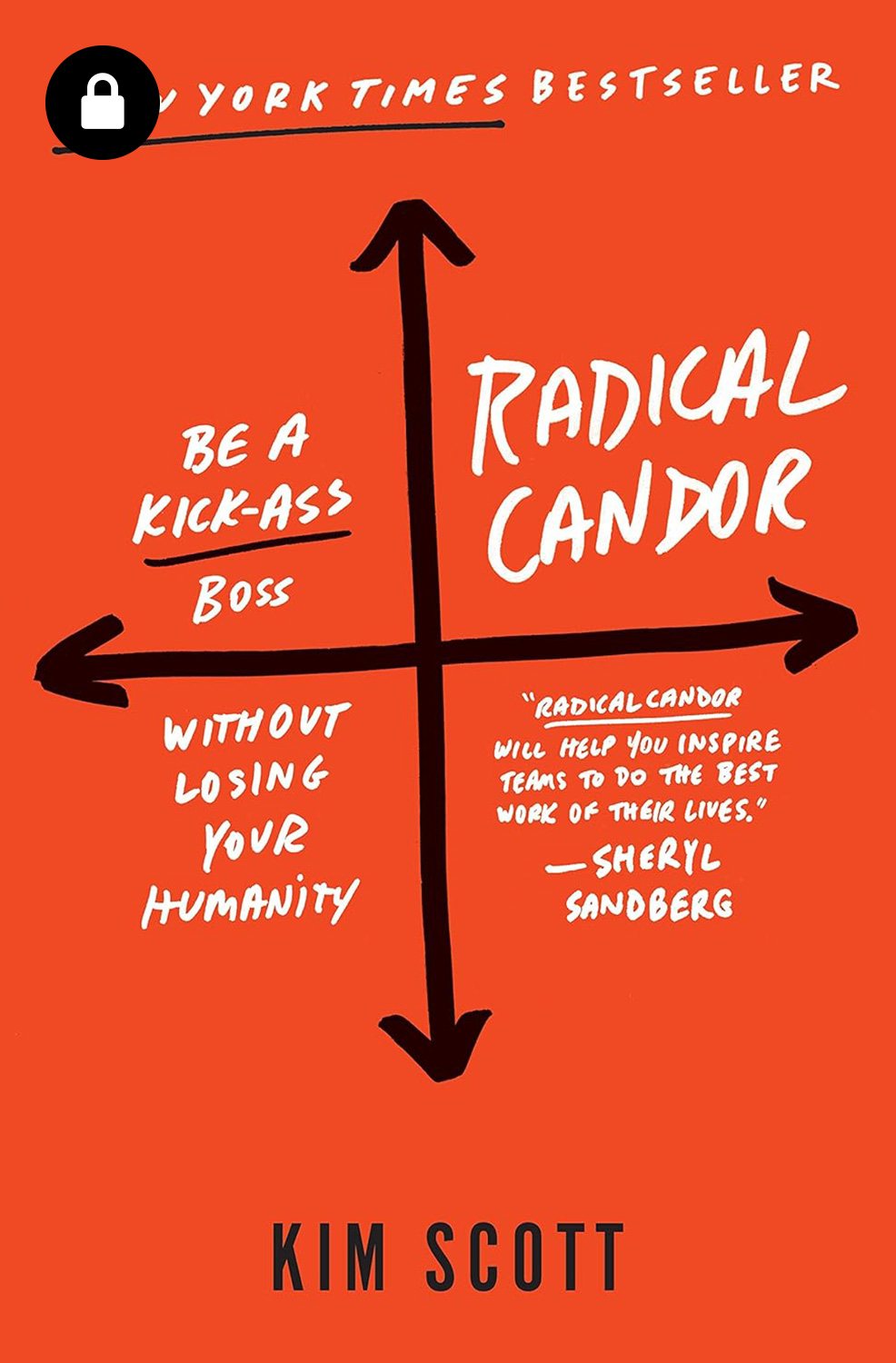
By Kim Scott
Let’s start with the basic question: what does it mean to be a great boss — one who gets results without becoming a tyrant or losing your soul?
That’s the heart of Radical Candor. Kim Scott, who’s led teams at Google and Apple, has lived on both sides of that equation — as a boss and as an employee under all types of leaders. The book is her honest attempt to share what she learned: that being a good boss isn’t about being the smartest person in the room, or the most charismatic. It’s about building strong, trusting relationships with the people you lead — relationships grounded in genuine care and honest communication.
Scott’s framework rests on two deceptively simple ideas:
No. 1 — Care Personally
Show up as a human. Genuinely care about the people you work with, their goals, and their lives.
No. 2 — Challenge Directly
Have the courage to say the hard things — to tell someone when their work isn’t good enough, when they’re off track, or when they’re letting others down.
When you put those two together — caring deeply while being brutally honest — you get Radical Candor. It’s leadership with backbone and heart.
But when you lean too far in one direction, things go sideways. You either become a jerk (too much challenge, not enough care), or a people-pleaser (too much care, not enough challenge). Scott calls these missteps the “four quadrants” of leadership — and they’re at the center of her model.
The Four Quadrants of Feedback
Imagine a two-by-two grid. On one axis, you have “Care Personally.” On the other, “Challenge Directly.”
Here’s what each quadrant looks like:
No. 1 — Radical Candor (High Care, High Challenge)
This is the sweet spot — you tell the truth with kindness. You care enough to say what needs to be said, even when it’s uncomfortable, because you want the other person to succeed.
No. 2 — Ruinous Empathy (High Care, Low Challenge
This is what happens when you’re so afraid of hurting someone’s feelings that you avoid giving honest feedback. You tell yourself you’re being nice, but really, you’re doing them a disservice. You let problems fester until they become disasters.
No. 3 — Obnoxious Aggression (Low Care, High Challenge)
This is the classic “jerk boss.” You tell it like it is — but you do it harshly, with no empathy. Sure, you’re honest, but you make people feel small or humiliated. The result? Fear, resentment, and high turnover.
No. 4 — Manipulative Insincerity (Low Care, Low Challenge)
The worst of all worlds. You don’t care about the person, and you’re not honest with them either. You gossip, sugarcoat, or play politics. This is where trust dies.
Scott’s message. You won’t live permanently in Radical Candor. You’ll slip between quadrants — everyone does. But you can learn to recognize where you are and steer yourself back to the right place.
Part One — Building Radically Candid Relationships
At its core, Radical Candor is about relationships. It’s not about management techniques or performance reviews — it’s about the messy, human work of connection.
Scott says it plainly: you can’t lead people effectively if they don’t trust you. And trust comes from caring personally — really caring, not performative caring. It means you see your employees as people first, not just as “resources” or “headcount.”
That might sound soft, but it’s actually the foundation of hard results. When people know you have their back, they’ll give you their best effort, and they’ll listen when you challenge them.
Here’s the twist: caring personally doesn’t mean coddling. It’s not about endless compliments or avoiding discomfort. Real care includes holding people accountable. It means you’re willing to say, “I know you can do better — and I’m not going to let you settle.”
Part Two — Guidance, The Gift Everyone Avoids
Feedback (or “guidance,” as Scott calls it) is where Radical Candor becomes real. Most people avoid giving feedback because it’s awkward. We worry we’ll hurt someone’s feelings, damage the relationship, or look like a jerk. So we hold back.
But withholding feedback isn’t kindness — it’s cowardice dressed up as empathy.
Scott argues that giving and receiving feedback should be a normal, continuous part of work, not something reserved for annual reviews. Think of it like brushing your teeth: you don’t do it once a year; you do it every day to prevent decay.
Here are her key rules for feedback:
No1 — Start by asking for feedback
Before you start dishing it out, show you can take it. Ask your team, “What’s one thing I could do differently?” This models humility and makes feedback a two-way street.
No. 2 — Give praise publicly, criticism privately
Public praise reinforces what good looks like. Private criticism protects dignity.
No. 3 — Be specific and kind, not vague and polite
“You’re great” means nothing. “The way you handled that client call showed real empathy and control — that’s exactly what we need more of” is specific and motivating.
No. 4 — Give feedback immediately
Don’t sit on it. When feedback is timely, it feels natural. When it’s delayed, it feels like an ambush.
No. 5 — Focus on behavior, not personality
Don’t say, “You’re careless.” Say, “There were three typos in your last report — let’s talk about what’s causing that.”
Scott also emphasizes the importance of checking how your feedback lands. After giving it, pause and ask, “How did that feel?” or “Was that helpful?” Feedback isn’t about what you say — it’s about what the other person hears.
And remember. Radical Candor isn’t a license to vent. It’s about caring enough to help someone improve. It’s kind, but not nice; clear, but not cruel.
Part Three — Understanding What Motivates People
If feedback is the fuel of Radical Candor, motivation is the engine.
Scott reminds us that people aren’t robots — they’re complex, emotional, and driven by different things. Some crave rapid growth; others value stability. Some want recognition; others just want autonomy.
She suggests that great managers take time to truly understand what motivates each team member. Have conversations not just about performance, but about purpose.
She recommends three key talks with every employee
No. 1 — Life Story Conversation
Learn where they’ve come from. What experiences shaped them? What do they care about?
No. 2 — Dream Job Conversation
Ask, “If you could do anything, what would it be?” It reveals their values and long-term aspirations.
No. 3 — 18-Month Plan
Get practical. What skills do they want to develop now? What experiences do they want to gain?
By connecting these dots, you can align their personal goals with the company’s needs. That’s where motivation comes from — not perks or pep talks, but purpose and progress.
Scott also introduces a helpful distinction: Rock Stars and Superstars.
- Superstars are on a steep growth trajectory. They’re hungry for promotion, challenge, and advancement.
- Rock Stars are steady, reliable performers who may not want to climb the ladder — but they form the foundation of a stable team.
Both are essential. The mistake many managers make is treating everyone like a Superstar, which burns people out. Or worse — ignoring the Rock Stars who hold the team together. The best leaders celebrate both.
Part Four — Collaboration and Decision-Making
Once you’ve built trust and motivation, the next challenge is driving results — and that means managing how decisions get made.
Scott is clear: good leadership isn’t about being the smartest person in the room. It’s about creating the conditions for your team to think, debate, and act effectively.
She lays out a simple model for decision-making in five steps:
No. 1 — Listen
Encourage debate, collect ideas, and make sure every voice is heard.
No. 2 — Clarify
Define the problem clearly. Half of poor decisions come from unclear problems.
No. 3 — Debate
Let people challenge each other’s ideas — openly and respectfully.
No. 4 — Decide
The leader doesn’t always have to decide, but someone has to. Once a decision is made, everyone aligns.
No. 5 — Learn
After execution, reflect on what worked and what didn’t.
Scott believes disagreement is healthy. Silence in a meeting doesn’t mean alignment; it usually means fear. The best teams argue passionately, but with trust. As she puts it: “It’s not mean to argue — it’s mean to let people fail without saying anything.”
Part Five — Building a Culture of Feedback
Individual relationships are just the start. The real magic happens when Radical Candor becomes part of your team culture.
A team built on Radical Candor doesn’t gossip, doesn’t hoard information, and doesn’t let resentment fester. Instead, people give feedback across levels — up, down, and sideways.
Scott offers practical ways to build this culture:
- Normalize feedback loops. Make it an everyday habit. Praise in meetings, critique in 1:1s, follow up often.
- Reward candor. When someone gives tough feedback, thank them — even if it stings.
- Lead by example. The team mirrors the leader’s behavior. If you’re open, they’ll be open. If you get defensive, they’ll shut down.
- Address gossip directly. Gossip is feedback gone underground. When you hear it, surface it. Ask, “Have you told that person directly?”
She also suggests regular “clean-up meetings” — open sessions where the team can air grievances, clarify confusion, or revisit decisions. The point isn’t to create drama, but to release tension before it poisons the culture.
Part Six — Growth, Promotion, and Letting People Go
One of the toughest parts of leadership is managing growth — and sometimes, the lack of it.
Scott says that growth conversations must be ongoing. Promotions should be based on readiness and results, not politics. Recognize people publicly, promote them transparently, and ensure fairness.
But what about when someone’s not performing? That’s where Radical Candor really gets tested.
Many bosses wait too long to have tough conversations. They rationalize — “Maybe they’ll improve” — or hope the problem fixes itself. But avoidance only prolongs pain.
Scott argues that if you truly care about someone, you’ll be honest when they’re not meeting the bar. You’ll coach them, support them, and give them a chance to improve. But if they still can’t perform, you have to make the hard call — with compassion and respect.
She says it simply: “Firing someone should never be a surprise.” If it is, you’ve failed them.
Radical Candor means you tell people the truth early, not after months of silence. And when you do have to let someone go, do it with dignity. Treat them like a human being, not a problem to eliminate.
Part Seven — Results and Accountability
All this — caring, feedback, motivation, culture — means nothing without results.
Scott’s point isn’t that being kind replaces performance. Quite the opposite: Radical Candor drives performance. When people trust you, they’ll stretch themselves. When they know you’ll be honest, they’ll course-correct faster.
She suggests tying Radical Candor to results through:
- Clear goals. Everyone should know what success looks like.
- Regular check-ins. Frequent, short meetings beat long, rare ones.
- Visible metrics. Track progress openly so everyone knows where they stand.
- Celebrations and recognition. Make wins visible — big or small.
The best teams, she says, operate like well-rehearsed jazz bands. Each musician knows their part but also listens to everyone else. They improvise, adjust, and create something better together — all built on trust and communication.
Part Eight — What Radical Candor Looks Like in Practice
To make it real, Scott gives tons of examples — from Google to startups to personal anecdotes. Here are a few takeaways that stick:
No. 1 — Feedback works best in real time
Don’t schedule a meeting for next week. Give feedback in the moment — after a presentation, during a project, while it’s fresh.
No. 2 — Kindness and clarity are not opposites
You can tell someone their work isn’t good enough and still make them feel valued. The key is your intention.
No. 3 — Don’t forget to praise
Most managers under-praise. Positive feedback reinforces the behavior you want repeated.
No. 4 — Your tone matters
The same words can land completely differently depending on your delivery. Check your tone, your timing, and your intent.
No. 5 — Start small
You don’t need a cultural revolution overnight. Begin with one conversation — one honest, kind piece of feedback — and build from there.
Part Nine: Why Radical Candor is Hard
Scott doesn’t sugarcoat it — Radical Candor is simple in theory, but hard in practice.
Why? Because people are emotional. Because power dynamics exist. Because ego, fear, and pride get in the way. Because we’ve all been conditioned to avoid discomfort.
She identifies common traps:
- The “Nice” Trap. You want everyone to like you, so you avoid giving tough feedback.
- The “Jerk” Trap. You value efficiency so much that you bulldoze people.
- The “Silent” Trap. You assume no news is good news. (It’s not.)
- The “Defensive” Trap. You ask for feedback, but can’t take it without explaining or deflecting.
The antidote? Self-awareness. You have to recognize which trap you fall into and practice the opposite behavior. Radical Candor isn’t a personality trait — it’s a skill you build.
Part Ten — Radical Candor Beyond Work
Though the book is written for leaders, Scott ends on a broader note: Radical Candor isn’t just for managers — it’s for anyone who cares about relationships.
The same principles apply at home, with friends, even with kids. Caring personally while challenging directly is how you build trust, deepen connection, and help others grow.
Whether it’s a team meeting or a dinner table, the formula holds: be honest, be kind, and never let fear of discomfort keep you from telling the truth.
Key Takeaways
Let’s pull together the essence of Kim Scott’s message in plain English:
No. 1 — Your job as a leader is to create an environment where people can do their best work and feel valued doing it.
That’s impossible without trust — and trust comes from Radical Candor.
No. 2 — Caring personally means you see people as humans first.
You take interest in their goals, their challenges, and their lives beyond work.
No. 3 — Challenging directly means you tell the truth, even when it’s hard.
You give feedback often, clearly, and compassionately.
No. 4 — Feedback is a gift, not a weapon.
When you give it with the right intention, it builds relationships instead of breaking them.
No. 5 — Great teams argue — respectfully.
Silence is not harmony; it’s fear. Debate, dissent, and honest discussion are signs of health.
No. 6 — Don’t confuse niceness with kindness.
Niceness avoids discomfort. Kindness confronts it with empathy and courage.
No. 7 — Tailor your leadership.
Some people thrive on challenge, others on consistency. Both have value.
No. 8 — Make feedback part of the rhythm of work.
Small, frequent conversations beat long, delayed reviews.
No. 9 — Address performance issues early.
Waiting doesn’t make them go away; it makes them worse.
No. 10 — Radical Candor is contagious.
When people see honesty handled with care, they’ll start practicing it too.
Final Reflection
Radical Candor isn’t a management fad — it’s a call to lead with both courage and compassion. It’s about rejecting the false choice between being a “nice boss” or a “tough boss.” You can be both.
Scott’s message is refreshing because it acknowledges that leadership is deeply human. You’ll screw up. You’ll say the wrong thing. You’ll hurt feelings by accident. But what matters is intent — that you’re trying to do right by your people, not protect your ego.
In the end, being radically candid isn’t just about managing better — it’s about living better. It’s a philosophy of integrity, empathy, and truth-telling that applies far beyond the office.
And maybe that’s why the book has struck such a chord. Because in a world full of corporate jargon and passive communication, Scott gives us permission to be what we all crave — real.In short: To be a kick-ass boss without losing your humanity, you have to do two hard things at once — care deeply and speak honestly. Everything else — culture, performance, trust, growth — flows from there.