
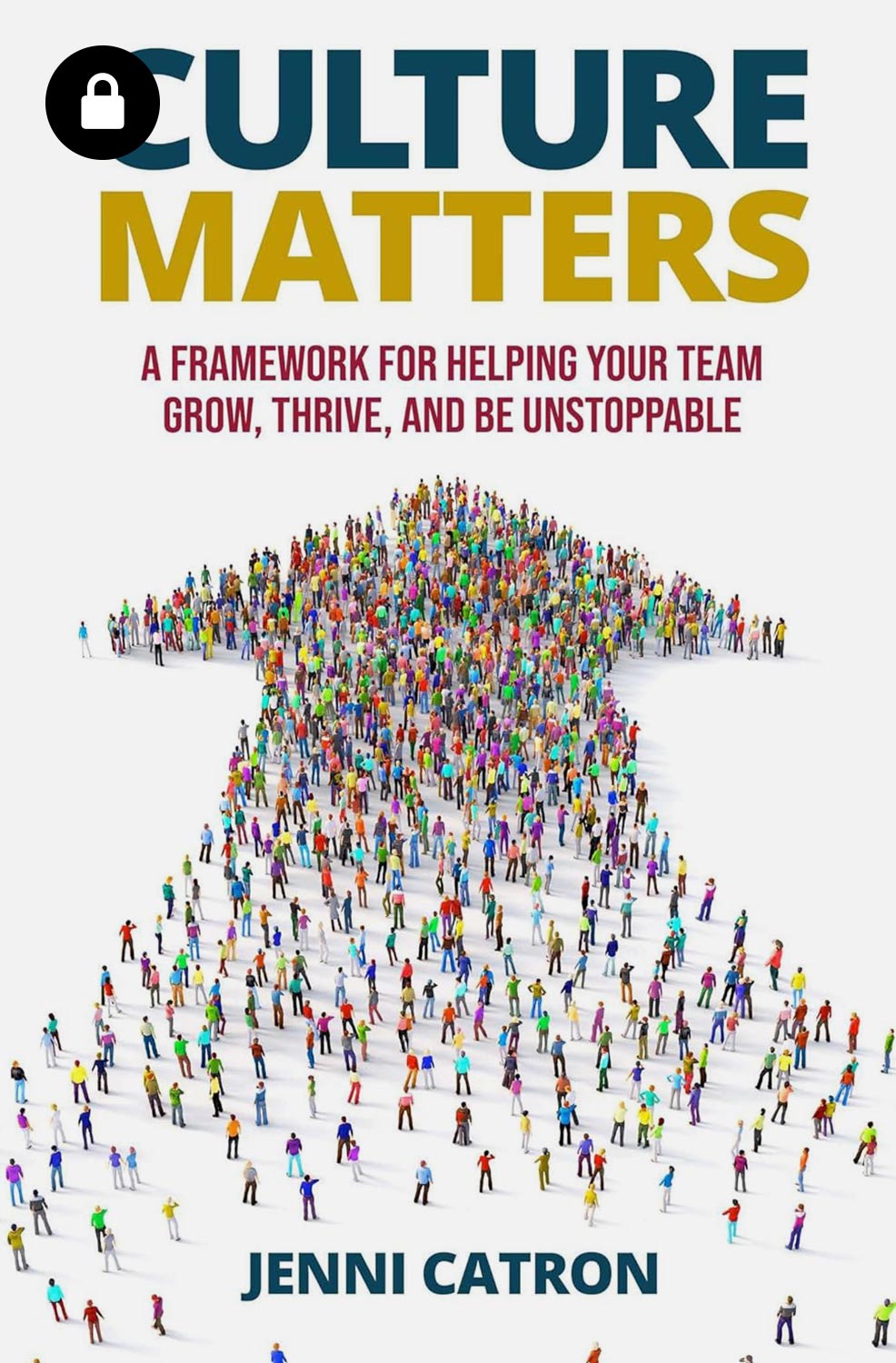
By Jenni Catron
In Culture Matters, Jenni Catron argues that culture is not a “soft” or secondary concern — it is one of the most critical levers a leader has. If culture is unhealthy, the best strategies, plans, or talent won’t overcome it. She insists that culture must be built on purpose rather than left to evolve by default. A team with clarity, trust, alignment, and resilient systems can withstand uncertainty, grow cohesively, and deliver sustained performance.
Catron draws from her decades of experience in both corporate and nonprofit contexts. She emphasizes that culture is a living system: it is shaped daily by decisions, behaviors, and feedback loops. A culture that thrives is dynamic and adaptive, not static. Her goal is to provide leaders with a framework — the LeadCulture Framework — that helps them assess where they are, define where they want to be, and create systems and practices to move forward.
Structure of the Book & Core Framework
Catron organizes her approach around five phases (or stages) in the LeadCulture Framework:
No. 1 — Assess. Understanding current reality
No. 2 — Define. Clarifying aspirations for culture
No. 3 — Build (Plan). Designing how to close the gap
No. 4 — Equip. Training and empowering leaders and teams
No. 5 — Commit. Embedding culture in the rhythms and systems of the organization
She portrays these phases as cyclical — not a one-time project — but as a recurring cycle of evaluation and refinement as organizations evolve.
Throughout the book, she uses stories, practical tools, and examples to bring each phase to life. One memorable anecdote involves a weekly team luncheon at a Mexican restaurant: when she and her team stopped going out one particular week, the restaurant called to ask if they were coming. It hit her: culture cannot be “caught” automatically at larger scale. What worked when the group was small doesn’t always translate as the team grows. You have to lead differently at scale. That story becomes a symbolic moment illustrating how unintentional culture collapse happens when leaders assume what once worked will continue to work. (This story is cited in her interviews about the book.)
Phase No. 1 — Assess: Know Where You Stand
The first task is not to implement culture changes immediately, but to understand the current state accurately. Catron cautions leaders against counting on intuition alone, particularly as the team grows. She encourages establishing a culture team made up of representatives from across the organization, not just senior leadership. This ensures they capture more voices and middle-level perspectives — those who see day-to-day tension points that senior leaders might miss.
Key practices in this phase:
- Data gathering. Surveys, interviews, focus groups, observation, listening sessions
- Blind spots. Creating avenues for feedback without fear of retribution
- Cultural “gaps” diagnosis. Where behaviors don’t match stated values
Catron notes that many organizations assume culture is fine until something breaks or misalignment becomes visible. When a leader acts without assessing first, they risk reinforcing dysfunction or token efforts that ring hollow.
Phase No. 2 — Define: Clarify the Culture You Aspire To
Once you know where you are, the next step is defining where you want to go. Catron says this is more than mission statements or slogans. It’s about clarifying how you will show up when things are working at their best.
Questions to surface:
- “What do we look like at our best?”
- “What values or behaviors do we hope people see if they joined our organization today?”
- “Which historic stories or moments crystallize who we are and how we operate?”
She warns that leaders often assume that their values are obvious to the team — especially things that seem obvious to them personally (e.g. attention to aesthetics, orderliness, punctuality). But if those are not articulated, they become implicit expectations that breed confusion, pain, and micromanagement when unspoken. She gives the example of a leader who would change baseboard colors in a building—because he cared about the environment aesthetically — but had never told his operations team that was a priority. The lack of clarity caused frustration.
Catron suggests ranking aspirational values on a spectrum (e.g., from “this reflects who we are now” to “this is what we hope to become”) and iterating based on feedback so the team doesn’t dismiss them as insincere or merely aspirational without grounding.
Phase No. 3 — Build (Plan): Close the Gap
Defining the culture is not enough — you need a deliberate plan. In this phase, Catron moves from vision to systems. Because while teams often want to focus on relational dynamics (trust, connection, belonging), she argues that structural clarity — roles, accountabilities, communication rhythms — is equally foundational.
Key areas in the plan:
- Talent and hiring. Embed cultural fit and values alignment in recruiting
- Performance systems. Reviews, feedback loops, coaching conversations tied to culture
- Rhythms and rituals. Rituals, communication cadence, onboarding, celebrations that reinforce culture
- Role clarity & structure. Ensuring people know their boundaries and responsibilities
- Decision-making frameworks. How you decide vs. how you consult vs. who owns the final call
She emphasizes that planning culture requires the same rigor as planning any strategic initiative. She points out that many leaders say “culture matters” but do not invest in a plan — research suggests up to 90% of people believe culture is important, but only ~25% of leaders report having a formal culture plan in place.
Catron teaches that the plan must include cultural levers — specific practices or processes through which culture is expressed (e.g., how performance conversations happen, how recognition is given, how errors are handled, how new hires are on boarded). The plan needs to map to behaviors, not just ideals.
Phase No. 4 — Equip: Build Leadership Capacity
A culture plan will fail if mid-level leaders and supervisors don’t understand or embody the culture. Catron emphasizes equipping every leader at every level to be culture carriers. This requires training, coaching, and support so that values and behaviors become normalized.
Key elements to equipping:
- Leadership training. Teaching how to coach, how to reinforce values, how to manage conflict
- Tools & frameworks. Templates, playbooks, communication guides, culture dashboards
- Ongoing feedback & coaching. Helping leaders interpret how culture shows up and course correction
- Role modeling. Senior leaders must model what they ask for
Without equipping, culture remains aspirational. Leaders will revert to old habits or default styles, especially under pressure or change.
Phase No. 5 — Commit: Embed Culture in System & Rhythm
Culture is not a one-off project. Catron insists that the final phase is commitment — making culture part of the regular operating rhythm and mechanisms of accountability.
Practices in this phase include:
- Annual culture assessments: revisit what’s working, what’s drifting, make adjustments
- Regular check-ins: quarterly or monthly reviews of how culture is lived
- Governance loops: tying culture metrics into executive review
- Renewal rituals: celebrating culture wins, telling stories, rituals that reinforce norms
- Reinforcing hiring & exit: look at how new people are integrated and how departures reflect cultural dissonance
The cycle then restarts: you assess again, redefine, refocus, and renew. Culture evolves, and the framework ensures it evolves intentionally.
Core Themes & Principles
Throughout the book, several recurring principles surface:
No. 1 — Culture is either by default or by design
If you don’t lead culture, it will evolve — but not in ways you necessarily want.
No. 2 — Clarity breeds trust
Many cultural issues stem from inconsistent or opaque expectations. If people know where they are, how decisions are made, and what success looks like, trust deepens.
No. 3 — Behavior matters more than words
Stated values are only as strong as the daily behaviors and decisions that reinforce or violate them.
No. 4 — Scale changes everything
What works when you have 5 people won’t survive intact at 50 or 500.
No. 5 — Culture is a system
It’s not just relationship or emotional energy — it’s a network of structural levers, decisions, feedback loops, training, and accountability.
No. 6 — Every leader is a culture influencer
You don’t need to be a direct manager to shape culture — your voice, behaviors, tone, and priorities matter.
No. 7 — Stories and symbols matter
Culture gets codified through stories, legends, rituals, artifacts, and the shared narrative of “how we do things.
No. 8 — Misalignment must be addressed
You can’t allow behavior that contradicts core values to persist. That creates cynicism.
Illustrative Examples & Stories
- Mexican restaurant lunch anecdote. This shows how culture that was once spontaneous and relational becomes unsustainable without intentional adaptation at scale.
- Changing baseboard color. A leader’s unarticulated aesthetic value caused friction until he clarified why it mattered.
- Stories from churches, ministries, startups, and nonprofits illustrate how culture collapse or renewal happened in real-time when one leader committed to clarity and intention.
These stories help ground the abstract principles in real human experience.
Strengths & Critiques
Strengths.
- The book is highly practical. It doesn’t stay in theory but prescribes tangible steps, frameworks, and tools.
- The cyclical model (assess → define → build → equip → commit → repeat) gives leaders a sustainable process for culture work.
- Catron balances relational dynamics with structural systems, which many culture books neglect.
- Her experience across organizations (small, large, nonprofit, for-profit) gives her perspective on how culture plays out unevenly at different scales.
Possible Weaknesses / Caveats.
- Because the book is conceptually broad, some readers may find it less prescriptive for highly regulated or technical industries where constraints differ.
- The work of assessing and equipping can be resource-intensive. Leaders with limited time or bandwidth might struggle to fully implement.
- Some of the examples are faith-based or ministry-oriented, which may require adaptation in secular or corporate environments.
- As with any framework, the risk is that leaders treat it as checklist rather than living system — losing the human, iterative dimension.
Practical Takeaways & How to Apply
For readers (leaders, executives, managers), here are actionable steps drawn from the book:
Form a Culture Team
That spans levels and functions — not just senior leaders — so you get more accurate insight.
Conduct an Honest Assessment
Gather data on how people experience the culture, not just how leaders hope it is.
No. 1 — Define your culture in living language
Behaviors, not platitudes. Ask, “What does it look like when we’re at our best?”
No. 2 — Plan for the gap
Build explicit systems, rituals, and structures that reinforce the culture.
No. 3 — Equip all leaders
To be culture carriers — do not leave mid-level or informal influencers unprepared.
No. 3 — Embed culture in your rhythms
Tie it to performance reviews, meetings, onboarding, and rituals.
No. 4 — Reassess regularly
(annually or quarterly) and iterate rather than assuming culture is “done.”
No. 5 — Address misalignment immediately
When behavior contradicts values, have the courage to call it out or make tough decisions.
No. 6 — Tell stories and celebrate symbols
Use narrative, recognition, and artifacts to reinforce culture.
No. 7 — Lead by modeling
Your consistency, humility, clarity, and vulnerability will signal to others how seriously you mean it.
Why This Book Matters in Today’s Context
Organizations today face volatility, hybrid work, remote teams, generational shifts, and constant change. Leaders who assume that “culture fixes itself” are being challenged more than ever. The disconnect between stated values and lived experience is a major risk for disengagement, turnover, and leadership breakdown.
Culture Matters gives leaders a map to navigate this complexity — not by treating culture as optional, but as the operating system for long-term alignment and resilience.
Conclusion
Jenni Catron’s Culture Matters is a well-crafted, deeply practical leadership book that shifts culture from being a vague aspiration to a deliberate, executable system. Her LeadCulture Framework offers leaders a cycle they can repeat, refine, and embed in their organizations.
The core message is clear: culture is not what happens if you don’t screw it up — it must be designed, apprenticed, and stewarded with intention. Vision without culture is empty. Strategy without relational and structural alignment collapses. Leaders who commit to culture are investing not just in performance today, but in the capacity to sustain, adapt, and thrive in any storm.If you lead a team, an organization, or want to build something that endures, Culture Matters gives you the language, the habits, and the framework to make your leadership — and your culture — nonnegotiable.
CHECK OUT THIS WEEK’S DEEP DIVES BOOK SUMMARY
If You Liked This Article, You May Also Like …
- EQ Isn’t “Soft” — It’s Strategic
- You Deserve to Protect Your Peace: The Emotional Intelligence of Choosing Better Relationships
- The Quiet Power of Emotional Minimalism: Why Less Can Be More in Leadership and Life