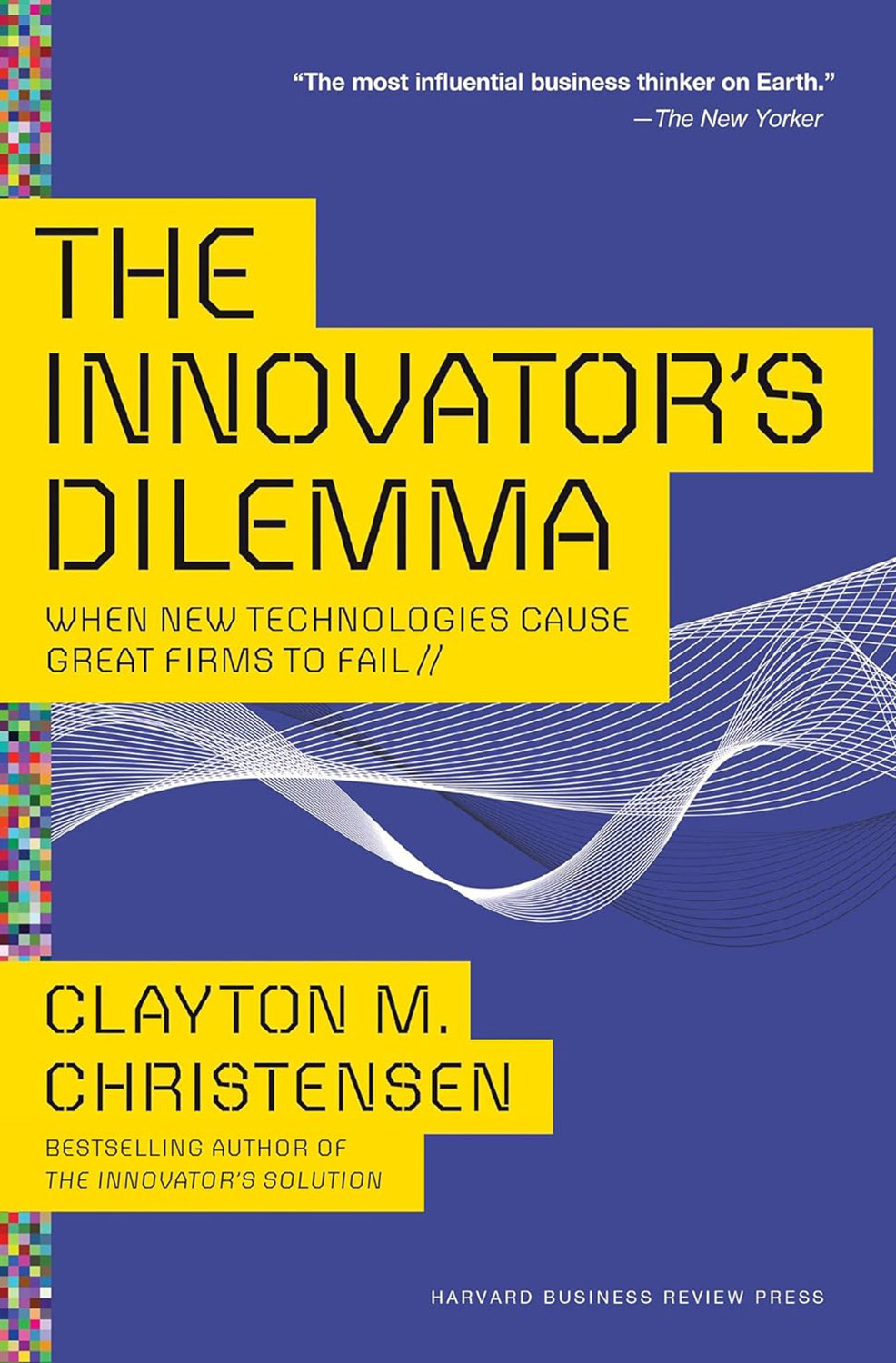
By Clayton M. Christensen
The Innovator’s Dilemma begins with a paradox that unsettles traditional business thinking: great companies—well managed, customer-focused, data-driven, and operationally excellent—are often the ones that fail when faced with disruptive innovation. Their failure is not caused by incompetence or laziness, but by doing exactly what made them successful.
Clayton Christensen challenges the assumption that good management practices naturally lead to long-term dominance. Instead, he demonstrates that listening closely to customers, investing in the highest-margin opportunities, and improving existing products can actively prevent companies from adapting to disruptive change.
The book is not an argument against excellence. It is an argument that excellence in one era can become rigidity in the next.
Sustaining vs. Disruptive Technologies
Understanding Sustaining Innovation
Christensen introduces a critical distinction between sustaining technologies and disruptive technologies. Sustaining innovations improve existing products along dimensions that mainstream customers already value—better performance, higher quality, more features.
Most companies are very good at sustaining innovation. It aligns with their business models, customer expectations, and performance metrics. These innovations help firms compete more effectively within their existing markets.
Importantly, sustaining technologies can be either incremental or radical. The key is not how advanced the technology is, but whether it reinforces existing value networks.
What Makes a Technology Disruptive
Disruptive technologies, by contrast, initially underperform established products on traditional performance metrics. They are often cheaper, simpler, more convenient, and targeted at customers who are overlooked or underserved by incumbents.
Early on, disruptive technologies appeal to:
- Low-end customers who don’t need premium performance
- New customers who were previously excluded from the market
Because these markets are small and margins are low, established firms tend to ignore them. Over time, however, disruptive technologies improve—and eventually become “good enough” for the mainstream market. When that happens, incumbents often find themselves displaced.
The Innovator’s Dilemma Explained
Why Rational Decisions Lead to Failure
Christensen’s core insight is that successful companies fail not because they make bad decisions, but because they make rational ones.
Managers are trained to:
- Listen to their best customers
- Focus on high-margin opportunities
- Allocate resources to projects with clear ROI
- Avoid small, uncertain markets
Disruptive innovations fail these tests. They promise low margins, unclear demand, and customers that incumbents don’t currently serve. As a result, they are systematically deprioritized.
This creates the innovator’s dilemma: invest in disruptive technology and undermine your current business, or ignore it and risk future irrelevance.
Value Networks and Organizational Constraints
A key concept in the book is the value network—the context within which a firm identifies customers, defines performance metrics, and makes investment decisions.
Value networks shape:
- What kinds of innovations are attractive
- Which customers matter most
- What cost structures are acceptable
Disruptive technologies often require new value networks. Trying to force them into existing organizations with established processes and incentives almost always fails.
This is why disruption is not just a technological problem—it is an organizational one.
Case Studies: Patterns of Disruption
The Disk Drive Industry
Christensen uses the disk drive industry as a central case study. Across multiple generations—from large drives to smaller ones—leading firms consistently failed to adapt to disruptive shifts, while new entrants thrived.
Incumbents did not lack awareness or technical capability. They often developed the new technology first. But they failed to commercialize it effectively because:
- Their customers didn’t want it yet
- Margins were too low
- The new technology threatened existing products
Entrants, unconstrained by legacy customers and cost structures, embraced the new markets and grew upward.
Mechanical Excavators and Hydraulic Systems
Another example is the transition from cable-actuated excavators to hydraulic ones. Established firms focused on improving cable systems because their largest customers demanded it. Hydraulic systems, initially inferior, were dismissed.
Smaller contractors adopted hydraulic excavators because they were easier to use and more flexible. As the technology improved, it overtook the cable systems entirely, leaving incumbents behind.
Technology Overshooting Customer Needs
When “Better” Becomes Too Much
Christensen argues that technological progress often outpaces what customers actually need. Companies keep adding features and performance improvements to satisfy their most demanding customers, unintentionally creating space at the low end of the market.
Disruptors enter this space with “good enough” products that trade performance for simplicity and affordability. Over time, they improve until they meet the needs of mainstream users.
This phenomenon explains why market leaders are often blindsided. They are competing on dimensions that no longer matter to most customers.
Performance Trajectories vs. Market Demand
The book introduces the idea of performance trajectories—how fast technologies improve relative to customer demand. Disruption occurs when a technology’s performance curve intersects with what the mainstream market requires.
By the time incumbents recognize the threat, it is often too late.
Why Market Research Fails for Disruption
Customers Can’t Ask for What They Don’t Know
Christensen challenges traditional market research methods. Customers can articulate needs based on current products, but they cannot reliably predict how they will use or value disruptive innovations.
Listening too closely to customers can therefore blind companies to future opportunities. Market research is excellent for sustaining innovation but deeply flawed for predicting disruption.
This creates a structural disadvantage for incumbents: the very feedback mechanisms they rely on discourage exploration of disruptive paths.
The Limits of Financial Forecasting
Similarly, financial analysis tends to reject disruptive innovations because:
- Markets appear too small
- Margins are unattractive
- Growth trajectories are unclear
But all successful disruptive innovations start small. Waiting for large, predictable markets guarantees missed opportunities.
Organizational Capabilities and Disabilities
Why Processes Become Constraints
Christensen emphasizes that organizations are defined not just by their people, but by their processes and values.
Processes that make companies efficient at one task make them incapable of others. Values that prioritize high margins and large customers systematically reject low-margin experimentation.
This is why talented teams fail inside established firms: the organization itself is optimized against disruption.
Resources, Processes, and Values Framework
Christensen introduces a framework for understanding organizational capability:
- Resources: people, technology, capital
- Processes: how work gets done
- Values: what the organization prioritizes
Disruption fails not due to lack of resources, but because processes and values are misaligned with the new opportunity.
How Companies Can Survive Disruption
Create Independent Organizations
One of the book’s most actionable insights is that disruptive innovations should be developed in separate organizations with their own processes, values, and success metrics.
Spin-offs or autonomous units allow disruptive teams to:
- Serve new customers
- Accept lower margins
- Experiment rapidly
- Build new cost structures
Trying to incubate disruption inside the core business almost always leads to its suppression.
Match the Organization to the Opportunity
Christensen stresses that there is no one-size-fits-all structure. The key is organizational fit.
Sustaining innovations belong in the core business.
Disruptive innovations require separate units.
As technologies mature, they can be reintegrated.
Strategy, therefore, is less about choosing technologies and more about choosing the right organizational context.
Disruption Is Predictable, Not Random
Patterns Repeat Across Industries
One of the most powerful arguments in the book is that disruption follows predictable patterns. It is not caused by sudden genius or luck, but by structural dynamics.
Industries as diverse as steel, retail, computing, healthcare, and education all exhibit similar trajectories. Once leaders understand the pattern, disruption becomes less mysterious and more manageable.
The Myth of the Visionary Genius
Christensen pushes back against the myth that disruption is driven by heroic visionaries alone. Most disruptors succeed because incumbents are structurally unable to respond—not because disruptors are uniquely brilliant.
This reframing is empowering: disruption is not about foresight alone, but about organizational design.
Implications for Leaders and Strategists
Rethinking Growth and Innovation
Leaders must rethink what growth looks like. Not all opportunities will be large or profitable at first. Long-term success requires patience, experimentation, and tolerance for ambiguity.
This often means protecting disruptive initiatives from the performance expectations of the core business.
Leading in the Face of Uncertainty
The Innovator’s Dilemma redefines leadership in uncertain environments. The job of leaders is not to predict the future perfectly, but to build organizations capable of adapting.
That requires humility, structural flexibility, and a willingness to cannibalize one’s own success.
Conclusion: The Cost of Doing Everything Right
The Innovator’s Dilemma ends with a sobering conclusion: there is no guarantee that good management will save a company from disruption. In fact, it may accelerate failure if leaders do not understand the limits of traditional practices.
The book’s enduring impact lies in its reframing of failure—not as a result of poor leadership, but as the consequence of structural success. It challenges leaders to think differently about innovation, growth, and organizational design.
Ultimately, Christensen offers not a warning, but a roadmap: disruption is inevitable, but decline is not. Those who understand the dilemma can design their organizations to survive—and even thrive—through waves of change.
If You Liked This Article, You May Also Like …
- Start with Why: How Great Leaders Inspire Everyone to Take Action
- Multipliers: How the Best Leaders Make Everyone Smarter
- Radical Candor: Be a Kick-Ass Boss Without Losing Your Humanity