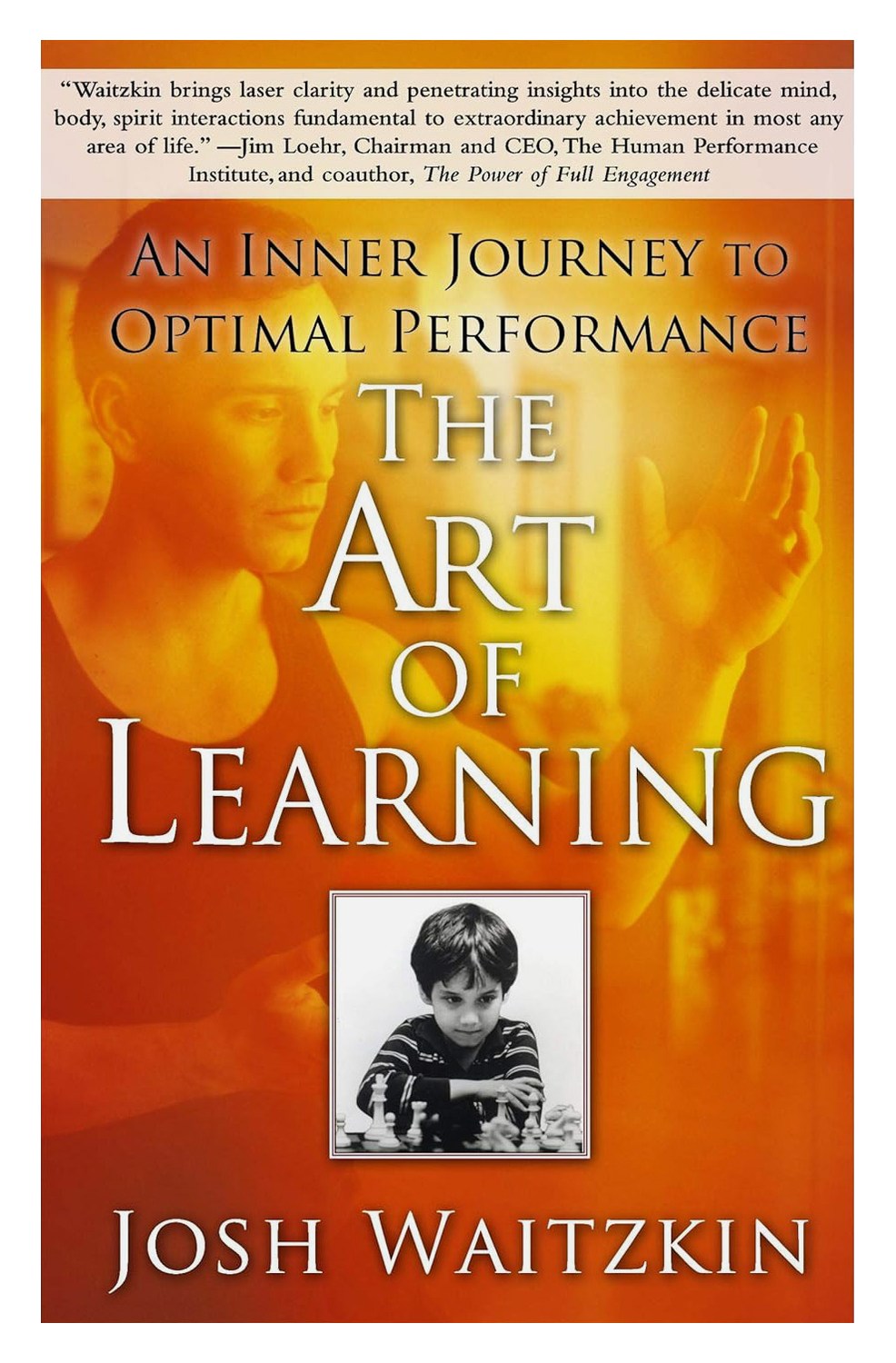
By Josh Waitzkin
Josh Waitzkin’s The Art of Learning is not really a book about chess, martial arts, or competition. Those are simply the environments through which he explores a much larger question: how do human beings develop mastery under pressure?
Waitzkin became internationally known as a chess prodigy as a child, the inspiration behind the film Searching for Bobby Fischer. Later, he transitioned from elite chess competition into martial arts, eventually winning multiple world championships in Tai Chi Push Hands. What makes the book unique is that Waitzkin is not merely recounting victories. He is attempting to reverse engineer excellence itself.
BUY THIS BOOK
The central idea running through the entire book is that mastery is not domain specific. The principles that create elite performance in chess can transfer into martial arts, business, creativity, leadership, or virtually any high pressure pursuit. Great performers are often not simply talented. They learn differently. They relate to failure differently. They structure growth differently. Most importantly, they build internal systems that allow them to remain calm, adaptive, and precise under pressure.
The book ultimately becomes a meditation on learning itself.
The Beginner’s Mind
One of Waitzkin’s earliest lessons involves the importance of maintaining what martial artists often call the “beginner’s mind.” As a child chess prodigy, he quickly discovered that ego is one of the greatest enemies of growth. The moment people become attached to appearing intelligent, talented, or advanced, their learning slows dramatically.
Beginners improve rapidly because they are open. They experiment. They fail without identity collapse. They absorb information fluidly. Experts, by contrast, often become rigid because they fear looking incompetent.
Waitzkin argues that true mastery requires preserving beginner-like openness even at elite levels of performance.
This idea appears repeatedly throughout the book. The strongest performers are often deeply humble before complexity. They understand how much they still do not know. Instead of defending identity, they pursue truth. This psychological flexibility allows them to adapt faster than competitors who cling to fixed self-images.
The lesson extends far beyond chess or sports. In business, leadership, and life, many people stop evolving because they become emotionally invested in certainty. They defend old models instead of remaining curious.
Waitzkin sees learning as an ongoing relationship with discomfort.
Learning Through Loss
A major theme in the book is Waitzkin’s relationship with failure. Unlike many performance books that glorify confidence and dominance, The Art of Learning repeatedly emphasizes vulnerability and honest self assessment.
Waitzkin describes painful tournament losses in great detail. Instead of protecting his ego afterward, he learned to study failure obsessively. Every mistake became information. Every collapse exposed structural weaknesses in his thinking.
This mindset allowed him to improve extraordinarily fast.
Most people experience failure emotionally first and analytically second. Waitzkin trained himself to reverse the sequence. He wanted the truth more than emotional comfort.
This distinction matters enormously because growth depends on accurate feedback loops. People who cannot confront their weaknesses honestly eventually stagnate. Their identity becomes too fragile to process reality clearly.
Waitzkin argues that the key is not becoming emotionally numb to failure. It is learning how to metabolize failure constructively. Loss should sharpen awareness rather than trigger shame.
This creates what psychologists might call antifragility. Pressure and setbacks become fuel for adaptation rather than evidence of inadequacy.
The Importance of Incremental Growth
One of the book’s most practical ideas is Waitzkin’s concept of “making smaller circles.”
Rather than chasing giant leaps of improvement, elite performers often focus on refining tiny details repeatedly until those refinements compound into extraordinary skill.
In chess, this meant studying subtle positional advantages most players overlooked. In martial arts, it meant refining balance, timing, and body awareness through countless repetitions.
Waitzkin believes mastery emerges from depth, not breadth.
Many people approach learning impatiently. They seek dramatic breakthroughs, shortcuts, and visible progress. But sustainable excellence usually develops through incremental refinement over long periods of time.
This idea reflects broader principles found in disciplines ranging from neuroscience to athletic training. Neural pathways strengthen through repetition. Muscle memory develops gradually. High performance systems are built through layered adaptation.
The key insight is that small improvements compound nonlinearly over time.
Tiny edges, consistently refined, eventually separate elite performers from average ones.
The Soft Zone
One of the most famous concepts in the book is the idea of the “soft zone.”
Most people perform well when conditions are ideal. They focus clearly when the environment is calm and distractions are absent. But elite performers develop the ability to remain centered amid chaos.
Waitzkin learned this during chess tournaments where opponents and spectators sometimes created psychological distractions intentionally. Later, in martial arts competitions, external unpredictability became even more intense.
The soft zone refers to a mental state where external disturbance no longer disrupts internal clarity.
Instead of resisting distractions emotionally, Waitzkin learned to incorporate them into awareness without becoming destabilized by them.
This principle has enormous relevance in modern life. Today’s world is built around distraction. Notifications, information overload, emotional reactivity, and constant interruption fragment attention continuously.
Most people’s minds are highly environmentally dependent. Their emotional state fluctuates with external conditions.
Waitzkin’s philosophy suggests true mastery involves building internal stability independent of environmental volatility.
This does not mean detachment or emotional suppression. It means flexibility.
The strongest performers can adapt fluidly without losing coherence.
Turning Adversity Into Advantage
Throughout the book, Waitzkin repeatedly demonstrates an unusual psychological pattern. He reframes adversity as opportunity.
When opponents behaved aggressively, he studied aggression. When environments became uncomfortable, he trained himself to grow comfortable inside discomfort. When pressure increased, he used pressure as a sharpening mechanism.
This mindset resembles concepts later popularized in books about resilience and mental toughness, but Waitzkin approaches it with far more nuance. He is not advocating blind positivity. He is advocating adaptive interpretation.
Circumstances do not automatically determine performance. Interpretation shapes performance.
Two people can experience identical setbacks while extracting completely different lessons from them.
This is partly why elite performers often appear psychologically different from average performers. They do not merely endure difficulty better. They process difficulty differently.
Pressure becomes informational rather than purely emotional.
Presence and the Flow State
Another major theme in The Art of Learning is the relationship between presence and peak performance.
Waitzkin discusses moments of complete immersion where conscious overthinking disappears and action becomes fluid, intuitive, and deeply responsive. Athletes often call this “being in the zone.” Psychologist Mihaly Csikszentmihalyi famously described it as flow.
But Waitzkin emphasizes that flow states are not accidental. They can be cultivated intentionally through training.
One technique he discusses is creating routines that trigger mental clarity under pressure. By practicing relaxation and focus repeatedly in difficult situations, performers can condition themselves to access calmness even during competition.
This idea becomes particularly powerful when applied outside sports.
Many executives, entrepreneurs, and leaders unknowingly train themselves into chronic stress responses. Their nervous systems become conditioned toward anxiety, urgency, and fragmentation.
Waitzkin argues that elite performance requires the opposite. The goal is to create calm intensity, not frantic intensity.
The best performers often appear deceptively relaxed precisely because they are not wasting energy fighting internal chaos.
The Transition From Chess to Martial Arts
One of the most fascinating aspects of the book is Waitzkin’s transition from chess into Tai Chi Push Hands competition.
At first glance, the disciplines seem unrelated. One is intellectual and strategic; the other is physical and embodied. But Waitzkin discovered that the underlying learning principles remained remarkably similar.
Pattern recognition, emotional regulation, timing, adaptability, presence, and psychological resilience transferred across domains.
This reinforced one of the book’s central arguments: excellence itself is transferable.
People often assume mastery is domain dependent. Waitzkin suggests that learning how to learn may be the ultimate competitive advantage.
Once someone understands how to structure deliberate practice, process setbacks, refine awareness, and remain calm under pressure, those skills can apply almost anywhere.
This idea is deeply empowering because it reframes talent entirely.
Natural ability matters, but learning architecture matters more over time.
Investment in Loss
Waitzkin also introduces the idea of “investment in loss,” one of the book’s most psychologically sophisticated concepts.
Sometimes short term setbacks are necessary for long term growth.
A competitor may temporarily abandon safe strategies in order to develop more advanced skills. A student may deliberately expose weaknesses in training rather than protecting current competence.
This requires unusual emotional maturity because the ego naturally resists temporary regression.
Most people optimize for looking good now. Elite performers optimize for becoming better later.
That distinction changes everything.
It requires long term thinking, patience, and identity stability. The learner must separate self worth from immediate performance outcomes.
In many ways, this concept applies directly to leadership and business. Organizations that avoid all short term discomfort often sacrifice long term adaptability. Individuals who constantly protect competence stop evolving.
Growth frequently requires temporary instability.
The Real Meaning of Mastery
By the end of the book, it becomes clear that Waitzkin’s deeper subject is not competition. It is self awareness.
Mastery is not simply about beating opponents. It is about understanding one’s own mind under pressure.
Can you remain calm amid chaos? Can you learn from failure without emotional collapse? Can you stay flexible as success grows? Can you maintain curiosity after becoming skilled? Can you adapt when conditions change?
These questions matter far beyond chessboards or martial arts competitions.
The modern world increasingly rewards superficial performance signals, speed, and visible achievement. Waitzkin’s philosophy points toward something slower and deeper. Sustainable excellence emerges from internal refinement.
The true art of learning is not accumulating information endlessly. It is developing the psychological and emotional architecture capable of continuous adaptation.
In that sense, the book becomes less about performance and more about consciousness itself.
It argues that excellence is not a finish line.
It is a way of relating to growth, pressure, failure, and life.