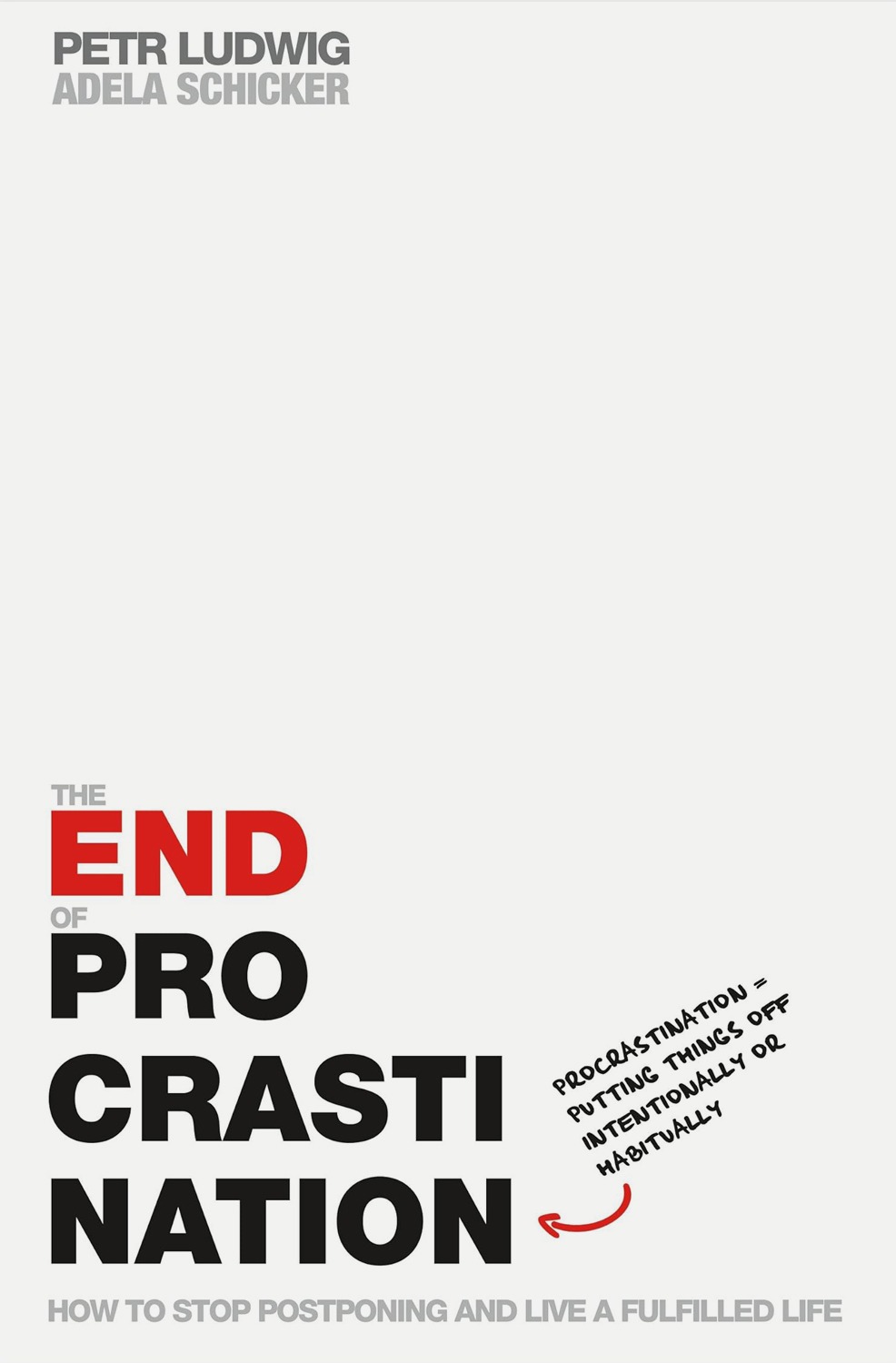
By Petr Ludwig and Adela Schicker
Most people think procrastination is a time-management problem.
They assume the issue is laziness, lack of discipline, poor scheduling, or insufficient motivation. Modern productivity culture reinforces this belief constantly. We are told to optimize calendars, download better apps, build morning routines, and “grind harder.” Yet despite endless systems and hacks, millions of intelligent, ambitious people continue delaying the very things they know matter most.
Petr Ludwig and Adela Schicker challenge this entire framework in The End of Procrastination. Their argument is both practical and psychologically profound: procrastination is not fundamentally about time. It is about emotion, meaning, and motivation.
BUY THIS BOOK
The book explores why human beings postpone important action despite understanding the consequences, and why the modern world has made procrastination far worse than previous generations experienced. Combining neuroscience, psychology, behavioral science, and practical frameworks, Ludwig argues that procrastination is ultimately a crisis of personal direction and emotional regulation.
The core message is simple but powerful. People procrastinate when they lose connection to meaningful vision, emotional energy, and purposeful action.
The solution is not merely working harder. It is rebuilding alignment between who you are, what you value, and how you spend your life.
The Modern Epidemic of Distraction
The authors argue that procrastination has become one of the defining diseases of the modern age because human beings now live in environments engineered for distraction.
Historically, people faced physical limitations. Today, they face cognitive overload. Smartphones, social media, endless entertainment, constant notifications, and information abundance create perpetual opportunities for avoidance. The brain becomes addicted to easy dopamine rather than meaningful progress.
The problem is neurological as much as behavioral. Researchers describe procrastination as a quintessential failure of self-regulation.
The human brain naturally seeks immediate rewards over long-term rewards. Evolutionarily, this made sense. Early humans optimized for short-term survival. But in modern environments, this same wiring creates destructive patterns where people continuously choose temporary comfort over meaningful future outcomes.
Checking Instagram feels easier than writing the book.
Watching Netflix feels easier than having the difficult conversation.
Scrolling endlessly feels easier than confronting uncertainty, failure, or discomfort.
Ludwig explains that procrastination is often emotional avoidance disguised as rational delay. People tell themselves they are “waiting for the right time,” but beneath the surface they are usually avoiding anxiety, uncertainty, fear of imperfection, or fear of failure.
This distinction matters enormously because it reframes procrastination from a character flaw into a psychological coping mechanism.
Personal Vision and Why Meaning Fuels Action
One of the book’s most important ideas is that motivation is directly tied to personal vision.
People procrastinate far less when they possess a deeply meaningful sense of direction. When someone understands why they are doing something and how it connects to their values, energy increases naturally. Discipline becomes less necessary because emotional alignment creates momentum.
This is why highly meaningful goals often produce extraordinary perseverance.
The authors argue that many people live reactively instead of intentionally. They move from obligation to obligation without stepping back to define what kind of life they actually want. Without vision, motivation fragments. Life becomes a series of short-term emotional reactions rather than purposeful action.
Ludwig introduces the idea of “personal vision” as a guiding framework for decision-making. A strong vision functions like an internal compass. It reduces procrastination because decisions become easier. People stop negotiating endlessly with themselves because they know what matters.
Importantly, the book distinguishes external goals from intrinsic motivation. External rewards such as money, status, titles, and approval create only temporary motivation. Sustainable action emerges from intrinsic values such as growth, contribution, mastery, relationships, creativity, and meaning.
This insight aligns with decades of psychological research, particularly Self-Determination Theory, developed by Edward Deci and Richard Ryan, which emphasizes autonomy, competence, and relatedness as core drivers of intrinsic motivation.
The deeper implication is provocative.
Many people are not procrastinating because they are lazy. They are procrastinating because they are disconnected from meaningful purpose.
Emotional Energy and Personal Effectiveness
Another central theme of the book is that productivity is inseparable from emotional energy.
Modern culture often glorifies hustle and constant output, but Ludwig argues that energy management matters more than time management. People cannot sustain meaningful action when emotionally exhausted, chronically stressed, or mentally fragmented.
The authors explore the role of dopamine in motivation and behavior. Dopamine is not simply the “pleasure chemical,” as it is often described. It is deeply connected to anticipation, drive, and goal-directed behavior.
When people experience progress toward meaningful goals, dopamine reinforces action positively. But modern digital environments hijack this system by providing endless low-effort rewards. Social media likes, entertainment, notifications, and novelty provide dopamine spikes without requiring meaningful effort.
Over time, this weakens the brain’s ability to tolerate delayed gratification.
The result is a culture increasingly addicted to stimulation while struggling with sustained focus.
The book repeatedly emphasizes the importance of restoring mental clarity and reducing cognitive clutter. Sleep, exercise, mindfulness, healthy relationships, and recovery are not treated as secondary wellness topics. They are foundational to sustained motivation.
This reflects a broader truth modern productivity culture often ignores: exhausted people procrastinate more because depleted nervous systems prioritize immediate emotional relief.
The Role of Fear and Perfectionism
One of the book’s strongest sections explores the relationship between procrastination and fear.
People often delay action not because they lack desire, but because action threatens identity.
A person postpones writing because writing exposes them to judgment.
They avoid launching the business because failure would damage self-image.
They delay difficult conversations because rejection feels emotionally dangerous.
The authors argue that perfectionism becomes one of the most destructive forms of procrastination because perfectionism creates impossible psychological standards before action even begins.
Perfectionists often confuse preparation with progress.
They endlessly optimize, research, organize, and plan while avoiding the vulnerability of execution itself.
Ludwig encourages readers to adopt experimentation over perfection. Action creates clarity. Waiting for certainty rarely does.
This idea reflects behavioral psychology principles around exposure and momentum. Confidence does not usually appear before action. It emerges through action.
The book repeatedly pushes readers toward small, imperfect steps because progress builds psychological reinforcement. Motion creates motivation more reliably than waiting for motivation to create motion.
The Importance of Habits and Automation
The authors also emphasize that willpower alone is unreliable.
Human beings dramatically overestimate self-control and underestimate environmental influence. This is why habits matter so much. Habits reduce cognitive resistance because behavior becomes automatic rather than emotionally negotiated every day.
The book draws heavily from behavioral science around habit loops, environmental design, and routine formation.
For example:
If healthy behavior requires constant decision-making, it eventually collapses under stress.
If productive behavior becomes embedded into systems and routines, consistency improves dramatically.
The key insight is that motivation fluctuates naturally, but systems stabilize behavior.
This includes reducing distractions proactively. Ludwig argues that many people design environments optimized for procrastination while expecting themselves to behave productively through sheer discipline.
That expectation is psychologically unrealistic.
Phones, notifications, multitasking, and fragmented attention continuously weaken deep focus. The authors strongly advocate protecting concentration deliberately because meaningful work requires uninterrupted cognitive immersion.
This aligns closely with later works such as Cal Newport’s Deep Work, which similarly argues that attention itself has become one of the most valuable resources of the modern era.
Flow and Meaningful Engagement
One of the most fascinating concepts discussed in the book is “flow,” the psychological state identified by Mihaly Csikszentmihalyi where people become fully immersed in meaningful activity.
Flow represents the opposite of procrastination.
In flow states, people lose track of time because action, focus, and engagement become unified. Anxiety decreases. Self-consciousness fades. Performance often improves dramatically.
The authors argue that procrastination thrives when people become disconnected from flow-producing activities. Modern life fragments attention constantly, preventing the sustained concentration necessary for deep engagement.
This has profound implications beyond productivity.
The book suggests that many people are not merely procrastinating tasks. They are procrastinating life itself. They delay meaningful pursuits, relationships, creative ambitions, health goals, and personal growth while trapped inside cycles of distraction and emotional avoidance.
This creates existential frustration because humans derive fulfillment less from passive consumption and more from meaningful participation.
The authors repeatedly return to a powerful idea: happiness emerges more reliably from purposeful progress than from short-term pleasure.
Responsibility and the Freedom to Choose
Underlying the entire book is a philosophical theme around personal responsibility.
Ludwig avoids moralizing procrastination, but he also rejects victimhood narratives. The book acknowledges biological tendencies, environmental pressures, and emotional complexity while still insisting that individuals retain agency.
This balance gives the book much of its practical strength.
The authors argue that fulfilled lives are built intentionally, not accidentally. Small daily decisions compound into identity, relationships, career trajectory, health, and emotional wellbeing over time.
Procrastination therefore becomes more than delayed productivity. It becomes delayed living.
Every postponed dream, avoided conversation, neglected relationship, or abandoned ambition quietly shapes the future self.
This perspective transforms procrastination from a scheduling issue into a deeply existential one.
What kind of life are you postponing while waiting for the “right moment”?
Final Reflections
What makes The End of Procrastination compelling is that it avoids simplistic productivity clichés.
The book does not reduce human behavior to hacks, routines, or motivational slogans. Instead, it explores procrastination as a deeply human struggle rooted in fear, distraction, emotional exhaustion, lack of meaning, and neurological wiring.
Its central insight is ultimately hopeful.
People are not doomed to procrastinate forever. But overcoming procrastination requires more than better calendars or stronger discipline. It requires reconnecting action to meaning, reducing emotional avoidance, protecting attention, building healthy habits, and intentionally designing a life aligned with personal values.
The book’s deeper message is that productivity and fulfillment are not separate pursuits.
The most productive people are often not the people obsessed with productivity itself. They are the people emotionally connected to meaningful purpose.
That distinction changes everything.
Because in the end, procrastination is rarely just about postponing work.
It is about postponing the life we know we are capable of living.