By Cal Newport
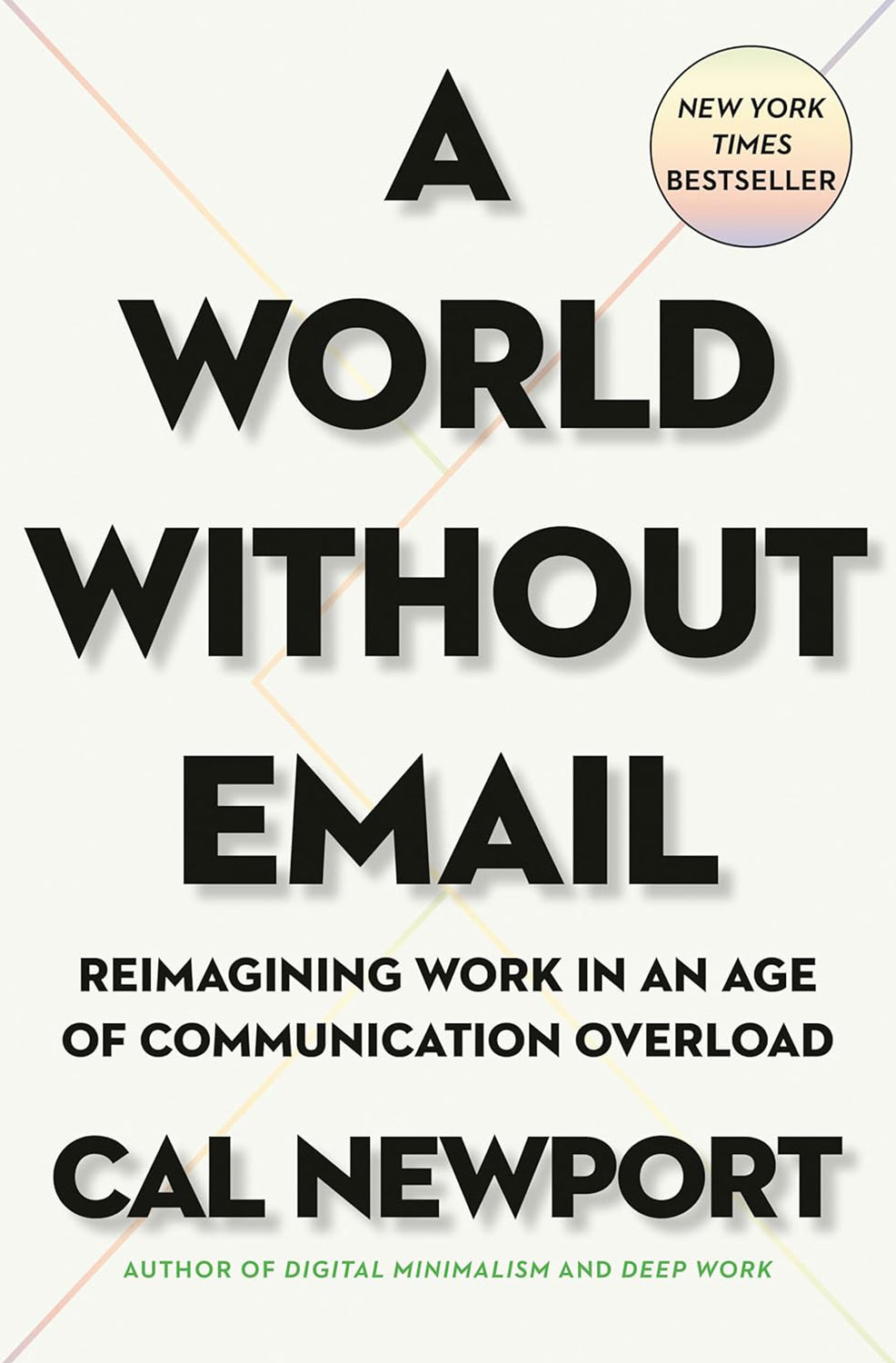
Every workday for knowledge workers — employees whose work is primarily about thinking and communication — is saturated with messages. We open our inboxes first thing, interrupt real tasks to respond to pings, and justify these behaviors as collaboration. Yet this steady stream of incoming communication consumes enormous mental energy and time. In A World Without Email, Cal Newport argues that our current model of asynchronous communication — particularly email, but also Slack and similar tools — isn’t efficient. It creates a landscape of constant context switching, hurting productivity, diminishing job satisfaction, and increasing stress.
Newport labels this dominant workflow “the hyperactive hive mind,” a model where constant back-and-forth messaging has become the default mode for almost all collaborative knowledge work. It’s not that emails and messages in themselves are inherently bad tools. The problem lies in how they have shaped how we work — moving modern knowledge work away from structured focus and toward reactive chatter.
BUY THIS BOOK
Part I — The Case Against Email
The Hyperactive Hive Mind
The hyperactive hive mind is not a planned system. It emerged unintentionally as email became widespread. Since early adoption in the 1990s, email replaced many forms of slower, scheduled communication and unintentionally enabled constant conversational threads about tasks, decisions, and coordination. The result is a workday increasingly defined by communication about work rather than the substantive work itself.
Humans are not wired for this environment. Switching tasks repeatedly — checking email, responding to chats, then trying to focus — imposes significant cognitive costs. The brain must reorient each time attention shifts, and these attention switches are far more costly than they feel. Instead of deep, productive work, we find ourselves stuck in short fragments of focus that rarely lead to meaningful progress.
Email Reduces Productivity and Job Satisfaction
Far from being a neutral tool that simply speeds up coordination, email actively reduces individual productivity. Constant interruptions keep workers from sustained focus, leading to shallow work that rarely mirrors true knowledge creation. Because most teams default to email for communication, workers often check their inboxes habitually — sometimes every few minutes — which diminishes the ability to do concentrated work.
This relentless communication also increases stress and reduces satisfaction. Workers internalize the anxiety of needing to respond quickly. Even when notifications are muted, the symbolic presence of an inbox — the ever-growing list of unanswered items — can remain psychologically burdensome.
Email Has a Mind of Its Own
Newport makes a striking point: the widespread adoption of email didn’t happen because people collectively decided it was the best way to work. It spread organically because it worked well enough and lowered barriers to communication. But the very success of email — its low-friction nature — is also its problem. Because it’s easy to send and respond to messages, people do it constantly. This has led to an ecosystem where communication begets more communication — often disproportionate to the work that truly needs to be done.
Once a workplace is embedded in this messaging culture, escaping it becomes extremely difficult. Individuals who try to limit email engagement often find that their colleagues expect instant responses, creating social pressure that reinforces the hive mind cycle.
Part II — Principles for a World Without Email
Newport doesn’t merely diagnose a problem. He proposes alternative principles and frameworks for reimagining how work gets done in knowledge environments, so that real work — not reactive messaging — is the central focus.
The Attention Capital Principle
At the heart of Newport’s thesis is the idea of attention capital — the brain’s limited capacity to think deeply and add real value. In manufacturing, capital is tied to machinery and materials. In knowledge work, the primary capital is human attention. How we deploy that attention determines quality outcomes.
Rather than scattering attention across countless brief correspondences, work systems should be structured to protect sustained focus. This means minimizing context switches and reducing the need for reactive communication.
The Process Principle
One of the most significant ideas Newport advocates is applying systematic workflows to knowledge work — inspired by how industrial engineering revolutionized manufacturing.
Just as assembly lines and workflow systems made physical production more predictable and efficient in the early 20th century, knowledge work needs analogous systems to manage tasks in a structured way. Rather than relying on ad-hoc communications to coordinate action, teams can define clear processes that assign responsibilities, track progress visually (e.g., with task boards), and reduce friction in collaboration.
This isn’t about bureaucracy for bureaucracy’s sake. It is about creating deliberate workflows that free cognitive bandwidth and minimize unnecessary coordination overhead.
The Protocol Principle
Protocols are standardized ways of handling recurring situations. Newport argues that instead of handling every coordination moment via email, organizations should develop clear protocols — predictable and agreed-upon approaches to common types of interactions. For example, which tasks require synchronous discussion, and which can be resolved through structured updates? Having such protocols means that employees don’t have to guess how to respond or when to ping someone — resulting in fewer interruptions and smoother coordination.
Protocols help reduce uncertainty and anxiety associated with messaging — people know how and when work will be discussed and resolved, and don’t feel compelled to constantly check for ad-hoc updates.
The Specialization Principle
Another key insight is that knowledge work includes many hidden administrative tasks — scheduling, clarifying requests, repeated back-and-forth discussions — that do not require high cognitive skill but absorb significant attention capital. Newport argues that organizations should specialize these tasks: assign routine work to systems or support roles designed specifically for task coordination, so high-value knowledge workers can focus on substantive intellectual labor.
This separation of concerns can lower overall communication volume and allow people to invest their attention where it matters most.
Examples and Case Studies
Throughout the book, Newport uses real-world examples to illustrate how alternative communication structures can succeed. Some teams have embraced specialized workflow tools — like task boards, project management systems, or structured ticketing systems — to replace much of their email traffic. This doesn’t eliminate communication, but it channels it through more structured, predictable systems that reduce context switching and cognitive load.
Case studies also show that optimizing communication systems not only improves productivity but can significantly improve worker satisfaction. When employees spend their days on structured tasks rather than reactive messaging, they report deeper focus and less stress.
Challenges and Critiques
Newport anticipates that eliminating email entirely — or even substantially reducing its centrality — will not be easy. Human beings, and organizations, resist change. People fear losing control or missing important information. There is also a natural anxiety associated with breaking habits, especially ones like email that feel familiar and “normal.”
Some critics argue that Newport’s framing oversimplifies the problem or ignores the value of fast communication in certain contexts. For example, while email creates overload, it also allows rapid coordination across time zones and organizational boundaries. These critics caution against assuming all messaging is bad, instead advocating for better practices and balance.
Newport acknowledges these complexities but holds that the harms of the hyperactive hive mind outweigh the conveniences it offers. His proposal isn’t technological purism but a thoughtful redesign of workflows and communication norms.
Toward a Better Tomorrow
The broader vision of A World Without Email is not necessarily a literal universe with zero email tools. Instead, it is a future where inboxes and real-time messaging are no longer the default hub of collaboration. Rather than reacting to each ping, workers operate within systems that assign tasks more deliberately, track progress transparently, and minimize needless context switches.
In such a world:
- Workers spend most of their time on meaningful tasks instead of reactive messaging.
- Teams coordinate through predictable protocols, not ad-hoc threads.
- Cognitive load is protected, enabling deeper focus and higher-value output.
- Job satisfaction and well-being improve as communication noise declines.
This is not a utopia — any transition requires strategic decisions, organizational buy-in, and cultural change. But Newport argues persuasively that the future of knowledge work depends on moving away from the default hive mind toward intentional, structured, and humane communication systems.
Four Core Principles Summarized
No. 1 — Attention Capital Principle. Focus is our most valuable resource; constant interruptions waste it.
No. 2 — Process Principle. Structured workflows replace chaotic email threads with deliberate systems.
No. 3 — Protocol Principle. Standardized approaches to common situations reduce ambiguity and unnecessary messaging.
No. 4 — Specialization Principle. Delegating routine coordination tasks frees attention for high-value thinking.
Why This Matters
Cal Newport’s A World Without Email is more than a book about productivity hacks. It is a call to rethink the default norms of collaboration in modern organizations. When communication overload becomes the norm, workers lose clarity, focus, and satisfaction — and organizations lose efficiency and innovation potential.
Rather than accepting email as an inevitable aspect of professional life, Newport asks us to question how work is structured and to design systems that respect human attention. The future he imagines may seem bold today, but the alternative — a continuation of reactive workflows — guarantees growing fragmentation, burnout, and missed potential.