Listen to this Book Summary, 17 min, read by Simon
By Eric Ries
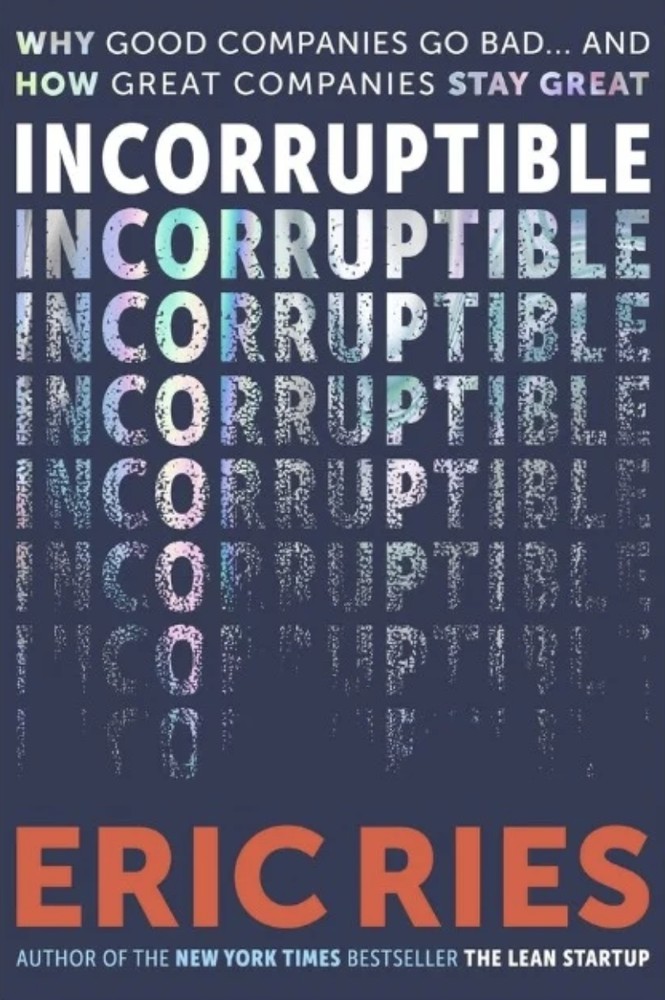
Eric Ries’s Incorruptible: Why Good Companies Go Bad and How Great Companies Stay Great is a business book about a problem almost every founder, investor, executive, employee, and customer has seen in some form: a company begins with a real mission, a distinctive culture, a set of promises, and a sense that it exists for something more than extraction. Then, slowly or suddenly, it becomes something else. The product gets worse. The customer promise thins out. The culture becomes political. Employees lose trust. The founding ideals become nostalgic branding. The company still exists, and may even still grow, but something essential has been hollowed out.
BUY THIS BOOK
Ries’s central argument is that this decline is not best understood as a morality tale about bad actors. The official publisher description frames the book as a rethink of how organizations are built and why success itself often turns companies against the principles that made them worth building. Ries argues that the failure is structural, shaped by ownership, incentives, charters, accountability, and decision making systems that quietly redirect behavior as organizations grow.
That is what makes the book important. It does not let leaders hide behind the comforting idea that corruption happens only when immoral people enter the room. Ries suggests that good intentions are not enough. If the governance structure, ownership model, incentive system, and legal purpose of the company are misaligned with the mission, then even principled people can be pushed toward decisions they never intended to make.
The Core Thesis: Success Creates Gravity
Financial Gravity Pulls Companies Away From Purpose
A key concept in Incorruptible is what Ries calls the force of financial gravity. As companies become larger, more valuable, and more visible, they attract pressure. Investors want returns. Boards want performance. Analysts want predictability. Executives want growth. Employees want security. The market wants more, faster, and sooner. Over time, these forces can bend a company away from its original mission, even when nobody consciously decides to betray it.
In an HBR IdeaCast conversation about the book, Ries describes organizations as subject to underlying forces, or a kind of organizational physics, that act on them whether leaders acknowledge those forces or not. He argues that many leaders focus on visible factors like strategy, business model, organizational chart, and culture, while missing the deeper systems that determine what the company will actually become. The full conversation, What Leads Companies to Betray Their Own Principles, is available from Harvard Business Review, with Ries in discussion with Adi Ignatius and Alison Beard.
This is the book’s deeper warning: the more successful a company becomes, the more vulnerable it may become to capture. Success makes the organization worth controlling. It increases the temptation to monetize trust, squeeze customers, cut corners, reduce long term investment, or treat the mission as decoration. The company may not collapse. It may simply become less worthy of belief.
Good Intentions Are Structurally Weak
Mission Statements Do Not Protect Mission
One of the strongest ideas in the book is that mission statements are often too weak to withstand institutional pressure. Companies can write beautiful values, display them publicly, train employees on them, and still behave in ways that contradict them when the economic system rewards something else.
Ries points to the gap between what companies say they exist to do and what their legal and governance structures actually require. In the HBR interview, he argues that many leaders have never seriously examined their corporate charter, even though it functions like a constitutional document. He uses the example of broad corporate purpose language, such as being incorporated to pursue any lawful act or activity, to show how a vague legal purpose can leave the practical meaning of the company vulnerable to shareholder primacy.
The implication is uncomfortable. A company may say it exists to serve customers, improve health, support communities, empower employees, advance innovation, or make the world better. But if its structure says, in effect, that financial return is the ultimate governing purpose, then the stated mission may eventually lose when the two come into conflict.
Ries’s point is not that mission statements are useless. It is that they are insufficient. The mission must be embedded into how the company is governed, financed, measured, owned, and led.
The Critique of Shareholder Primacy
The Problem With Treating the Company as a Financial Instrument
Ries’s argument sits squarely inside the long running debate about shareholder primacy. He is not anti business, anti profit, or anti capitalism. In fact, the publisher frames the book as a practical blueprint for enduring, mission controlled companies, not a rejection of commercial ambition. Joseph Bower and Lynn Paine of Harvard Business School make a related argument in The Error at the Heart of Corporate Leadership for Harvard Business Review, challenging the belief that a board’s main duty is to maximize shareholder value.
His critique is more precise. When a company is treated primarily as a financial instrument for maximizing shareholder value, every non financial commitment becomes vulnerable. Customer trust, employee dignity, product quality, supplier relationships, community contribution, environmental responsibility, and long term innovation can all be reinterpreted as costs unless they can be justified immediately through financial return.
Ries argues in the HBR discussion that stakeholder capitalism, at least as popularly discussed, often lacked a sufficiently strong affirmative vision. If stakeholders conflict, the model does not always tell leaders how to decide. His answer is not vague stakeholder language. It is governance design that makes the company’s real commitments explicit and durable.
This is where the book becomes practical rather than merely philosophical. Ries wants companies to ask what they are truly committed to, then build structures that make betrayal harder.
“Harder Is Easier”
The Long Term Road Often Looks Irrational in the Spreadsheet
One of the book’s most useful principles is Ries’s idea that harder is easier. Many of the most important mission preserving decisions look financially unattractive in the short term because their costs are visible and their returns are intangible. A company can calculate the cost of paying higher wages, refusing a price increase, giving customers the benefit of the doubt, or investing in quality. It is much harder to calculate the long term value of trust.
Ries uses examples like H-E-B and Costco to show how operational discipline can protect a company’s promise. In the HBR discussion, he describes H-E-B giving customers groceries during a Texas ice storm when the store lost power and the point of sale system could not function. His point is that this was not simply a heroic manager improvising; it reflected operational training around taking care of customers in tangible ways.
Costco is another major example. Ries highlights Costco’s refusal to take easy margin, including its famous discipline around limited markups and the long standing hot dog and soda price. His larger argument is that taking the easy price increase can become addictive because it resets expectations and forces the company to keep extracting more. MIT Sloan’s How Costco’s obsession with culture drove success adds the view of co-founder James Sinegal, who paid some of the highest wages in retail and insisted on passing savings on to customers every time.
The lesson is not that every company should imitate Costco’s pricing. The lesson is that promises must become operational constraints. If a company truly stands for something, it must sometimes refuse the easy money.
Governance as a Creative Act
Corporate Design Is Not Bureaucracy
One of Ries’s major reframings is that governance should not be treated as boring legal administration. He describes governance as a creative and strategic act, central to building companies that can remain aligned with their purpose over time.
This is an important shift. Founders often obsess over product, brand, growth, culture, hiring, fundraising, and go to market strategy. They may treat governance as something lawyers handle in the background. Ries argues that this is dangerous. Governance determines who has power, what duties they owe, what the company is legally committed to, and how decisions will be made when values and money collide.
For Ries, an incorruptible company is not one led by unusually virtuous people. It is one designed so that future leaders, investors, and boards are more likely to preserve the company’s commitments. That means mission must live not only in speeches, culture decks, and founder lore, but in charters, board duties, ownership structures, voting rights, incentive systems, and accountability mechanisms.
Mission Must Be Protected at Multiple Levels
The Ownership Stack Matters
Ries argues that companies need protection throughout what he calls the ownership stack. The mission must be clear at the operating level, but also defended at the board, shareholder, and corporate structure levels. In the HBR interview, he discusses putting mission into the corporate charter, considering a director’s oath, and examining alternative structures such as industrial foundations, employee ownership, and perpetual purpose trusts.
This is where Incorruptible becomes especially relevant for founders planning for scale, financing, succession, or exit. The question is not only how to build something valuable. The question is how to prevent that value from being redirected away from the purpose that created it.
A company can be founder led and still vulnerable. A charismatic founder may protect the mission while present, but what happens after the founder steps back, sells, dies, burns out, or gets pushed aside? Ries wants mission to become less dependent on heroic leadership and more embedded into durable structure.
The Limits of Founder Mythology
One Leader Cannot Be the Whole Defense System
Modern business culture often romanticizes founders. We like stories of visionary individuals who defy convention, build beloved companies, and protect the mission through sheer conviction. Ries understands that founders matter. But he is skeptical of relying on one person’s character as the primary defense against drift.
That is because founders leave, change, compromise, or lose control. Even when they remain, they may be pressured by investors, markets, debt, growth expectations, boards, or succession demands. A founder’s values may start the company, but structure determines whether those values survive the founder.
This is one reason Ries’s argument extends beyond personality. The company needs what might be called institutional memory, a design that preserves what the company owes to its customers, employees, partners, and broader purpose.
Great Companies Stay Great by Making Betrayal Harder
Incorruptibility Is Designed, Not Assumed
The title Incorruptible does not imply that any company can become morally perfect. Rather, it suggests that companies can be designed to resist predictable forms of corruption. That means identifying the pressures most likely to pull the company away from its mission, then building legal, cultural, operational, and financial safeguards.
A company that claims to care about customers must decide what it will not do to customers, even when profitable. A company that claims to care about employees must decide what obligations survive during downturns. A company that claims to care about long term innovation must protect investment from quarterly panic. A company that claims to care about community must give that concern actual standing in governance and decisions.
The point is not to eliminate tradeoffs. Tradeoffs are unavoidable. The point is to stop pretending that values will defend themselves.
Conclusion: The Company You Build Is Not Automatically the Company That Survives
Incorruptible is ultimately a book about institutional character. Its central warning is that a company’s founding ideals are fragile unless they are translated into structure. Good people can build bad systems. Good companies can drift into extractive behavior. Successful brands can become hollowed out by the very forces their success attracts.
Ries’s contribution is to move the conversation from virtue to design. He does not say character is irrelevant. He says character is not enough. The real work is to build companies whose charters, ownership, boards, incentives, metrics, culture, and operating practices are aligned with the mission they claim to serve.
That makes the book especially relevant for founders, CEOs, boards, investors, and anyone trying to build something that should outlast the personalities who created it. The question is not simply, “Are we good people?” The harder question is, “Have we built a company that can remain good when the pressure arrives?”
In Ries’s view, success alone will not protect what matters. If anything, success may increase the danger. The stronger the company becomes, the more important it is to design against the forces that will try to redirect it. A company stays great not because it remembers its mission fondly, but because it gives that mission power.
Key Takeaways
No. 1 — Corruption Is Often Structural, Not Merely Personal
Companies do not go bad only because bad people take over. They drift when governance, incentives, ownership, and decision rights reward behavior that conflicts with the mission.
No. 2 — Mission Statements Are Not Enough
A mission written on the wall, in a deck, or on a website will not protect a company when financial pressure rises. The mission must be embedded into legal and operating structures.
No. 3 — Success Can Create Vulnerability
The more valuable a company becomes, the more likely it is to attract pressure from investors, acquirers, boards, executives, and markets that may not share the founding purpose.
No. 4 — Great Companies Make Promises Operational
Companies like Costco and H-E-B illustrate the idea that values must become trained behaviors, pricing rules, service standards, and decision disciplines, not just inspiring language.
No. 5 — Governance Is Strategy
Corporate governance is not housekeeping. It determines what the company is legally and practically committed to when tradeoffs become real.
No. 6 — The Founder Cannot Be the Only Guardian
A founder’s conviction may start the company, but durable structures are needed to protect it after leadership changes, capital changes, or market pressure intensifies.
No. 7 — The Harder Road May Be the Stronger Road
Short term extraction often looks easier, but it can erode trust and identity. The harder path of keeping promises may create more durable value over time.