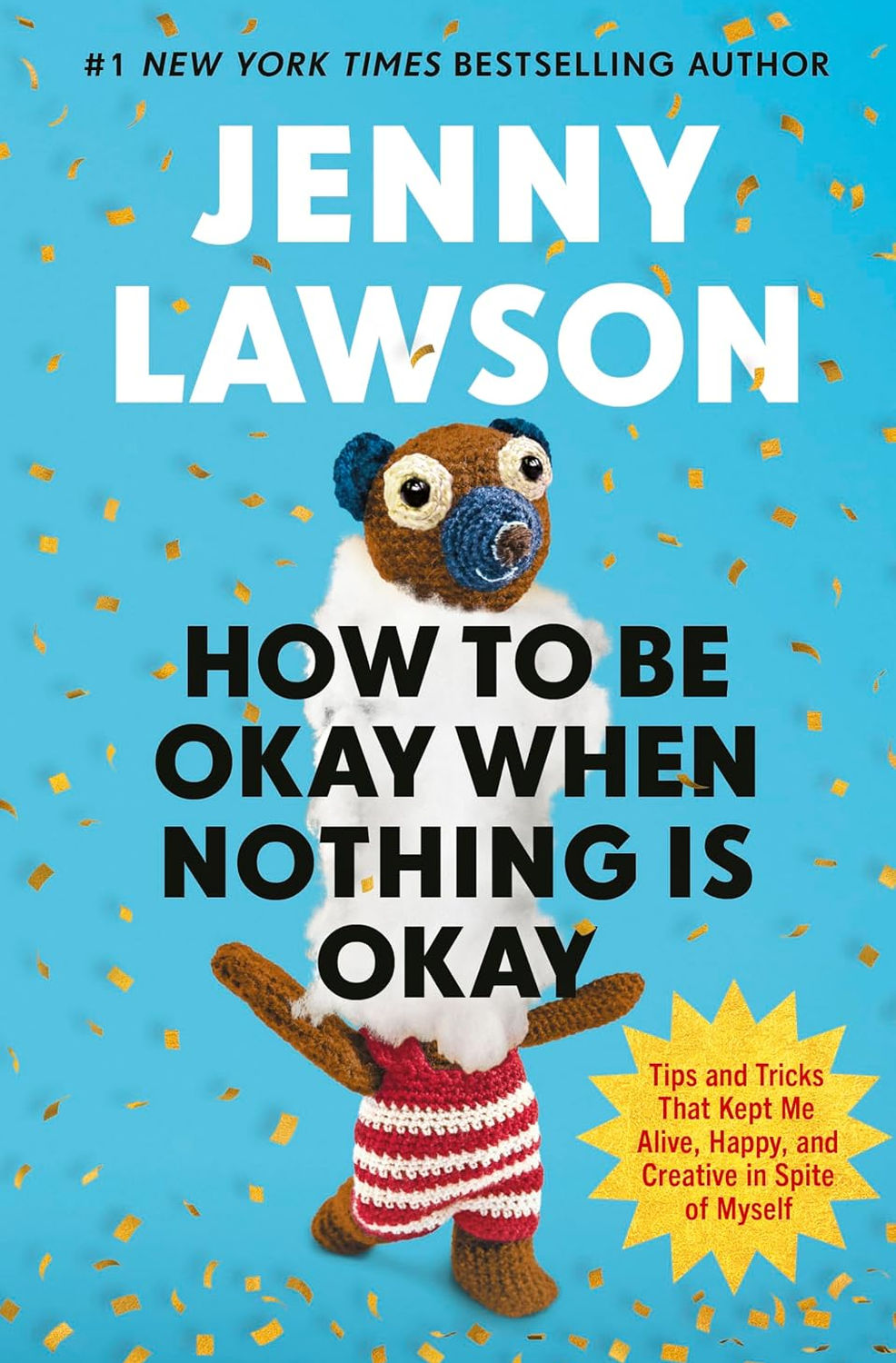
By Jenny Lawson
Jenny Lawson’s How to Be Okay When Nothing Is Okay is not conventional self-help. It does not promise transformation, optimization, perfect habits, or a better version of yourself waiting on the other side of a ten-step program. Instead, Lawson starts from a much more forgiving premise: sometimes life is difficult, sometimes your brain refuses to cooperate, and sometimes success simply means figuring out how to make it through the day without making things worse.
BUY THIS BOOK
Published in March 2026, the book brings together more than one hundred short pieces of advice, coping strategies, mental tricks, reminders, and creative exercises that Lawson says she has developed while living with depression, anxiety, ADHD, self-doubt, and periods of creative paralysis. The chapters are deliberately brief, often only a page or two, and the book is designed either to be read straight through or opened when a particular kind of struggle appears.
The result is part self-help manual, part memoir, part comedy, and part survival guide. Lawson is less interested in teaching readers how to conquer their minds than in showing them how to work with the minds they actually have.
The Central Idea: Being Okay Does Not Mean Everything Is Okay
The most important idea running through the book is contained in its title. Lawson separates being okay from the expectation that circumstances themselves must become okay.
This distinction changes the definition of resilience.
Traditional self-improvement often suggests that difficult feelings are problems to be solved. Anxiety should be defeated. Depression should be overcome. Productivity should be restored. Motivation should be found. Lawson takes a different approach. Sometimes anxiety remains anxiety. Depression remains depression. The difficult situation may still exist tomorrow.
The question therefore becomes: What can I do inside this reality?
For Lawson, being okay can mean taking a shower. It can mean sleeping. It can mean completing one small task rather than the entire list. It can mean asking someone for help. It can mean recognizing that the thoughts produced by a struggling brain are not necessarily accurate descriptions of reality.
This philosophy removes an enormous amount of pressure. You do not have to fix your entire life before you are allowed to feel that you have accomplished something.
Sometimes survival itself deserves credit.
Stop Treating Your Brain as an Objective Narrator
One recurring theme is Lawson’s complicated relationship with her own mind.
A person experiencing anxiety, depression, ADHD, or extreme self-doubt can easily begin treating every thought as evidence. If your brain tells you that everyone dislikes you, you assume everyone dislikes you. If it says you are failing, failure begins to feel like an objective fact. If it tells you that there is no point starting something because you will probably screw it up, procrastination starts to look rational.
Lawson encourages readers to create some distance between having a thought and believing a thought.
Your brain is extraordinarily powerful, but it is not always reliable.
It can catastrophize. It can exaggerate rejection. It can magnify embarrassment. It can turn temporary exhaustion into a prediction about your entire future.
Instead of immediately accepting these conclusions, Lawson encourages interruption. Sometimes the solution involves grounding yourself in physical or sensory details around you, breaking the emotional spiral long enough for your nervous system to settle. Publishers Weekly specifically highlights her use of concrete sensory observations as a technique for interrupting overwhelming emotional loops.
The larger lesson is simple: you are allowed to question the narrator inside your own head.
Make Life Easier Without Apologizing for It
One of Lawson’s most useful principles is captured in the wonderfully direct idea that “working on easy mode is still working.”
She rejects the notion that difficulty makes an accomplishment more legitimate.
People routinely create unnecessary hardship for themselves because they believe they should be able to operate the same way everyone else does. Lawson argues that accommodations, shortcuts, reminders, external systems, modified environments, medication, assistance, and unusual routines are not cheating.
They are tools.
If your brain works better under certain conditions, create those conditions.
This is especially relevant for neurodivergent readers, but the principle extends far beyond ADHD or mental illness. Human beings have different capacities, sensitivities, limitations, energy levels, and ways of concentrating.
The objective should not be proving that you can struggle heroically.
The objective should be finding a way to function.
A person using a ramp instead of stairs still entered the building. Someone using a calendar reminder still remembered the appointment. A writer who produces five hundred words instead of five thousand still wrote.
The outcome counts.
Lower the Barrier to Starting
Lawson repeatedly returns to one of the most frustrating experiences associated with anxiety, depression, ADHD, and creative work: knowing what you need to do but somehow being unable to begin.
Large tasks become psychologically enormous.
The more important the task feels, the more pressure surrounds it. The more pressure you feel, the harder starting becomes. Eventually, even relatively simple activities can produce paralysis.
Lawson’s answer is often to shrink the task.
Lower the expectation.
Make the first step almost embarrassingly easy.
Instead of demanding that you finish the project, open the document. Instead of expecting yourself to clean the house, deal with one thing. Instead of waiting for inspiration sufficient to produce something brilliant, make something mediocre.
Publishers Weekly notes that Lawson specifically advocates lowering expectations as a way of bypassing creative paralysis.
This is not surrendering ambition. It is understanding momentum.
Starting badly is often more productive than waiting to start perfectly.
Protect Your Energy
Another important theme is that human energy is finite.
People who struggle with anxiety, depression, chronic illness, ADHD, or overstimulation may have even less predictable reserves. Lawson encourages readers to pay attention to where their mental and emotional energy goes rather than judging themselves against someone else’s capacity.
Some relationships drain energy. Certain environments create stress. Some obligations cost far more psychologically than their apparent importance would suggest.
Recognizing this is not selfishness.
It is resource management.
The underlying idea is that you cannot endlessly withdraw from yourself without eventually becoming depleted. Saying no, cancelling something, resting, leaving an uncomfortable situation, asking for assistance, or changing expectations may sometimes be the healthiest available choice.
Lawson therefore reframes boundaries not as rejection of other people, but as protection of the limited energy required to remain functional and creative.
Sleep, Rest, and Basic Maintenance Matter More Than We Admit
Lawson’s advice is frequently humorous because the underlying truths are surprisingly ordinary.
One chapter title, “Wash Your Brain More Than You Wash Your Bra,” ultimately points toward the importance of sleep.
That captures much of Lawson’s approach.
We often search for sophisticated explanations for why we feel terrible when the first questions should sometimes be extremely basic.
Did you sleep?
Did you eat?
Have you left the house?
Have you moved your body?
Have you spent hours scrolling through things specifically designed to trigger emotional reactions?
Have you had any meaningful human contact?
None of these things cures serious mental illness, and Lawson does not pretend that they do. The point is that ignoring physical maintenance can amplify an already difficult mental state.
When everything feels psychologically complicated, addressing something physically simple can occasionally create enough stability to deal with the larger problem.
Creativity Requires Permission to Be Bad
The subtitle of the book includes the word creative, and creativity becomes one of its major concerns.
Lawson understands the strange contradiction of creative work: people often care so deeply about what they are making that their desire to make something good prevents them from making anything at all.
Perfectionism disguises itself as high standards.
In reality, it frequently produces inactivity.
Lawson encourages the reader to rediscover experimentation, curiosity, silliness, and amateurism. Blinkist’s overview of the book identifies “reclaiming the joy of being an amateur” as one of its central ideas.
There is freedom in doing something you are not expected to master.
Draw badly.
Write badly.
Try something absurd.
Create something no one needs to see.
Creative confidence often returns when the demand for creative excellence disappears.
The irony is that lowering the stakes can ultimately improve the work because experimentation becomes possible again.
Rejection Is Not a Universal Verdict
Lawson also confronts the sensitivity many people feel toward criticism, embarrassment, and rejection.
One of her reminders is essentially that you are not for everyone, and that is actually good news. Publishers Weekly highlights this theme when discussing her approach to rejection sensitivity.
Trying to become universally acceptable is an impossible project.
Some people will misunderstand you.
Some will dislike what you create.
Some relationships will not work.
Some audiences will not understand your humor, writing, personality, ideas, or choices.
The instinctive response is often to interpret rejection as evidence of inadequacy. Lawson encourages a different interpretation: incompatibility does not necessarily mean deficiency.
You do not need everyone.
You need your people.
That shift allows individuality to survive criticism.
Celebrate More Than Major Victories
One of the book’s lighter but surprisingly important messages is that people are often terrible at acknowledging what is going right.
Lawson recommends deliberately celebrating good things, reflected in another chapter title, “Celebrate Good Times, Come On!”
Humans possess an enormous negativity bias. We can accomplish ten things and obsess over the eleventh thing we missed.
Lawson argues for deliberately pushing back.
Notice the finished task.
Celebrate the weird little victory.
Acknowledge that you tried something difficult.
Give yourself credit for continuing.
These celebrations may seem trivial, but psychologically they create evidence that life consists of more than failures, obligations, and threats.
You begin constructing a competing record.
Yes, difficult things happened.
But these things happened too.
Kindness as a Survival Strategy
Perhaps the warmest theme in the book is Lawson’s belief in kindness, both toward other people and toward yourself.
This is not generic positivity.
It is an acknowledgement that people are often fighting battles invisible to everyone around them. Lawson’s own experience illustrates the contradiction. She can be professionally successful, funny, productive, and publicly admired while simultaneously dealing with profound internal struggles.
Those realities can coexist.
The same may be true of everyone else.
Kindness therefore becomes less about politeness and more about recognizing the limits of what we know about another person.
It also applies inwardly.
Many people speak to themselves with a level of cruelty they would never direct toward someone they loved. Lawson repeatedly encourages a softer standard.
If someone you cared about were struggling, you probably would not call them lazy, pathetic, useless, or weak.
Why should those rules suddenly change when the struggling person is you?
Humor Is Not Denial
Lawson’s greatest distinguishing characteristic as a self-help writer is her humor.
The book contains bizarre stories, embarrassing moments, absurd observations, profanity, strange metaphors, and deliberately ridiculous ideas. Reviewers point to episodes such as accidentally presenting an expired hotel key card while paying at Dunkin’ Donuts and fleeing a hot-yoga class as examples of how Lawson turns ordinary embarrassment into evidence of persistence rather than defeat.
But humor is doing something deeper.
Lawson does not laugh because suffering is insignificant.
She laughs because suffering does not deserve complete ownership of the narrative.
Humor gives her psychological distance.
It allows her to look at anxiety without becoming entirely consumed by anxiety. It transforms humiliation into a story. It turns failure into something shareable.
Laughter becomes a small act of rebellion.
The Larger Message
Ultimately, How to Be Okay When Nothing Is Okay is a book about rejecting the fantasy that eventually we will become perfectly functioning human beings.
Lawson does not appear interested in becoming someone who never experiences anxiety, depression, self-doubt, distraction, embarrassment, or creative paralysis.
She is interested in learning how to continue living alongside those things.
That may be the most useful distinction in the entire book.
Life does not necessarily improve because we eliminate every weakness. Sometimes it improves because we develop systems around those weaknesses, recognize them sooner, forgive ourselves faster, and learn which voices inside our heads should not be trusted.
The book therefore offers a different model of strength.
Strength can be asking for accommodation.
Strength can be lowering the bar.
Strength can be sleeping.
Strength can be making something terrible simply because creating it makes you happy.
Strength can be admitting that today is difficult without assuming tomorrow will be equally difficult.
And sometimes strength is simply remaining here long enough to discover what happens next.
Lawson’s message is ultimately compassionate rather than inspirational: you do not have to become extraordinary before your life becomes worth living.
You can be anxious, distracted, messy, imperfect, occasionally ridiculous, creatively blocked, exhausted, and uncertain about what you are doing.
And somehow, in spite of all of that, you can still create things, love people, laugh at yourself, experience joy, and build a meaningful life.
Perhaps that is what being okay actually means.