By David Epstein
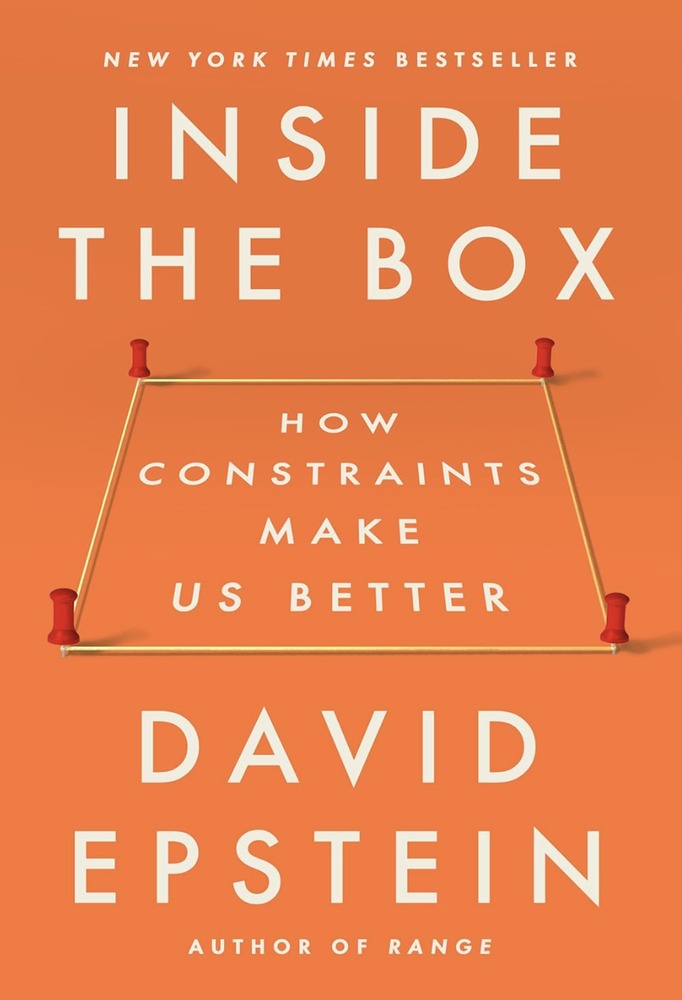
David Epstein’s Inside the Box: How Constraints Make Us Better argues against one of the most seductive assumptions of modern life: that more freedom, more choice, more resources, and fewer limits naturally lead to better outcomes. Epstein’s central claim is almost the opposite. Constraints, when properly understood and intelligently designed, can sharpen creativity, deepen focus, improve collaboration, and help people achieve more meaningful results. The book is presented as a deeply researched exploration of how individuals, organizations, institutions, and societies can benefit from narrowing their options rather than endlessly expanding them.
BUY THIS BOOK
The argument is counterintuitive because freedom has become one of the dominant virtues of contemporary culture. We tend to assume that the ideal condition for creativity is unlimited possibility. Give talented people enough time, money, information, technology, and autonomy, and they will produce their best work. Epstein challenges that belief. Too much freedom can become paralyzing. Too many choices can dilute attention. Too many resources can reduce ingenuity. Too few boundaries can leave people drifting in abstraction rather than solving the actual problem in front of them.
The title itself is a deliberate reversal of a familiar business cliché. We are often told to “think outside the box,” as if the box were always the enemy of imagination. Epstein asks us to reconsider the box. Sometimes the box is not a prison. Sometimes it is the structure that makes invention possible.
The Central Idea: Constraint as a Creative Force
At the heart of Inside the Box is the idea that constraints do not merely limit action. They shape action. A constraint forces a person or team to confront the real nature of a problem. It removes lazy options. It demands prioritization. It asks, “What can you do with what is actually available?”
This is an important distinction. Epstein is not romanticizing scarcity for its own sake. He is not arguing that deprivation is noble or that every limitation is useful. Some constraints are destructive. Poverty, discrimination, poor health, political repression, and badly designed systems can crush potential rather than release it. The point is more precise: carefully framed constraints can produce better thinking because they force people to work with discipline.
When options are unlimited, the mind can wander. When options are narrowed, the mind begins to search more intensely. This is why a short deadline, a restricted format, a limited budget, a fixed rule, or an unexpected obstacle can sometimes produce a better result than total freedom. The constraint becomes a focusing mechanism. A Harvard Business Review analysis of 145 studies, Why Constraints Are Good for Innovation, reached the same conclusion: individuals, teams, and organizations all benefit from a healthy dose of constraints, up to the point where they become excessive.
Epstein’s deeper insight is that limits can create productive tension. They make problems more concrete. They transform vague aspiration into practical invention. “Make something better” is an inspiring but imprecise instruction. “Make something better with half the money, a smaller team, and one week to do it” is a very different challenge. The second version may be harder, but it is also more clarifying.
Why Infinite Choice Can Weaken Us
A major theme in the book is the burden of excessive choice. Modern culture often assumes that choice equals freedom and freedom equals happiness. But the relationship is not so simple. When people face too many options, they can become anxious, indecisive, dissatisfied, or less confident in the choices they make. The book’s public descriptions emphasize Epstein’s concern that seemingly infinite options about what to do, who to be, and how to spend time can become overwhelming rather than liberating.
This matters not only in consumer life, but in work, creativity, and leadership. Teams with too many priorities often execute none of them well. Individuals with too many possible identities may struggle to commit to any path deeply enough to develop mastery. Organizations with too many initiatives can mistake activity for strategy.
The hidden cost of unlimited choice is fragmentation. Attention gets divided. Standards become unclear. Effort spreads too thinly across too many surfaces. Epstein’s argument suggests that one of the great disciplines of modern life is not simply gaining more options, but learning how to reduce options wisely. The Association for Psychological Science revisits the evidence for this in The Paradox of Choice, 10 Years Later, which looks at how an abundance of options raises expectations and regret rather than satisfaction.
This is a profound leadership lesson. The job of a leader is not to keep every possibility alive forever. It is to choose the few constraints that make the work sharper. A strategy is, in many ways, a set of chosen limits. We will serve these customers, not all customers. We will compete on these dimensions, not every dimension. We will focus on this problem, not every adjacent opportunity.
Without that discipline, organizations do not become free. They become scattered.
Constraints and Creativity
One of Epstein’s core contributions is to show that creativity often thrives within boundaries. Artists, writers, scientists, chefs, musicians, entrepreneurs, and inventors have frequently produced extraordinary work not in spite of constraints, but because of them.
A blank page can be intimidating precisely because it offers too much freedom. A sonnet, a haiku, a recipe built from limited ingredients, a scientific problem with strict experimental conditions, or a design challenge with tight parameters gives the creator something to push against. The constraint creates form. Form invites variation. Variation produces originality.
This is why the phrase “thinking inside the box” is more provocative than it first appears. The box gives the mind a defined field. Within that field, the creator is forced to notice relationships, combinations, substitutions, and possibilities that might otherwise remain invisible.
Epstein’s publisher describes the book as exploring the science and practice of constraints, including how guardrails can stimulate focus and innovation, whether through limited resources or self imposed boundaries. That idea is especially useful because it suggests that constraints are not always imposed from the outside. They can be chosen. A writer may choose a form. A company may choose a narrow market. A leader may choose a small number of operating priorities. A person may choose fewer commitments in order to do more meaningful work.
The discipline is not merely accepting limits. It is learning to design the right ones. Harvard Business Review’s Innovation Starts with Defining the Right Constraints makes the practical case for this, arguing that leaders who specify the boundaries of a problem get more useful ideas than those who ask for anything.
Scarcity, Ingenuity, and the Danger of Romanticizing Hardship
A subtle but important point in any discussion of constraints is the difference between productive limitation and harmful deprivation. Epstein’s argument is strongest when constraints are understood as structures that focus thinking, not as suffering that automatically ennobles people.
Limited resources can create ingenuity. A startup with little capital may be forced to talk directly to customers, build leanly, and avoid bureaucratic waste. A chef with few ingredients may create something more inventive than a chef with endless access. A team with a tight deadline may stop polishing secondary features and solve the central problem.
But constraints can also overwhelm. Too little time can damage quality. Too little money can prevent experimentation. Too little support can exhaust people. Too many imposed restrictions can turn creativity into mere survival.
The practical lesson is that constraints must be calibrated. They should focus attention without crushing capacity. They should create productive pressure without making failure inevitable. The best constraints are not arbitrary obstacles. They are intelligent boundaries that force meaningful tradeoffs.
For leaders, this is a critical distinction. It is easy to use the language of constraints to justify under resourcing teams. “Do more with less” can be a creative challenge, but it can also become an excuse for poor planning or exploitation. Epstein’s broader idea should not be reduced to a slogan about austerity. The point is not that less is always better. The point is that the right limitation can make people think better.
Constraints as a Path to Focus
The book also speaks to a modern crisis of attention. We live in a world of interruptions, notifications, open tabs, competing obligations, and infinite information. In such an environment, focus is no longer merely a personal virtue. It is a strategic advantage.
Constraints protect focus by removing distractions before willpower has to fight them. A person who blocks off uninterrupted time is creating a constraint. A team that limits active projects is creating a constraint. A company that defines a clear customer segment is creating a constraint. A writer who refuses to check email during creative work is creating a constraint.
The constraint does not reduce capability. It protects it.
This connects Epstein’s book to a broader conversation about productivity and creative performance. Many people believe they need more motivation, when what they really need is a better box. A poorly designed environment asks the individual to make endless good decisions. A well designed constraint reduces the number of decisions required.
That is why constraints can be humane. They spare us from the exhaustion of constant choice. They help us conserve cognitive energy for the work that matters most.
Collaboration Improves When the Box Is Clear
Constraints also affect teams. When a group has no clear limits, collaboration can become messy and political. People debate endlessly. Priorities shift. Roles blur. Success becomes difficult to define. The lack of constraint creates ambiguity, and ambiguity often creates conflict.
A clear constraint gives the team something shared to solve. It creates alignment. Everyone knows the boundaries, the tradeoffs, and the problem. This can improve collaboration because the team is no longer debating every possible world. It is working inside a defined challenge.
This is one reason deadlines, budgets, formats, and operating principles can be powerful. They create a shared reality. They force decisions. They reveal what matters. They also make creativity more democratic, because when the problem is clearly framed, more people can contribute intelligently.
In this sense, constraints can reduce the dominance of personality. Instead of the loudest person defining the work, the constraint defines the work. The team can then argue about solutions rather than wandering through preferences.
The Better Box
A useful way to understand Epstein’s argument is that the goal is not to escape every box, but to choose or build a better box. Some boxes are inherited. They come from industry norms, family expectations, institutional rules, old habits, or outdated assumptions. These boxes may need to be challenged or broken.
But other boxes are chosen deliberately. A creative brief is a box. A budget is a box. A moral principle is a box. A strategic focus is a box. A daily routine is a box. These can make us better because they reduce the universe of possibility to a field where real work can happen.
The challenge is discernment. Which constraints are helping us think? Which constraints are protecting laziness? Which constraints are outdated? Which constraints are missing? Which constraints would make our work more original, not less?
This is where Inside the Box becomes more than a creativity book. It becomes a book about judgment. Freedom and constraint are not enemies. They are partners. Freedom without constraint becomes chaos. Constraint without freedom becomes suffocation. The art is in finding the relationship between the two.
Conclusion: Limits Can Liberate
The enduring value of Inside the Box lies in its challenge to one of the great myths of contemporary achievement. We do not always need more choices, more resources, more time, more space, or more freedom. Sometimes we need a clearer problem, a sharper boundary, a better deadline, a narrower focus, or a more intelligent limitation.
Epstein’s book suggests that constraints can make us better because they force seriousness. They expose what matters. They turn vague desire into practical invention. They help individuals focus, teams collaborate, and organizations make strategy real.
The lesson is not to worship limits. The lesson is to stop assuming they are always the enemy.
A good constraint does not shrink human potential. It concentrates it. It asks us to become more resourceful, more disciplined, more imaginative, and more honest about the work in front of us. In a world drowning in options, the right box may be one of the few things that helps us think clearly enough to create something worthwhile.
Key Takeaways
1. Total Freedom Can Be Overrated
Unlimited choice can create confusion, anxiety, and shallow commitment. The right constraint narrows the field and makes action more possible.
2. Creativity Often Needs Boundaries
Rules, limits, forms, budgets, deadlines, and formats can create the pressure that forces original thinking.
3. Constraints Must Be Designed Carefully
Some constraints focus and strengthen people. Others exhaust or diminish them. The difference lies in whether the constraint creates useful pressure or destructive scarcity.
4. Strategy Is a Chosen Constraint
Organizations become stronger when they deliberately decide what they will not do, not just what they will pursue.
5. The Right Box Can Set You Free
A well designed constraint does not imprison creativity. It gives creativity enough shape to become real.