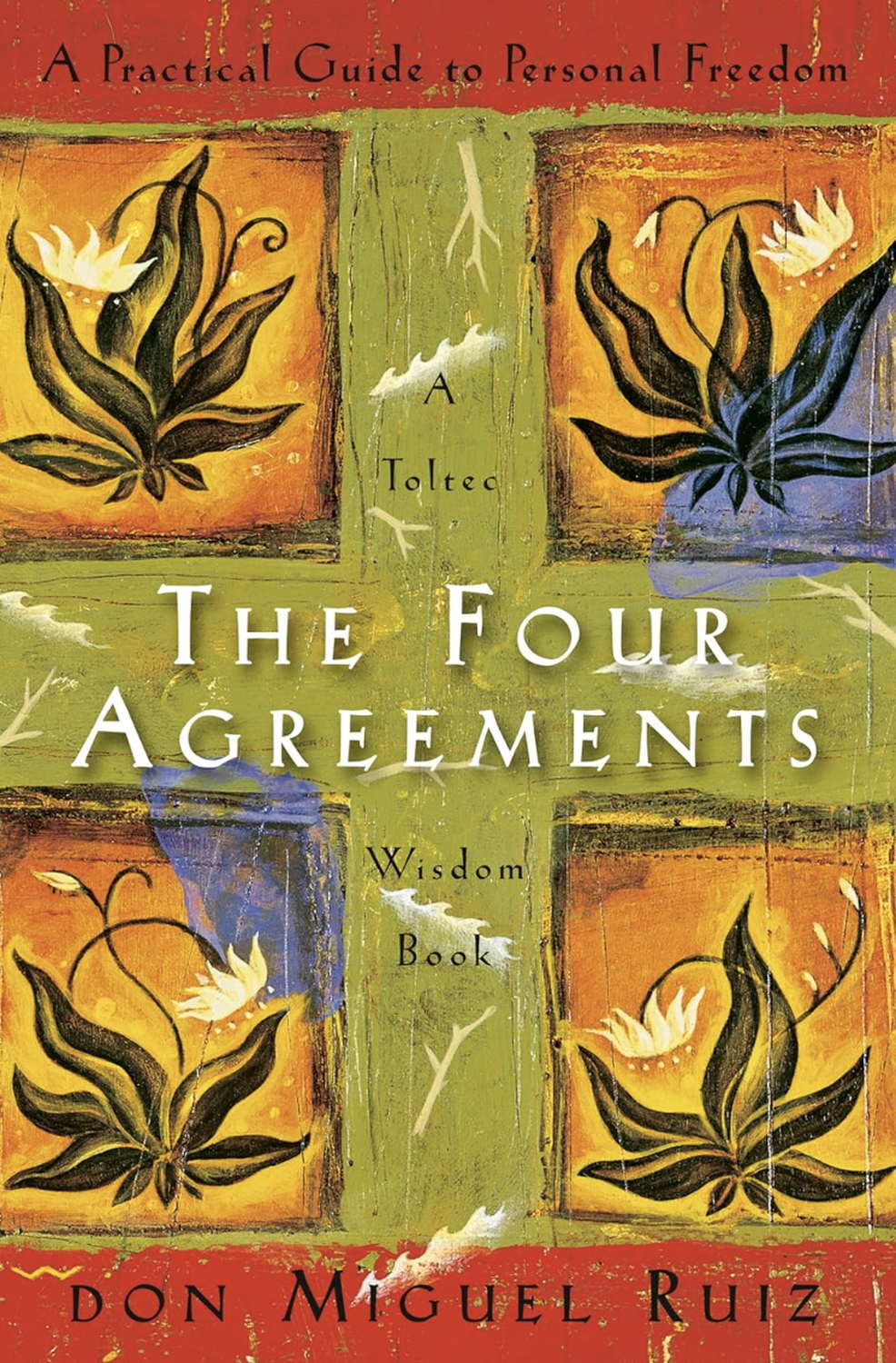
By Don Miguel Ruiz with Janet Mills
The Four Agreements by Don Miguel Ruiz, with Janet Mills, is a short but influential book about personal freedom, self-mastery, and the unseen belief systems that shape human suffering. Drawing from Toltec wisdom, Ruiz argues that much of what limits us is not reality itself, but the agreements we have unconsciously made with ourselves, with others, and with the world. These agreements determine what we believe, how we interpret events, how we judge ourselves, and how we respond to life. The central premise of the book is simple but profound: if the agreements we currently live by create fear, guilt, shame, and emotional suffering, then we can choose new agreements that create freedom, love, and peace.
BUY THIS BOOK
Ruiz begins by describing the process through which human beings are “domesticated.” From childhood, we are taught how to think, behave, speak, believe, and belong. Parents, teachers, religious authorities, communities, and cultures transmit rules about what is good and bad, acceptable and unacceptable, worthy and unworthy. As children, we do not have the power to evaluate these ideas critically. We absorb them. We agree with them. Over time, these external rules become internal voices. We begin to police ourselves according to standards we did not consciously choose.
This process creates what Ruiz calls “the dream of the planet,” the collective dream of society. Each individual also develops a personal dream, a worldview built from beliefs, assumptions, fears, memories, judgments, and interpretations. The problem is that most people mistake this dream for reality. They live inside inherited stories, then suffer because those stories feel absolute. Ruiz suggests that human beings are not merely living life; they are living through a mental and emotional construction shaped by agreements.
One of the most powerful ideas in the book is the notion of the inner Judge and the Victim. The Judge condemns us for failing to meet the rules we have internalized. The Victim receives the punishment and says, “Poor me, I am not good enough.” This cycle repeats constantly. People punish themselves again and again for old mistakes, perceived inadequacies, and imagined failures. Ruiz argues that much human suffering comes from this internal court system, where we are both accused and condemned by our own beliefs.
Against this background, Ruiz introduces the four agreements as a practical path to personal freedom. They are not presented as abstract philosophy, but as daily disciplines. Each agreement challenges a fundamental source of suffering. Together, they offer a way to break free from fear-based conditioning and begin living with greater integrity, clarity, and love.
The First Agreement: Be Impeccable with Your Word
The first agreement, “Be impeccable with your word,” is the foundation of the entire book. Ruiz argues that the word is one of the most powerful tools human beings possess. Through language, we create meaning, shape identity, influence others, and construct our experience of reality. Words can heal or wound, liberate or imprison, clarify or distort. To be impeccable with your word means to use language with truth, integrity, and love.
Ruiz places special emphasis on the power of self-talk. The words we direct toward ourselves shape our sense of identity. If we repeatedly tell ourselves we are stupid, unattractive, incapable, unworthy, or broken, those words become agreements. They form an inner reality that influences behavior and expectation. In this sense, language is not merely descriptive. It is creative. It builds the psychological world we inhabit.
Being impeccable with the word also means refusing to use words to spread emotional poison. Gossip, criticism, blame, insult, and manipulation are examples of misuse of the word. Ruiz compares gossip to a kind of virus that spreads from mind to mind, distorting perception and creating mistrust. People often gossip to bond, to feel superior, or to relieve their own insecurity, but the result is usually more fear and separation.
This agreement is not simply about being polite. It is about recognizing that language carries moral and spiritual weight. To be impeccable is to speak from alignment rather than fear. It means saying what is true without using truth as a weapon. It means avoiding self-betrayal, refusing to make promises carelessly, and using words to create clarity rather than confusion.
The deeper implication of the first agreement is that freedom begins with responsibility for one’s own language. If words create agreements, then changing one’s words can begin to change one’s life. The person who becomes more conscious of speech becomes less enslaved by old beliefs and less likely to enslave others through careless or harmful language.
The Second Agreement: Don’t Take Anything Personally
The second agreement, “Don’t take anything personally,” is one of the book’s most memorable teachings. Ruiz argues that what other people say and do is primarily a reflection of their own dream, not of us. Each person lives inside their own beliefs, wounds, fears, projections, assumptions, and interpretations. When someone praises us, criticizes us, rejects us, or attacks us, they are revealing their own inner world as much as, and often more than, they are revealing anything about us.
This agreement is difficult because human beings are naturally inclined to interpret the behavior of others as personal. If someone is rude, we assume it is about us. If someone disapproves, we feel diminished. If someone ignores us, we may conclude we are unimportant. Ruiz suggests that this habit gives enormous power to other people’s opinions. We become emotionally dependent on external reactions, constantly pushed and pulled by praise, criticism, approval, and rejection.
Not taking things personally does not mean becoming indifferent, cold, or emotionally numb. It means recognizing that we are not the center of everyone else’s behavior. Other people’s anger may come from their fear. Their judgment may come from their conditioning. Their rejection may come from their preferences, limitations, or unresolved wounds. Even their praise may be filtered through their own needs and perceptions. When we understand this, we become less reactive.
Ruiz emphasizes that even our own opinions about ourselves should not always be taken personally. The mind can produce harsh judgments, distorted interpretations, and old emotional patterns. We may think terrible things about ourselves, but those thoughts often come from prior conditioning rather than truth. In this sense, the second agreement also invites us to stop identifying with every thought that passes through the mind.
The freedom of this agreement lies in emotional independence. When we stop taking things personally, we are less easily offended, manipulated, or controlled. We can listen without collapsing. We can receive feedback without turning it into identity destruction. We can experience rejection without making it a verdict on our worth. We can move through the world with more steadiness because we no longer outsource our peace to other people’s opinions.
The Third Agreement: Don’t Make Assumptions
The third agreement, “Don’t make assumptions,” addresses the human tendency to create stories in the absence of information. Ruiz argues that people often suffer not because of what is actually happening, but because of what they assume is happening. We assume we know what others think. We assume we understand their motives. We assume people should know what we want. We assume our interpretations are facts. These assumptions then produce misunderstanding, conflict, resentment, and unnecessary pain.
Assumptions are seductive because they give us a sense of certainty. The mind dislikes ambiguity, so it fills gaps quickly. If someone does not return a call, we create a story. If a colleague seems distant, we create a story. If a partner is quiet, we create a story. The story may be completely wrong, but once we believe it, our emotions respond as if it were true. We may become angry, defensive, hurt, or withdrawn based on an imagined reality.
Ruiz highlights how destructive assumptions can be in relationships. Many people assume their partners should intuitively know what they need or feel. When this does not happen, they become disappointed or resentful. Instead of asking clear questions or making direct requests, they expect others to read their minds. This creates unnecessary conflict because people are punished for failing to meet expectations they may not even understand.
The antidote to assumptions is communication. Ruiz encourages readers to ask questions, seek clarity, and express what they truly want. This sounds simple, but it requires courage. Asking questions exposes uncertainty. Making requests risks rejection. Clarifying meaning requires humility. Many people prefer the false security of assumptions because direct communication feels vulnerable.
This agreement is deeply practical. It asks us to stop treating our interpretations as reality. It asks us to slow down before reacting. It asks us to become curious rather than certain. In leadership, relationships, and personal development, this agreement has enormous power. Many conflicts could be avoided if people replaced assumption with inquiry. Many wounds could be prevented if people asked, “What did you mean?” or “Can you help me understand?” before building an emotional case against someone.
At its core, the third agreement is about intellectual humility. It reminds us that the mind is not always a reliable narrator. We do not always know what we think we know. Freedom requires the discipline to question our own stories before we become imprisoned by them.
The Fourth Agreement: Always Do Your Best
The fourth agreement, “Always do your best,” brings the first three agreements into daily practice. Ruiz explains that our best will change from moment to moment depending on energy, health, circumstances, emotional state, and experience. Doing your best does not mean perfection. It does not mean constant maximum output. It means giving the best you are honestly capable of in the present moment.
This agreement is important because it protects against both self-judgment and laziness. If we do less than our best, we may feel guilt, regret, or frustration. If we try to do more than our best, we may exhaust ourselves and create unnecessary suffering. The goal is not heroic overexertion. The goal is sincere effort aligned with reality.
Ruiz argues that when we do our best, we reduce the power of the inner Judge. Kristin Neff makes a related case in her work on the myths of self-compassion, arguing that self-kindness is a more reliable motivator than self-punishment, not a softer substitute for it. Even if the outcome is imperfect, we can know that we acted with integrity. This creates a sense of peace. We may still make mistakes, but mistakes become opportunities for learning rather than reasons for self-abuse. Doing our best allows us to act without becoming attached to perfection.
The fourth agreement also emphasizes action. Transformation does not happen merely by understanding the first three agreements intellectually. It happens through practice. We will fail. We will misuse our words. We will take things personally. We will make assumptions. But if we continue doing our best, the agreements gradually become stronger. Old agreements lose power through repetition of new behavior.
This teaching is compassionate because it acknowledges human imperfection. Ruiz is not asking readers to become flawless. He is asking them to become conscious and committed. Personal freedom is not achieved in a single insight. It is built through repeated effort, forgiveness, and recommitment.
Breaking Old Agreements
A major theme of the book is that personal freedom requires breaking old agreements that were formed through fear. These agreements may include beliefs such as “I am not enough,” “I must please everyone,” “I cannot trust people,” “I must be perfect,” or “I am responsible for other people’s emotions.” Such beliefs often feel true because they have been rehearsed for years. But Ruiz insists that they are agreements, not permanent realities.
Breaking old agreements requires awareness, discipline, and courage. First, we must become aware of the beliefs that govern us. Awareness of that kind is trainable rather than innate, and the American Psychological Association notes that mindfulness practice measurably changes how people relate to their own thoughts. Then we must challenge them and replace them with agreements rooted in love, truth, and freedom. This process is not easy because old agreements are reinforced by habit and emotional familiarity. Even suffering can feel familiar enough to seem safe.
Ruiz describes this transformation almost as a spiritual battle for attention and belief. The mind has been conditioned to live in fear, judgment, and illusion. Freedom comes from reclaiming the power to choose what we believe and how we act. The four agreements are tools for that reclamation.
Personal Freedom and the New Dream
The ultimate promise of The Four Agreements is personal freedom. For Ruiz, freedom does not primarily mean external independence. It means freedom from self-limiting beliefs, emotional reactivity, needless suffering, and the tyranny of other people’s opinions. It means living with greater awareness, love, integrity, and joy.
Ruiz suggests that when we practice the four agreements, we begin to create a new dream. Instead of living in a dream of fear, judgment, and punishment, we can live in a dream of respect, truth, and love. This does not mean life becomes free of pain or difficulty. It means we no longer multiply suffering through self-judgment, assumption, personalization, and careless speech.
The book’s power lies in its simplicity. None of the four agreements is complicated, but each is difficult to practice consistently. Their difficulty reveals how deeply conditioned most people are. To be impeccable with your word requires awareness. To not take things personally requires emotional maturity. To avoid assumptions requires humility and communication. To always do your best requires discipline and self-compassion.
Conclusion
The Four Agreements is ultimately a book about waking up from inherited patterns of fear. Don Miguel Ruiz argues that human beings suffer because they mistake old agreements for truth. We believe the voices of judgment, shame, comparison, and fear, then build lives around them. The four agreements offer a way out. They do not promise an easy life, but they offer a freer one.
To be impeccable with your word is to recognize the creative power of language. To not take anything personally is to stop letting other people’s dreams control your emotional life. To not make assumptions is to replace fantasy with communication and curiosity. To always do your best is to live with sincere effort rather than perfectionism or regret.
The deeper message of the book is that personal freedom is not something granted by the world. It is cultivated through consciousness. We become free by questioning what we have agreed to believe. We become free by changing how we speak, interpret, communicate, and act. The four agreements are simple enough to remember, but profound enough to reshape a life if practiced with seriousness. In that sense, the book is less a collection of ideas than an invitation to live with greater truth, love, and responsibility.