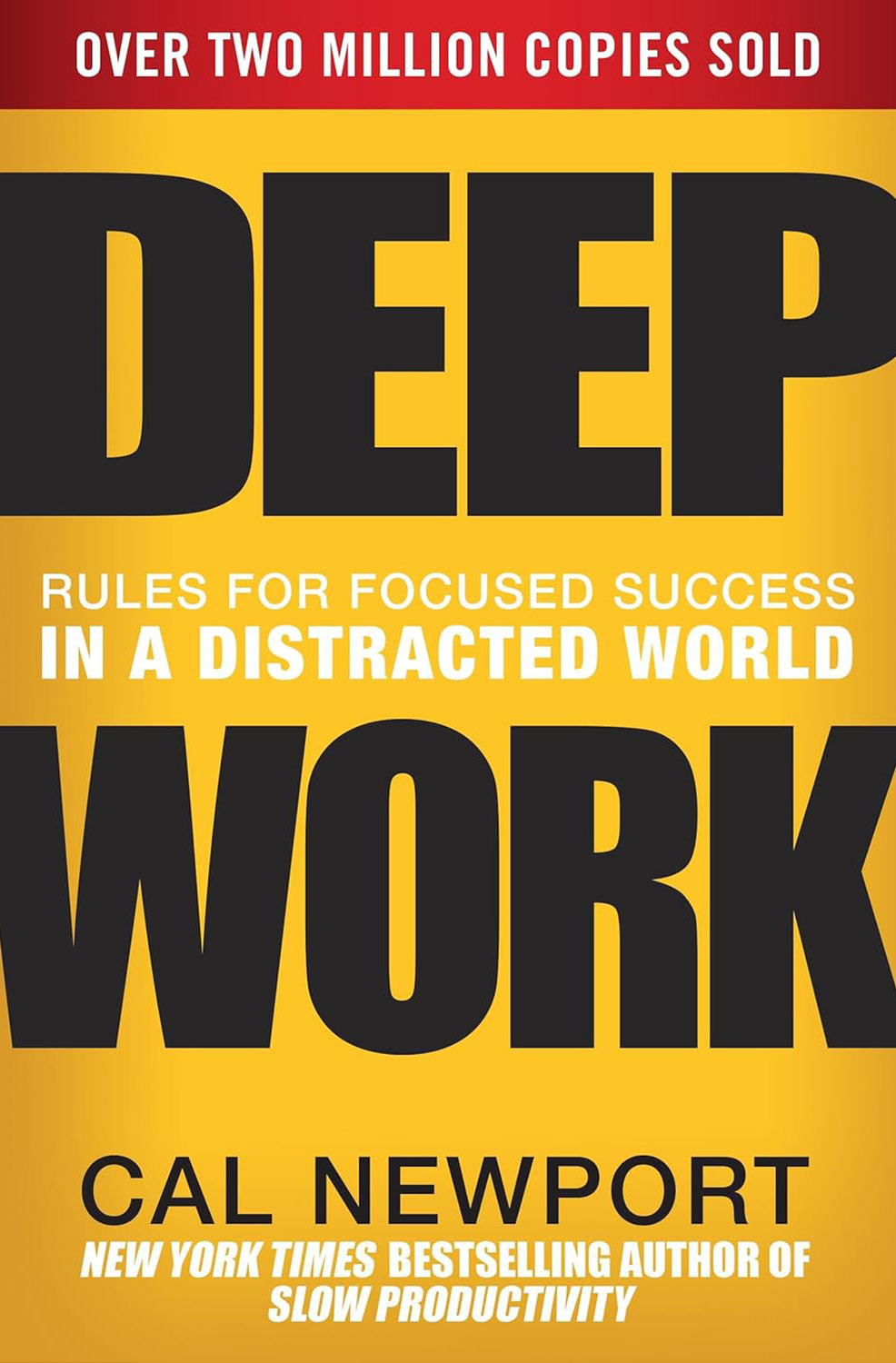
By Cal Newport
At its core, Deep Work is not just a productivity book. It is a diagnosis of a modern crisis, one that most people feel but struggle to articulate. We live in a world saturated with distraction. Notifications, emails, social media, open offices, and constant communication have created an environment where sustained focus has become rare.
Cal Newport’s central argument is both simple and provocative. The ability to perform deep work, defined as cognitively demanding tasks performed in a state of distraction-free concentration, is becoming increasingly valuable at the exact moment it is becoming increasingly rare.
BUY THIS BOOK
This imbalance creates an opportunity. Those who can cultivate deep work will produce higher-quality output, learn faster, and ultimately outperform their peers. Those who cannot will struggle to keep up, no matter how busy they appear.
The book is structured in two parts. The first builds the case for why deep work matters. The second provides a set of rules for cultivating it.
Part No. One — Why Deep Work Matters
Deep Work Is Valuable
Newport begins by arguing that the modern economy rewards individuals who can do two things well. First, quickly master hard things. Second, produce at an elite level in terms of both quality and speed.
Both of these capabilities require deep work.
In a knowledge economy, value is no longer created by routine tasks. It is created by solving complex problems, generating new ideas, and producing work that cannot easily be replicated. Deep work enables this by pushing cognitive abilities to their limits.
This is why professions like software development, writing, research, and high-level strategy depend heavily on focused concentration. Without it, output becomes shallow, incremental, and easily replaceable.
Newport contrasts this with what he calls shallow work. These are tasks that are logistical, easy to replicate, and often performed while distracted. Examples include responding to emails, attending low-value meetings, or managing administrative tasks.
While shallow work feels productive, it rarely creates meaningful value.
Deep Work Is Rare
Despite its importance, deep work is becoming increasingly uncommon.
Modern work environments are optimized for connectivity, not concentration. Open offices, constant messaging, and an expectation of immediate responsiveness fragment attention. Technology amplifies this effect, creating a constant stream of interruptions.
Newport argues that this shift is not accidental. It is driven by what he calls the “busyness as productivity” mindset. In many organizations, visible activity is mistaken for meaningful output. Responding quickly to emails, attending meetings, and being constantly available create the appearance of productivity, even when they contribute little to actual value creation.
This creates a cultural trap. Individuals feel pressure to remain connected, even when it undermines their ability to do deep work.
The result is a workforce that is perpetually busy but increasingly shallow.
Deep Work Is Meaningful
Beyond its economic value, Newport makes a deeper claim. Deep work is intrinsically meaningful.
When individuals engage in focused, challenging tasks, they experience a sense of satisfaction and fulfillment. This aligns with psychological research on “flow,” a state where individuals are fully immersed in an activity that stretches their abilities.
Deep work creates this state because it requires full engagement. It demands attention, effort, and skill. In doing so, it provides a sense of progress and mastery.
By contrast, shallow work often feels empty. It fragments attention, provides little sense of accomplishment, and leaves individuals feeling drained rather than fulfilled.
Newport suggests that a meaningful professional life is built not on constant activity, but on the ability to focus deeply on what matters.
Part No. Two — Rules for Cultivating Deep Work
The second half of the book shifts from theory to practice. Newport outlines four key rules for developing the ability to work deeply.
Rule No. 1 — Work Deeply
Deep work does not happen by accident. It requires deliberate structure.
Newport emphasizes the importance of rituals and routines. Rather than relying on willpower, individuals should create environments and schedules that support focused work.
This includes:
- Setting specific times for deep work
- Defining clear goals for each session
- Minimizing distractions in the work environment
- Establishing boundaries around availability
One of Newport’s key insights is that the brain resists deep work because it is cognitively demanding. Without structure, individuals default to easier, more immediately rewarding tasks.
By creating rituals, deep work becomes a habit rather than a constant struggle.
Newport also introduces different philosophies for integrating deep work into one’s schedule. These include:
- Monastic approach, eliminating or minimizing shallow obligations
- Bimodal approach, dividing time into deep work and everything else
- Rhythmic approach, establishing a daily routine of focused work
- Journalistic approach, fitting deep work into any available time
Each approach reflects a different level of commitment and flexibility.
Rule No. 2 — Embrace Boredom
One of the most counterintuitive ideas in the book is the importance of boredom.
Newport argues that the ability to focus is like a muscle. It must be trained. Constant exposure to distraction weakens this muscle, making it harder to sustain attention.
In a world of instant gratification, people have become conditioned to avoid boredom. The moment attention wavers, they reach for their phone, check email, or seek some form of stimulation.
This habit erodes the ability to concentrate.
To counter this, Newport suggests deliberately practicing boredom. This means allowing moments of inactivity without immediately filling them with distraction. It also means resisting the urge to switch tasks at the first sign of difficulty.
By doing so, individuals strengthen their capacity for sustained focus.
This is a critical insight. Deep work is not just about eliminating distractions. It is about retraining the brain to tolerate and even embrace the absence of stimulation.
Rule No. 3 — Quit Social Media
Newport takes a strong stance on social media, arguing that it is one of the most significant barriers to deep work.
His argument is not that social media is inherently bad. Rather, it is that most people use it without considering its impact on their attention.
Social platforms are designed to capture and hold attention. They provide constant novelty and intermittent rewards, making them highly addictive.
This creates a tradeoff. Time spent on social media is time not spent on deep work. More importantly, the habit of frequent checking fragments attention, making it harder to focus even when not using these platforms.
Newport suggests a more deliberate approach. Instead of adopting every new tool, individuals should evaluate whether it provides significant value relative to its cost.
If a tool does not meaningfully support one’s goals, it should be eliminated.
This principle extends beyond social media. It reflects a broader philosophy of intentional technology use.
Rule No. 4 — Drain the Shallows
The final rule focuses on minimizing shallow work.
Newport acknowledges that shallow tasks are unavoidable. Emails must be answered. Meetings must be attended. Administrative work must be done.
However, the goal is to contain these tasks so they do not consume the majority of one’s time.
This involves several strategies:
- Scheduling every minute of the day to ensure time is allocated intentionally
- Setting limits on shallow work to prevent it from expanding
- Reducing or eliminating unnecessary meetings
- Being more selective about commitments
One of Newport’s key insights is that shallow work tends to expand to fill available time. Without constraints, it can dominate the workday.
By actively managing shallow work, individuals create space for deep work.
The Larger Argument: Depth as a Competitive Advantage
Beyond its practical advice, Deep Work makes a broader argument about the future of work.
As technology continues to evolve, many routine tasks will become automated. What remains are tasks that require creativity, problem-solving, and high-level thinking.
These tasks cannot be performed effectively in a distracted state.
This creates a divide. On one side are individuals who operate in a state of constant distraction, producing shallow, easily replaceable work. On the other are those who cultivate deep work, producing high-value, difficult-to-replicate output.
The gap between these two groups will continue to widen.
Newport’s message is clear. Deep work is not just a productivity strategy. It is a competitive advantage, a case echoed in Knowledge at Wharton’s look at deep work as the secret to achieving peak productivity.
The Philosophical Undercurrent
While Deep Work is often categorized as a productivity book, it carries a deeper philosophical message.
It challenges the modern assumption that more connectivity, more communication, and more activity are inherently beneficial. It questions the idea that responsiveness equals effectiveness.
Instead, it proposes a different model. One where value is created through focus, depth, and deliberate effort.
This is a fundamentally different way of thinking about work. It prioritizes quality over quantity, depth over breadth, and intentionality over reactivity.
It also reframes success. Instead of measuring productivity by how busy one is, it measures it by the value of what is produced.
Critiques and Limitations
While Newport’s argument is compelling, it is not without limitations.
One challenge is that not all roles allow for extended periods of deep work. Many jobs require constant communication and responsiveness. For these individuals, implementing Newport’s strategies may be difficult.
Additionally, the emphasis on individual behavior may overlook systemic factors. Organizational culture, expectations, and structures often drive distraction. Without addressing these, individual efforts may have limited impact.
However, even within these constraints, the principles of deep work remain relevant. They highlight the importance of intentionality and the need to protect attention in an increasingly distracted world.
Conclusion: The Discipline of Focus
Deep Work ultimately argues that attention is one of the most valuable resources in the modern world. How it is used determines not only productivity, but also the quality of one’s work and life.
The ability to focus deeply is not innate. It is a skill that must be developed and protected. It requires discipline, structure, and a willingness to resist the pull of distraction.
In a world that rewards speed, visibility, and constant activity, this is a countercultural stance.
But it is also a powerful one.
Those who cultivate deep work do not just get more done. They do better work. They think more clearly. They create more value.
And perhaps most importantly, they reclaim control over their attention, which in many ways is the foundation of everything else.