By Jim Loehr
There are productivity books that promise better hacks.
And then there are books that quietly change the question altogether.
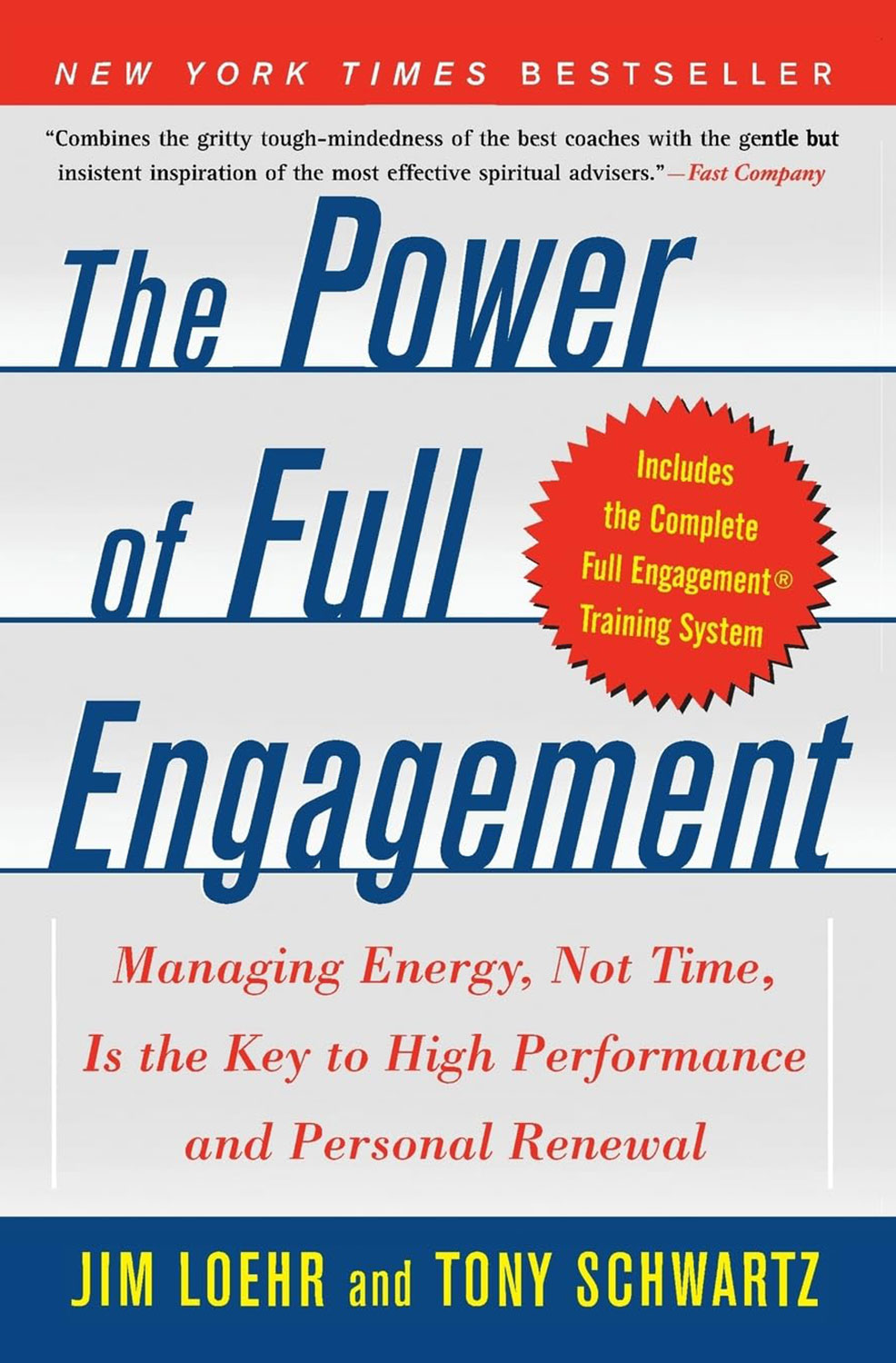
The Power of Full Engagement by Jim Loehr and Tony Schwartz does the latter.
Instead of asking, How do I manage my time better? this book asks a far more consequential question: How do I manage my energy?
That single shift reframes everything—work, leadership, performance, burnout, and even meaning. And once you see it, time management alone feels like trying to optimize a car while ignoring whether there’s any fuel in the tank.
The Central Thesis: Energy, Not Time, Is the Ultimate Currency
Time is fixed. Energy is not.
That’s the foundational premise of the book—and it immediately exposes why so many high performers feel exhausted despite being disciplined, organized, and productive.
You can schedule your calendar perfectly and still feel depleted. You can work fewer hours and still feel fried. You can hit every metric and still feel empty.
Because performance doesn’t depend on how many hours you put in.
It depends on the quality of energy you bring to those hours.
The authors argue that sustainable high performance requires rhythmic renewal across four dimensions of energy: physical, emotional, mental, and spiritual.
Ignore any one of them, and the system eventually collapses.
Why the Time-Management Model Fails
Traditional productivity models assume humans are machines.
Work more efficiently. Remove friction. Stack habits. Maximize utilization.
But humans aren’t machines. We’re biological systems that operate in cycles.
Loehr and Schwartz draw heavily from elite athletics, where no coach would ever expect continuous output without recovery. Muscles grow not during exertion, but during rest.
Yet in knowledge work, we attempt the impossible: sustained cognitive output without renewal.
The result is predictable—burnout, disengagement, and diminishing returns.
Full Engagement Defined
Full engagement is the ability to:
- Be physically energized
- Be emotionally connected
- Be mentally focused
- Be spiritually aligned
When all four are present, performance feels powerful and sustainable. When any are missing, effort becomes forced.
Importantly, the book does not romanticize balance as a static state. Instead, it emphasizes oscillation—the natural movement between stress and recovery.
Stress is not the enemy. Lack of recovery is.
Physical Energy: The Foundation Everyone Ignores
The authors are blunt: physical energy is the base layer. Neglect it, and everything else degrades.
Sleep, nutrition, hydration, movement—none of these are optional. They are performance enablers.
What’s striking is how many high performers try to solve physical exhaustion with mental tricks. More coffee. More willpower. More pressure.
That works briefly. Then it fails catastrophically.
The book reframes physical discipline not as self-control, but as self-respect. You can’t ask your body to perform at a high level indefinitely without replenishment.
Peak performers treat their bodies like assets, not obstacles.
Emotional Energy: The Most Overlooked Driver of Performance
Emotional energy determines how we show up.
Positive emotions—interest, enjoyment, challenge, appreciation—expand capacity. Negative emotions—fear, anger, frustration, anxiety—contract it.
This doesn’t mean avoiding negative emotions. It means learning to regulate them.
The authors emphasize that emotional intelligence is not about feeling good all the time. It’s about choosing emotions that serve performance rather than sabotage it.
One of the most practical insights in the book is that gratitude is a performance strategy.
When people regularly practice appreciation—toward others and themselves—emotional energy rises. Resilience improves. Perspective widens.
This isn’t sentimental. It’s physiological.
Mental Energy: Focus Is a Finite Resource
Mental energy is the ability to concentrate deeply and think clearly.
The book makes a compelling case that constant distraction—email, notifications, multitasking—is one of the biggest drains on performance.
Switching tasks feels productive. It isn’t.
Every context switch carries a cognitive cost. Over time, those costs accumulate as mental fatigue, shallow thinking, and reduced creativity.
The authors advocate for periods of deep, undistracted work—followed by deliberate recovery.
Again, oscillation is the theme.
Focus hard. Then disengage fully.
Anything else leads to cognitive burnout.
Spiritual Energy: The Most Misunderstood Dimension
Spiritual energy has nothing to do with religion.
It’s about meaning and purpose.
Why does this work matter? What values does it serve? Who does it benefit?
Spiritual energy provides the endurance that physical and emotional energy alone cannot.
People can push through exhaustion when their effort feels meaningful. They collapse when it doesn’t—even if conditions are otherwise favorable.
The authors argue that values act as a compass. When behavior aligns with values, energy increases. When it doesn’t, internal friction drains it.
This is why people burn out in “successful” careers that feel misaligned. The energy leak isn’t external—it’s internal.
Stress Is Necessary—But Only in Cycles
One of the book’s most important contributions is reframing stress.
Stress is not the enemy of performance. It’s a requirement.
The problem is chronic stress without recovery.
In athletics, training is intentionally stressful—but always paired with rest. In work, stress is constant and recovery is optional (and often stigmatized).
The authors call this the “sprinter’s paradox”—humans are built to sprint and recover, not jog endlessly.
High performance requires intensity and rest, not moderation alone.
Rituals Over Willpower
Perhaps the most practical concept in the book is the idea of rituals.
Rituals are behaviors performed consistently, automatically, and without requiring conscious motivation.
Willpower is unreliable. Rituals are not.
Instead of trying to make better choices every day, the authors suggest designing rituals that conserve energy by removing decision fatigue.
Examples include:
- Fixed sleep and wake times
- Scheduled breaks
- Transition rituals between work and home
- Morning and evening routines
The goal is not rigidity. It’s reliability.
Rituals protect energy when motivation fluctuates.
The Corporate Cost of Disengagement
Loehr and Schwartz make a compelling case that disengagement is not a motivation problem—it’s an energy problem.
Employees don’t disengage because they don’t care. They disengage because they are depleted.
Organizations that demand constant availability, punish rest, and reward overwork systematically drain energy—and then act surprised when performance drops.
The book argues that sustainable engagement requires cultural permission to recover.
Without it, burnout becomes a feature, not a bug.
Why More Effort Isn’t the Answer
One of the most liberating insights in the book is this: when performance drops, the answer is rarely more effort.
It’s better energy.
Trying harder with less energy accelerates decline. It creates a vicious cycle where exhaustion leads to mistakes, mistakes create stress, and stress drains more energy.
Breaking that cycle requires stepping back—not pushing forward.
This is deeply countercultural, especially in high-achievement environments. But it’s also non-negotiable if longevity matters.
The Myth of Work-Life Balance
The book rejects the idea of balance as a static state.
Balance implies equal distribution. Life doesn’t work that way.
Instead, the authors propose engagement and disengagement.
Be fully present at work—then fully present in recovery.
Half-working, half-resting drains energy faster than either extreme.
The real enemy is not work. It’s always-on.
Leadership Through Energy
One of the quieter insights in the book is that leaders don’t just manage tasks—they manage energy.
Their mood sets the tone. Their behavior signals permission. Their boundaries model norms.
A depleted leader creates a depleted organization, regardless of strategy or vision.
Conversely, leaders who manage their own energy effectively create cultures where renewal is normalized and performance is sustainable.
Energy is contagious—both positive and negative.
Values as Performance Anchors
The authors place significant emphasis on clarifying values—not as abstract ideals, but as behavioral commitments.
Values become real only when they guide choices under pressure.
When values are clear, decisions consume less energy. When they’re vague, every decision becomes draining.
This is why alignment matters so much. It reduces friction. It conserves energy. It increases coherence.
The Long-Term Cost of Ignoring Energy
The book is honest about the consequences of ignoring these principles.
Short-term success is possible on adrenaline and obligation. Long-term excellence is not.
Eventually, something breaks:
- Health
- Relationships
- Focus
- Meaning
By the time most people address energy, the cost is already high.
The Power of Full Engagement is, in many ways, a preventive book. It asks readers to redesign how they work before collapse forces the issue.
What This Book Is Really About
On the surface, this is a book about performance.
At a deeper level, it’s a book about how to live sustainably in a demanding world.
It challenges the assumption that success requires sacrifice of health, presence, and meaning. And it replaces that narrative with a more durable one: success requires intelligent renewal.
Why This Book Endures
Many productivity books age quickly. Tools change. Technology evolves.
This book endures because it’s built on biology and psychology—not trends.
Humans still need rest. Energy still fluctuates. Meaning still matters.
As long as those truths remain, The Power of Full Engagement will stay relevant.
The Final Takeaway
If there is one message to carry forward, it’s this: Manage your energy, not your time. Build rituals, not reliance on willpower. Honor recovery as seriously as effort.
Peak performance is not about doing more.
It’s about showing up fully—again and again—without burning out.
And that requires a different definition of discipline—one rooted not in force, but in renewal.