By Oliver Burkeman
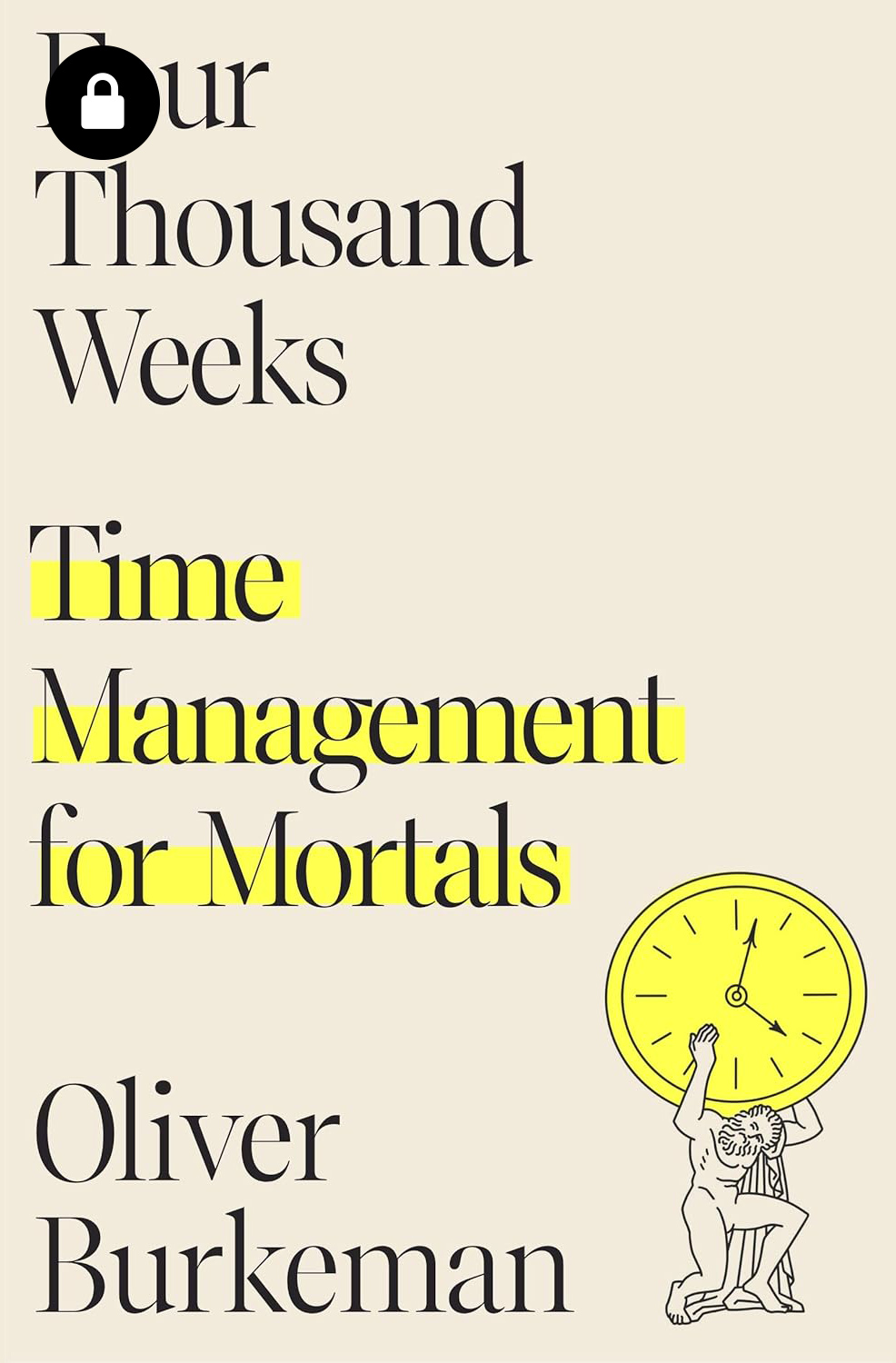
Imagine you get 4,000 weeks. That’s roughly what an 80-year life amounts to. Oliver Burkeman starts there—not to be morbid, but to be honest. And his central thesis is disarmingly simple: the usual approach to “time management” is broken because it treats time like a thing you can tame, optimize, and finally control. But your time isn’t a tool outside you—it’s your life itself. When you stop trying to dominate it and start working with your limits, everything gets saner, richer, and more meaningful.
Let’s walk through the book’s big ideas in plain language and then get into the practical moves he suggests.
The Problem Underneath All the Productivity Hacks
Most of us are running a quiet race to “get on top of everything.” Clear the inbox. Finish the projects. Tidy the house. Then, finally, we’ll relax. Burkeman calls this the efficiency trap: the more efficient you get, the more work and commitments rush in to fill the space. Reply to emails faster? You get more emails. Prove you can handle more? People give you more. And because the incoming stream is infinite and you’re finite, “getting on top of it all” is a mirage.
He argues that our productivity obsession is often a way of avoiding a deeper discomfort: the fact that we’re limited. We can’t do everything. We will let people down. We will miss out. We will die. That’s heavy—but it’s also liberating, because once you stop pretending you can do it all, you can finally do a few things that actually matter.
Time Isn’t a Resource “Out There”—It’s Where Your Life Happens
A subtle but powerful shift in the book is the move from treating time like a commodity (“I have 30 minutes to squeeze in a workout”) to seeing time as your lived experience (“for the next 30 minutes, this is my life”). When you see time this way, two things happen:
- Presence stops being optional. You can’t postpone living until later because “later” is just more moments like this one.
- Instrumentalization loses its grip. If you do everything only for its future payoff, you never actually live—you’re perpetually deferring life to a later date that never arrives.
Burkeman isn’t wagging a finger about mindfulness; he’s pointing out a pragmatic truth: your attention is your life. Where it goes, you go. If it’s endlessly scattered, your life will feel scattered. If it’s gathered on what matters, your life will feel meaningful, even if your calendar is full.
The Truth You Don’t Want (But Need) to Hear: You Can’t Do It All
Here’s a bracing passage idea from the book, paraphrased: in a world of unlimited options and infinite demands, your finite capacity means not choosing is still a choice—usually the worst one. Trying to keep every option open means you never go deep enough to get the joy that depth offers.
So the sane move is to choose what to neglect on purpose. That sounds harsh, but it’s realistic. You already neglect things, just not deliberately. Burkeman invites you to be explicit: what will you be mediocre at for a while? What will you drop? Where will you be late? It’s not about apathy. It’s about owning trade-offs so you can pour yourself into what matters most.
The Efficiency Trap Meets the Impatience Spiral
Another big culprit is impatience—the itchy, restless urge to speed everything up. You’ve felt it in a slow checkout line or while waiting for a file to load. We’ve been trained to treat waiting as intolerable. But the more we try to eliminate waiting, the more irritable and anxious we become, because life keeps presenting us with… reality. There will always be lines, delays, seasonality, and slow progress.
Burkeman suggests cultivating patience as a practice. Not as a moral virtue, but as a skill: the capacity to turn toward moments we can’t speed up and meet them without flipping out. Patience rearranges your experience of time. Suddenly the present isn’t an obstacle; it’s the site of living.
Distraction Isn’t Just a Tech Problem—It’s an Existential One
Yes, our devices are engineered to hijack attention. But Burkeman says we also reach for distraction because attention makes us feel our finitude. When you focus, you’re forced to confront that you’re choosing this and not everything else. That’s uncomfortable. So we ping-pong away: check another tab, hit “refresh,” peek at messages. The cost isn’t just lost minutes; it’s a life perpetually lived at arm’s length.
The fix is not “digital puritanism” as much as it’s acceptance plus design. Accept that you’ll feel discomfort when you focus, and design your environment so attention is the default, not the uphill battle (more on how in the tools later).
Cosmic Insignificance Therapy (It’s Friendlier Than It Sounds)
One of the most freeing chapters offers “cosmic insignificance therapy.” From the universe’s perspective, you and your projects are a blip. At first that sounds depressing. But it releases you from grandiosity. If you’re not responsible for justifying your existence to the cosmos, you’re free to commit to a few meaningful things because they matter to you and your people.
Counterintuitively, embracing smallness doesn’t make you apathetic—it makes you courageous. You can stop waiting for the perfect, heroic project and get on with the work in front of you, which is the only work anyone ever actually gets to do.
The Myth of the Perfectly Cleared Deck
A common move is delaying the important thing (the book draft, the quality time, the strategy work) “until I clear the decks.” Burkeman’s verdict: the decks never stay clear. Life refills them. If something matters, do it amid the mess. Block time for it. Defend that block like you would a doctor’s appointment. There will always be laundry, notifications, invoices, and “quick questions.” The day you’re waiting for—empty inbox, no fires, a bright-open calendar—doesn’t exist.
The Gift of Commitment and Constraint
Modern culture glorifies keeping options open. The book argues for a radical alternative: commitment as freedom. Constraints create a shape for your time, which is what allows meaning to accumulate. A marriage or a long project or a craft, pursued over years, generates a kind of depth that sampling forever never will.
This doesn’t mean lock yourself into terrible choices. It means stop trying to preserve infinite optionality. Use constraints—deadlines, rituals, boundaries—as a way to make progress and build a life that feels like yours.
Time Is Felt, Not Just Counted
We all know the experience of time stretching or shrinking. Vacations feel fast; a restless hour feels endless. Burkeman points out that novelty and attention shape our felt sense of time. Paradox: chasing novelty at scale (constant stimulation) deadens attention. But finding novelty in the ordinary—the exact taste of your coffee, the pattern of light on the floor, the subtle differences in today’s walk—reawakens time. Your days feel fuller not because you squeezed in more, but because you were there for them.
The Moral: Embrace Your Limits to Get Your Life Back
Everything funnels to this: you have finite weeks, finite energy, finite attention. When you work with those limits—choosing, committing, focusing, practicing patience—you stop waging war on reality and start cooperating with it. That cooperation produces a surprising side effect: calm progress. Not frantic, brittle, perfectionist progress. Just steady movement in the directions you’ve actually chosen.
Now, let’s land the plane with Burkeman’s practical playbook—simple, very doable shifts that stack up.
Practical Moves (You Can Start Today)
These aren’t hacks to “win the day.” They’re habits that honor your limits so you can build a meaningful week, and then another, and then a life.
1) Adopt a “fixed-volume” approach
Limit how many tasks/projects you actively juggle. It’s like putting “work-in-progress” caps on your personal Kanban. Fewer items in play means more items actually finish. Choose the three to five outcomes that define a good week. Don’t start a new “active” project until one finishes or is deliberately parked.
Why it helps: It counters the efficiency trap by eliminating overflow at the source. Finished beats “in progress” every time.
2) Serialize your big bets
Work on one significant initiative at a time (or one per domain, like one at work and one in personal life). Rotate as needed, but resist parallel pursuit of five “priorities.”
Why it helps: Depth compounds. Split attention kills momentum.
3) Decide in advance what to fail at
Let some areas coast for a season. Maybe you won’t be the world’s best email correspondent this quarter. Maybe workouts are maintenance-mode while you finish a product launch. Make the trade-offs explicit and time-bound.
Why it helps: You’re already failing at something. Owning it reduces guilt and increases clarity.
4) “Pay yourself first” with time
Schedule your most meaningful work first—first hour of the day, first block after lunch, or first three mornings of the week. Treat that time like a non-negotiable appointment.
Why it helps: If you leave your best work for after everything else, everything else wins.
5) Stop “clearing the decks”
Don’t wait to start important work until all the small stuff is done. Flip the sequence: do a chunk of meaningful work, then sweep some small tasks.
Why it helps: The decks will refill. This keeps the important from getting indefinitely postponed.
6) Keep a “done list”
Each day, jot what you finished. It’s not a brag sheet; it’s a reality check.
Why it helps: It builds momentum and corrects the illusion that “nothing’s happening.”
7) Make attention the default
Reduce friction for focus and add friction for distraction. Put the phone in another room for your deep-work block. Close messaging apps. Work in a clean window with just what you need. Set modest timers (e.g., 25–45 minutes), then take a short break.
Why it helps: Willpower is unreliable. Environment is steady.
8) Practice patience on purpose
Pick small drills: stand in a slow line without your phone, let a page load without clicking away, breathe for ten seconds before replying. You’re training your nervous system to tolerate reality.
Why it helps: Patience expands your usable time. Impatience turns everything into an emergency.
9) Seek novelty in the ordinary
On a familiar walk, notice five new details. Eat slowly enough to taste the meal. Look at someone’s face when they talk.
Why it helps: Attention stretches the felt texture of time. Your days feel roomier.
10) Use commitments as scaffolding
Build weekly rituals: a writing hour, a date night, a long run, a family meeting. Protect them with simple rules.
Why it helps: Repetition creates grooves. Over time, grooves become identity: “I’m the kind of person who…”
11) Let some emails die
Not everything requires a response. Use short replies when good enough. Batch the rest. Set expectations that you’re not instantly available.
Why it helps: Email is an anyone-can-claim-your-time machine. You need gates.
12) Beware of “when I finally have time…”
Translate that phrase into “I haven’t chosen this yet.” If it matters, choose a small next step now—fifteen minutes counts.
Why it helps: Reality lives in calendars, not in intentions.
How This Feels in Real Life
Put the ideas into a single week and it looks like this:
- Sunday night or Monday morning: Pick three meaningful outcomes for the week (one work, one personal, one relationship/health). Decide your “acceptable failures” for the week (e.g., slower email). Block the first 60–90 minutes on three days for your main outcome.
- Each day: Start by doing a slice of your main outcome. Keep a simple done list. Batch communications in one or two windows. Use a visible WIP cap: no more than five active tasks on your board.
- Environment: Phone out of reach during deep-work blocks. Browser with a single tab. Short, respectful timers (you’re not a machine; this is scaffolding, not self-punishment).
- Patience & presence drills: One slow line without your phone. One conversation with total attention. One mundane task done as if it mattered (because your life is happening during it).
- End of week: Review your done list. Celebrate actual progress, not mythical perfection. Reset WIP caps and choose the next three outcomes.
You’ll still have messy days, but the tone shifts from frantic to focused. You stop bargaining with the future and show up to the present with what you’ve got.
The Deeper Payoff: Meaning, Not Mastery
Burkeman isn’t anti-achievement. He’s against the fantasy of total mastery over time—because it keeps you skimming the surface of your own life. The alternative he offers is kinder and bolder: accept your limits and then choose, commit, and attend. Meaning arises not from controlling time but from investing yourself in specific people and projects over time.
This also softens the fear of missing out. Of course you’ll miss out. On almost everything. That’s how being human works. But the trade-in is depth: the chance to really know a craft, a place, a person, a community. You trade breadth of possibilities for depth of experience—and discover that depth is where fulfillment hides.
Common Objections (and the Book’s Gentle Responses)
- “If I accept my limits, won’t I become lazy?”
No—acceptance isn’t resignation. It’s the starting point for intelligent action. When you stop pretending you can do it all, you finally do the few things you choose. - “My job won’t let me slow down.”
You don’t have to slow everything. You can reclaim a few non-negotiable blocks, batch low-value work, and stop clearing decks. Even small structural changes compound. - “This sounds nice, but my inbox is still exploding.”
Right—and it always will. The move is to stop treating the inbox as a moral scorecard. You triage, you reply where it matters, and you allow some messages to age out. That’s not failure; that’s reality. - “I want to keep options open—what if I choose wrong?”
You will choose wrong sometimes. But trying to preserve infinite optionality ensures you never go deep enough to find out what’s right. Choosing is how you learn.
A Word on Mortality (Oddly Uplifting)
The title isn’t a gimmick. We really do get a few thousand weeks. Facing that fact might pinch at first, but it’s also the source of urgency, clarity, and tenderness. You start noticing that an ordinary Tuesday contains everything a life needs: work worth doing, people to love, a body to care for, a world to pay attention to. That awareness isn’t mystical; it’s practical. It changes where you put your next hour.
Bringing It Home
Four Thousand Weeks is not another calendar system. It’s a perspective shift with practical teeth:
- There’s too much to do and that will never change.
- The goal isn’t to do it all but to choose, on purpose, what to do (and not do).
- Attention is your life; design your days to gather it, not scatter it.
- Patience makes more time usable.
- Commitment and constraints don’t trap you; they free you to go deep.
- “Getting on top of everything” is a mirage; doing something that matters today is real.
If you read the book and adopt even two or three of its moves—fixed-volume work, serializing big projects, paying yourself first with time—you’ll likely feel a subtle but durable shift. Less dread. More traction. And, most importantly, a growing sense that you’re spending your actual weeks on the few things you’d be proud to have spent a life on.
That’s the point. Not mastering time, but inhabiting it. Not squeezing more in, but filling what’s here—with care, attention, and chosen commitments—so your four thousand weeks add up to a life that feels fully lived.