Listen to this Book Summary, 14 min, read by Simon
By Julia Dhar, Kristy R. Ellmer, and Philip Jameson
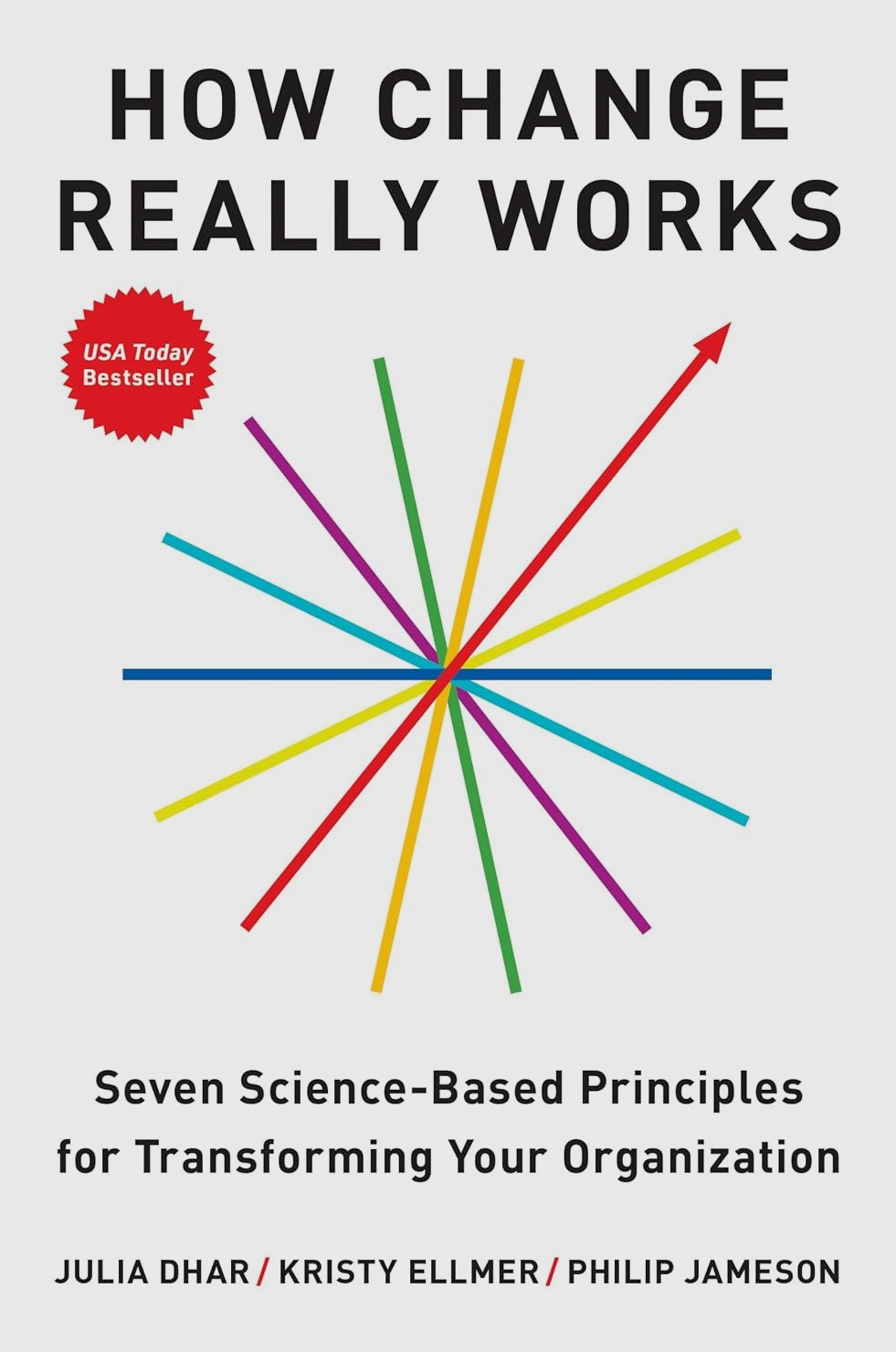
How Change Really Works by Julia Dhar, Kristy R. Ellmer, and Philip Jameson is a practical book about organizational transformation, but its real subject is human behavior. Published by Harvard Business Review Press in May 2026, the book argues that organizations are investing heavily in transformation while still seeing too many initiatives fail to deliver the outcomes promised. The authors, all Boston Consulting Group experts, draw on behavioral science, executive interviews, employee research, and their own experience leading large-scale change efforts.
BUY THIS BOOK
The core argument is refreshingly direct: change does not fail simply because people resist it. Change fails because leaders misunderstand how people actually change. That distinction matters. The usual leadership story says employees are stubborn, risk averse, cynical, or attached to the old way. Dhar, Ellmer, and Jameson suggest something more useful. Employees often resist not because they hate change, but because the conditions for change have not been properly created.
The book’s central phrase is “change distance,” the gap between how leaders experience change and how employees live it. Leaders often see change earlier, know more about the rationale, feel more agency, and have more time to adjust emotionally. Employees often hear about it later, with less context, less control, and more uncertainty about what it will mean for their daily work. BCG’s research for the book found that 68 percent of executives felt positive about a change before hearing the details, compared with 45 percent of employees; 72 percent of leaders thought a change was likely to succeed, compared with 49 percent of employees.
That gap is the book’s starting point. Transformation is not just strategy, structure, technology, and targets. It is a human adoption challenge.
The Seven Principles
The first half of the book presents seven principles for successful change. The chapter titles themselves capture much of the book’s philosophy: get true agreement, not false alignment; increase agency, not just involvement; expect take-up to be earned, not automatic; understand emotions through feedback, not instinct; use a process with rituals, not reactions; share stories and symbols, not just dollars; and create momentum throughout, not just at the start.
The first principle, get true agreement, not false alignment, is aimed squarely at executive teams. Many transformations begin with surface-level agreement. Everyone nods, the deck is approved, the initiative is named, and the organization is told that leadership is aligned. But false alignment is dangerous because disagreement does not disappear; it simply leaks into the organization through contradictory signals, private reservations, competing priorities, and inconsistent behavior. The authors argue that leaders must genuinely debate why change is needed, what exactly will change, and how the organization will pursue it before asking the rest of the company to follow.
The second principle, increase agency, not just involvement, challenges a common mistake. Leaders often believe they have involved employees because they held listening sessions, sent surveys, or invited input. But involvement without real influence can backfire. People are more likely to adopt new behaviors when they have actual agency, meaning they can shape decisions, influence outcomes, and see trusted peers represented in the process.
This is an important leadership lesson. Asking for input while already knowing the answer is not participation. It is theater. The authors’ point is not that every employee gets a vote on every decision. It is that people need to feel some genuine ability to affect the path, not merely receive the message.
The third principle, expect take-up to be earned, not automatic, is perhaps the most operationally useful. Leaders often assume that if a change is rational, communicated, and sponsored from the top, employees will adopt it. The book argues that adoption must be earned by identifying and removing barriers. Employees may lack capability, opportunity, or motivation. The work of leaders is to understand which barrier exists and then use organizational resources to lower it.
This shifts the blame away from “resistant employees” and toward leadership design. If people are not changing, the more useful question is not, “Why won’t they get on board?” It is, “What is preventing them from doing this well?”
The fourth principle, understand emotions through feedback, not instinct, pushes against executive guesswork. Leaders often assume they know how people feel because they are close to the business or because they hear from a few vocal employees. Dhar, Ellmer, and Jameson argue that successful organizations measure employee emotion, confidence, and capacity continuously, then act on what they learn.
This is one of the book’s most important contributions. Emotion is not soft data. In change, emotion is operating data. If people are anxious, confused, overloaded, cynical, or quietly unconvinced, the transformation will feel those emotions whether leaders measure them or not.
The fifth principle, use a process with rituals, not reactions, recognizes that transformation is cognitively exhausting. Change creates ambiguity, decisions, meetings, conflicts, tradeoffs, and emotional load. Structured rituals help reduce decision fatigue and protect cognitive capacity. The book emphasizes rituals for reflection, debate, celebration, coordination, and progress tracking.
The point is not bureaucracy for its own sake. The point is rhythm. Without ritual, change becomes reactive. Teams spend too much energy figuring out how to work on the change instead of actually doing the work.
The sixth principle, share stories and symbols, not just dollars, addresses meaning. Leaders often explain change through financial targets, market pressures, margin gaps, efficiency needs, or strategic imperatives. Those may be valid, but numbers alone rarely create emotional commitment. The authors argue that leaders need a compelling story that connects with employees’ goals and desires, then reinforces that story through visible symbols, actions, and events.
This does not mean manipulation. It means that human beings do not change simply because a spreadsheet says they should. They need a believable story about why the effort matters and what future they are being asked to help build.
The seventh principle, create momentum throughout, not just at the start, recognizes that change usually begins with energy and then enters the “messy middle.” Leaders often overinvest in the launch and underinvest in the long stretch when enthusiasm fades, obstacles accumulate, and old habits reassert themselves. The authors argue that leaders must anticipate stalls, refresh initiative pipelines, respond to emotional data, and keep energy moving beyond early wins.
The Five Phases of Transformation
The second half of the book turns the seven principles into a five-phase operating guide: deciding to change, planning for change, starting change, persisting with change, and ending change.
In deciding to change, senior leaders debate the rationale, scope, goals, and approach before committing. This phase is about creating true agreement at the top rather than rushing to announce a transformation that executives have not fully internalized.
In planning for change, the organization establishes the Transformation Office, defines workstreams and goals, appoints leaders, and prepares the operating machinery. This includes training, incentives, communication plans, rituals, and other practical scaffolding needed before launch.
In starting change, the organization launches with announcements and events, develops bottom-up plans, prioritizes initiatives, delivers early wins, and begins executing the transformation plan. The book treats this phase not as a communications event, but as the moment where ambition has to become detailed work.
In persisting with change, the organization works through the harder middle. This is where difficult initiatives have to be executed, emotions must be monitored, rituals must continue, and leaders must manage pressure from competing business realities. The book is especially useful here because many transformation guides underplay the endurance required after the launch moment has passed.
In ending change, leaders decide how to close the formal transformation, consolidate what has been learned, celebrate achievement, and determine what comes next. This is an important but often neglected idea. Transformations cannot remain permanent campaigns. At some point, the organization has to absorb the new way of working into normal operations or decide what next chapter the change has made possible.
The Deeper Message: Change Is Designed, Not Announced
The most valuable message of How Change Really Works is that transformation is not primarily a communication challenge. It is a design challenge. Leaders must design the conditions under which people can adopt new behaviors, build confidence, overcome barriers, and sustain energy.
This is why the book is so critical of leadership assumptions. Leaders often invest heavily in the “what” of change, the strategic goals, financial targets, operating model, technology, and structure, while underinvesting in the “how,” meaning the actual lived experience of adoption. BCG summarizes the failure pattern clearly: organizations struggle when leaders lack true agreement, ask for input without agency, assume adoption is automatic, rely on instinct instead of feedback, overload people with reactive processes, focus too narrowly on financial targets, and fail to sustain momentum.
That is the book’s practical gift. It turns change from a vague leadership aspiration into a series of testable questions. Do leaders truly agree? Do employees have agency? Have barriers been removed? Are emotions being measured? Are rituals reducing complexity? Does the story matter beyond the numbers? Is momentum being sustained after the launch?
Why the Book Matters Now
The book is especially timely because organizations are facing volatility from AI, regulation, geopolitical risk, market disruption, and shifting expectations of work. HBR’s description notes that leaders know they must adapt faster, yet transformations still often fail to deliver expected outcomes.
The implication is clear. In an era when change is constant, the ability to lead change well becomes a core organizational capability. Companies cannot afford transformation scar tissue, where failed efforts leave employees cynical, depleted, and less willing to believe the next initiative. BCG’s press release explicitly notes that failed change carries both financial costs and human costs, leaving organizations with “scar tissue” that reduces future adaptability.
Conclusion: Change Is Human Before It Is Structural
How Change Really Works is not a revolutionary book because it says change matters. Everyone already knows that. Its value is that it makes change more human, more operational, and more honest. It reminds leaders that people do not adopt new behaviors because executives have approved a deck. They change when the conditions around them make the new behavior understandable, credible, emotionally tolerable, socially supported, and practically possible.
The book’s real challenge to leaders is this: stop blaming people for resisting change that has not been designed for human adoption. Close the change distance. Earn take-up. Measure emotion. Build rituals. Tell a story that means something. Keep momentum alive after the launch energy fades.
In the end, the book is less about managing change and more about respecting how people actually move from old behavior to new behavior. Strategy may define the destination, but human behavior determines whether the organization gets there.