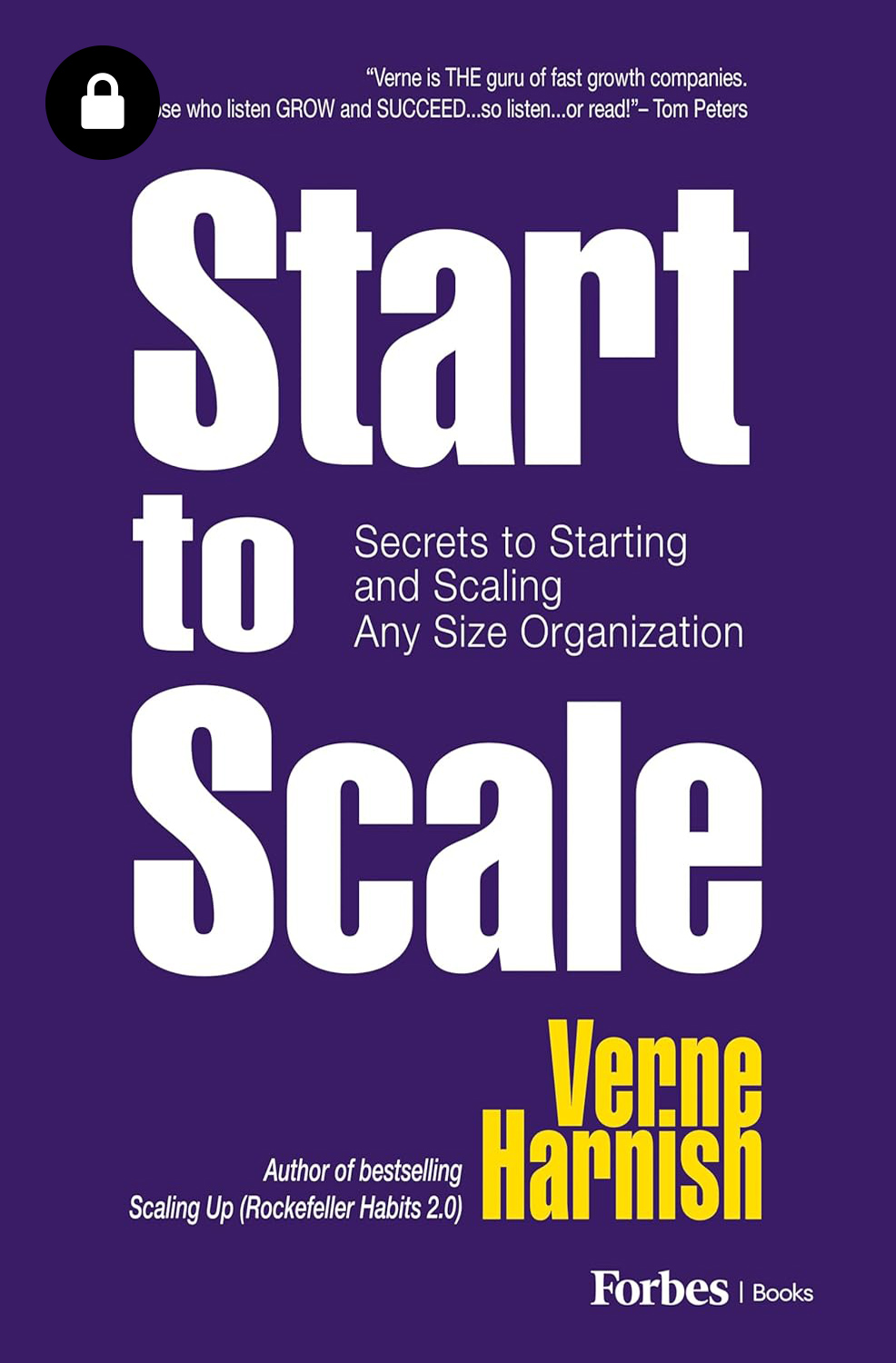
By Verne Harnish
Verne Harnish’s Scaling Up isn’t another motivational business book — it’s a field manual for companies that have found product-market fit and are now struggling to handle growth without breaking their people, systems, or sanity.
It’s about building a business that can run — and thrive — without being held together by heroics.
Harnish distills decades of experience from working with high-growth organizations worldwide into a practical operating system called The Rockefeller Habits 2.0 — a set of principles and tools that help leaders scale in four critical dimensions:
No. 1 — People. Getting the right team in the right roles.
No. 2 — Strategy. Creating a differentiating strategy that drives profit and purpose.
No. 3 — Execution. Building habits and processes that create focus and accountability.
No. 4 — Cash. Managing cash flow as oxygen for sustainable growth.
These four decisions — People, Strategy, Execution, and Cash — form the foundation of every scaling company. Fail in one, and you’ll stall. Master all four, and growth becomes inevitable.
The Scaling Challenge
Most companies fail to scale not because of market forces, but because complexity increases faster than capability.
As revenue grows, so does chaos: communication breaks down, priorities blur, bureaucracy creeps in, and culture weakens.
Harnish argues that the key to sustainable growth isn’t adding more people or resources — it’s simplifying, systematizing, and aligning.
Scaling is about installing rhythms, metrics, and decision frameworks that make performance predictable.
He puts it bluntly:
“Scaling up is not about managing more. It’s about managing less — but better.”
The Four Decisions Framework
Let’s break down Harnish’s system — what he calls “the four decisions every leader must get right.”
No. 1 — PEOPLE: Building a Team That Scales
“If you can’t get the right people in the right seats, nothing else matters.”
Harnish starts with the most obvious — and most overlooked — challenge in scaling: people.
You can’t scale chaos. You can only scale clarity and competence.
Key Insight. Growth amplifies whatever already exists in your culture — both good and bad. If you have the wrong people or poor communication, scaling just multiplies the dysfunction.
The A-Player Principle
Your company’s growth rate will never exceed the growth rate of the people running it.
That’s why Harnish pushes leaders to identify “A-players” — employees who are both highly competent and aligned with your core values.
He recommends using the Function Accountability Chart (FACe) — a simple tool to clarify who owns what. Every critical function (sales, marketing, ops, finance, HR, etc.) must have a clearly defined owner and metric.
Right People, Right Seats
Harnish borrows from Jim Collins’ Good to Great:
- Right People = Cultural fit (they live your core values).
- Right Seats = Role fit (they have the skills and drive).
The biggest mistake leaders make is keeping people who are one but not the other.
Communication Rhythms
As companies grow, communication is the first system to fail.
Harnish prescribes a meeting rhythm that builds alignment and trust:
- Daily Huddles. 10–15 minutes for rapid alignment.
- Weekly Meetings. Focus on metrics, progress, and obstacles.
- Monthly Reviews. Deep dives into strategy and learning.
- Quarterly/Annual Planning. Set priorities and refresh the vision.
These rhythms prevent drift and keep energy high.
The Leadership Flywheel
Great leaders coach more than they command.
They build culture, create clarity, and remove friction.
In short: hire slowly, fire kindly, and never stop developing your people.
No. 2 — Strategy: Create a Plan That Differentiates and Scales
“Revenue is vanity. Profit is sanity. Cash is king.”
Many companies grow revenue but not profit. That’s because they’re running faster, not running smarter.
Harnish argues that most businesses don’t actually have a strategy — they have goals, slogans, and vague differentiators that no one can execute against.
A real strategy answers two questions:
No. 1 — What makes you different?
No. 2 — Why will customers pay for that difference?
The One-Page Strategic Plan (OPSP)
At the heart of Harnish’s method is the One-Page Strategic Plan — a tool to distill vision, values, and goals into a single page everyone in the company can understand.
It covers:
- Core values & purpose (why you exist).
- BHAG (Big Hairy Audacious Goal — your long-term ambition).
- Brand promises (what you guarantee customers).
- Key thrusts/capabilities (how you’ll win).
- Critical numbers (how you’ll measure progress).
- Quarterly priorities (what you’ll focus on now).
The OPSP creates strategic clarity — the antidote to the “everyone doing everything” chaos that plagues scaling firms.
Core Ideologies
You scale culture, not charisma.
That’s why Harnish insists leaders define Core Values and Core Purpose before scaling.
Values tell people how to behave when no one’s watching.
Purpose tells them why their work matters.
Together, they attract the right people and repel the wrong ones — creating cultural gravity.
Differentiation: The 7 Strata of Strategy
Harnish introduces the “7 Strata” framework to help companies clarify their position in the market:
No. 1 — Words you own in the marketplace.
No. 2 — Brand promises that matter.
No. 3 — Key processes that set you apart.
No. 4 — X-factor (something competitors can’t copy).
No. 5 — Economic engine (how you make money).
No. 6 — Profit per X (a metric that drives scalability).
Example. Southwest Airlines’ “Low fares. Lots of fun.” isn’t just a tagline — it’s a system-level strategy supported by operations, pricing, and culture.
The Power of the BHAG
Borrowing from Jim Collins, Harnish urges every company to define a 10–25 year Big Hairy Audacious Goal.
Why? Because scaling requires purpose beyond the next quarter. A BHAG creates alignment and inspires persistence when growth gets messy.
No. 3 — Execution: Turn Strategy into Action
“Vision without execution is hallucination.”
Once people and strategy are in place, execution determines whether you scale profitably or just scale the chaos.
The execution discipline is about turning plans into habits and data into decisions.
The Three Habits of Great Execution
No. 1 — Everyone is aligned with the #1 priority each quarter.
Every team member should know, “If I accomplish nothing else, this one thing matters most.”
No. 2 — Every metric has an owner.
Accountability is clear, not collective.
No. 3 — Everyone is in a regular rhythm of communication.
Daily, weekly, monthly, quarterly — always with clear outcomes.
Meeting Rhythms (The Backbone of Execution)
Harnish’s famous “Meeting Rhythm” model ensures speed without chaos:
- Daily Huddle (10–15 min). What’s up? Where are you stuck? What’s the metric status?
- Weekly Meeting (60–90 min). Tactical — review priorities, customer feedback, KPIs.
- Monthly (Half-Day). Strategic — look at longer-term trends.
- Quarterly/Annual Planning (1–2 Days). Refresh the One-Page Plan, realign on purpose and priorities.
The point. Communication scales intentionally, not reactively.
KPIs and the Critical Number
Harnish warns against “dashboard overload.”
Instead, every quarter should have one Critical Number that acts as the leading indicator of health or progress.
This focus drives alignment — and prevents the “metric soup” that causes paralysis.
Process Discipline
Most companies operate on “tribal knowledge” — processes that live in people’s heads.
Scaling requires documented, repeatable systems — playbooks, checklists, SOPs.
As Harnish says:
“Routine sets you free.”
Discipline doesn’t kill creativity; it liberates it from chaos.
Accountability and Feedback
Weekly scorecards, visual dashboards, and transparent reporting build self-correcting teams.
When everyone can see the numbers, peer accountability replaces micromanagement.
No. 4 — Cash: The Oxygen of Growth
“Growth sucks cash.”
This is Harnish’s most practical (and sobering) insight: the faster you grow, the more cash you burn.
It’s not enough to have profit on paper — scaling companies need cash in hand to survive growth spurts.
The Cash Conversion Cycle
Harnish introduces a simple yet powerful formula:
CCC = Days to convert $1 invested into $1 collected
The shorter the cycle, the healthier your business.
He recommends tightening it through four levers:
No. 1 — Reduce sales cycle time (faster deals = faster cash).
No. 2 — Shorten production/delivery times.
No. 3 — Collect receivables faster.
No. 4 — Extend payables without damaging relationships.
Each improvement adds liquidity — the difference between scaling confidently and gasping for air.
10 Ways to Improve Cash Flow
Harnish lists practical tactics:
- Increase prices (most underpriced firms fear doing so).
- Eliminate underperforming products or customers.
- Improve margins through data-driven pricing.
- Require deposits or partial payments upfront.
- Tighten inventory turns.
These are boring disciplines — but they separate scalable companies from the ones that flame out.
Profit per X
Find your “X-factor” — a financial metric that scales cleanly as you grow (e.g., profit per customer, per location, per transaction).
That number becomes the lens through which every decision is made.
The Power of Data
Harnish argues that every executive should know their company’s key numbers cold.
Cash flow isn’t finance’s job — it’s everyone’s responsibility.
The Rockefeller Habits 2.0
The book’s foundation is Harnish’s updated version of his original Rockefeller Habits — simple but rigorous leadership disciplines inspired by John D. Rockefeller, who scaled Standard Oil into a global empire.
The 10 Rockefeller Habits:
No. 1 — The executive team is healthy and aligned.
No. 2 — Everyone is aligned with the #1 priority this quarter.
No. 3 — Communication rhythm is established and information moves quickly.
No. 4 — Every facet of the organization has an accountable person.
No. 5 — Ongoing employee input is collected to identify obstacles and opportunities.
No. 6 — Customer feedback is routinely gathered and shared.
No. 7 — Core values and purpose are “alive” in the organization.
No. 8 — Employees can articulate the company’s strategy in a simple sentence.
No. 9 — All employees can report their KPIs and progress weekly.
No. 10 — Company plans and performance are visible to everyone.
These habits create what Harnish calls a “self-correcting organization” — one that doesn’t rely on the founder’s heroics to function.
Tools and Frameworks
Harnish’s genius isn’t just in the philosophy — it’s in the tools.
- The One-Page Strategic Plan (OPSP). A roadmap that keeps every department aligned.
- The Functional Accountability Chart (FACe). Clarifies ownership and metrics.
- The Process Accountability Chart (PACe). Defines who owns each core process.
- The Cash Acceleration Strategies (CASh). Optimizes cash flow through small, compounding changes.
These tools turn “conceptual” strategy into practical operating rhythms.
Key Quotes
- “Routine sets you free.”
- “If you want to predict the future, look at your systems.”
- “The bottleneck is always at the top of the bottle.”
- “Without a cash strategy, growth kills.”
- “What gets measured gets done — what gets celebrated gets repeated.”
The Flywheel of Scaling
When the four decisions — People, Strategy, Execution, and Cash — align, they reinforce each other:
- Strong people drive clear execution.
- Clear execution brings in more cash.
- Healthy cash enables smarter strategy.
- A strong strategy attracts stronger people.
That’s the compounding loop of scale.
The Mindset Shift
The final — and perhaps most profound — lesson of Scaling Up is a leadership mindset shift:
At some point, founders must move from entrepreneur to architect.
Early success comes from hustle, improvisation, and personal heroics. Scaling success comes from designing systems that make excellence inevitable.
Harnish writes:
“Your job as CEO is to build a company that can run — and thrive — without you.”
That’s not abdication. It’s liberation.
Final Takeaways
Scaling is a systems problem, not a strategy problem.
Most companies don’t fail for lack of ideas; they fail for lack of operational discipline.
No. 1 — Simplify to Scale
Complexity is the silent killer of momentum. Ruthlessly simplify priorities, metrics, and communication.
No. 2 — Culture Compounds
Core values aren’t wall art — they’re the behavioral code that keeps the company coherent as it grows.
No. 3 — Cash is Oxygen
Profit is theory. Cash flow is survival.
No. 4 — Routine Creates Freedom
Consistency beats intensity. Systemize success so it doesn’t depend on heroics.
In Summary
Scaling Up isn’t a book about chasing growth — it’s about engineering it.
It’s a manual for turning chaos into clarity, effort into systems, and small wins into sustainable momentum.
In an age obsessed with disruption, Harnish reminds leaders that real growth comes not from chasing the new, but from perfecting the repeatable.
Scaling isn’t about doing more — it’s about doing less, better.When you master that, you don’t just scale a company. You scale yourself.