Listen to this Book Summary, 15 min, read by Simon
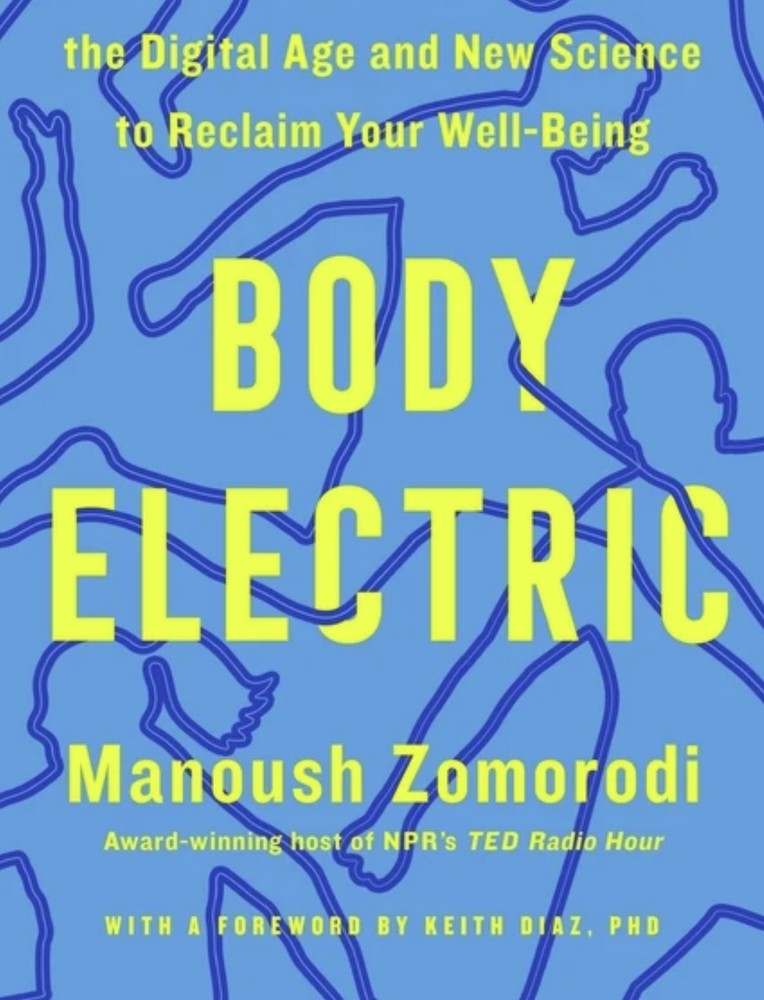
By Manoush Zomorodi and Keith Diaz PhD
Body Electric is a book about a problem that feels both ordinary and strangely new: we are living more and more of our lives through screens, but our bodies are still biological, rhythmic, physical systems that require movement, rest, breath, light, posture, and sensory feedback. Manoush Zomorodi, host of NPR’s TED Radio Hour, brings a journalist’s curiosity to the subject, while Keith Diaz, a Columbia University exercise physiologist, provides the scientific foundation for much of the book’s central argument. The book was published by Flatiron Books in May 2026 and runs 304 pages.
BUY THIS BOOK
The book’s core claim is simple but important: technology has not only changed our attention, relationships, and productivity. It has changed our bodies. A normal day for many people now involves eight to ten hours of sitting in front of screens, followed by more scrolling, streaming, and device use after work. Zomorodi argues that this way of living is reshaping posture, eyesight, breathing, metabolism, energy, focus, mood, and sleep.
This is not a book arguing that people should abandon technology or retreat from modern life. Zomorodi is clear that digital tools are useful, often essential, and not going away. The question is more practical and more human: can we live with technology without letting our bodies become collateral damage?
The Central Problem: Screen Life Has Become Body Life
The Digital Day Is Physically Demanding
One of the book’s most useful reframings is that screen work is not physically neutral. It may look quiet, clean, and sedentary, but the body is still being shaped by it. We sit for long stretches. We round our shoulders. We crane our necks toward laptops and phones. We stare at close range. We hold our breath or breathe shallowly while concentrating. We plug in headphones, ignore fatigue, work through meals, and treat the body as an inconvenience attached to the head.
Zomorodi’s larger point is that the body does not simply tolerate this indefinitely. It adapts, then rebels. Fatigue, stiffness, brain fog, sleep disruption, eye strain, anxiety, shallow breathing, and metabolic changes are not random annoyances. They may be signals that our work systems and digital habits are no longer compatible with basic human physiology.
The book therefore moves beyond the usual conversation about screen time. It is not only about distraction or mental health. It is about the physical consequences of living through devices.
Keith Diaz and the Science of Sitting
The Myth That Exercise Cancels Out Sitting
Keith Diaz’s research plays a central role in the book. Diaz studies sedentary behavior and its effects on metabolic, cardiovascular, and psychological systems. His work asks a deceptively practical question: what is the minimum amount of movement people need in order to counteract the harms of sitting?
One of the key ideas in Body Electric is that a single workout may not fully erase the effects of sitting all day. Many people think that if they run in the morning, go to the gym at lunch, or take a long walk after work, they have paid their movement debt. Diaz’s research challenges that assumption. The body needs regular interruption of sedentary time, not just a block of exercise placed somewhere else in the day.
This is one of the book’s most practical insights. The issue is not only how much you move, but how often you interrupt stillness.
The Five Minute Movement Break
Diaz’s 2023 laboratory study tested several doses of movement during an eight hour sedentary period. Participants tried different combinations, including one minute or five minutes of walking after thirty or sixty minutes of sitting. The strongest lab finding was that five minutes of walking every thirty minutes significantly improved blood sugar and blood pressure compared with sitting continuously. It also reduced blood sugar spikes after meals, while all tested walking patterns reduced blood pressure by four to five millimeters of mercury. Columbia University Irving Medical Center reported those findings in Rx for Prolonged Sitting: A Five-Minute Stroll Every Half Hour.
The study was small, with eleven adults, which matters. Zomorodi does not treat it as the final word on all human health. Instead, the book uses the study as the spark for a larger question: if this works in a controlled lab, can ordinary people actually do it in real life?
That question becomes the heart of the Body Electric project.
The Body Electric Experiment
Citizen Science Meets Public Radio
Zomorodi and Diaz partnered with NPR and Columbia University to turn the science into a large public experiment. NPR listeners were invited to test movement breaks in daily life. The response was enormous. More than 20,000 participants qualified, representing all fifty states and seventy four other countries. Many were full time workers, and the group included teachers, lawyers, medical professionals, software engineers, consultants, business owners, caregivers, and retirees. NPR shared the results in a piece titled Listeners joined ‘Body Electric’ study to move throughout the day. Did it work?
The participants were not people with unusually empty schedules. They were busy, educated, high functioning, and tired. Many worked remotely or in hybrid arrangements. Many were media multitasking. On workdays, they averaged 7.6 hours of sitting, and on days off they sat even more, averaging around nine hours.
That detail is important because the book is not written for elite athletes or wellness obsessives. It is written for people trying to survive the ordinary digital day.
From Ideal Protocol to Real Life
The Body Electric project gave participants movement prescriptions, including five minutes of activity every thirty, sixty, or one hundred twenty minutes of sitting. The purpose was not merely to prove that movement is good. Everyone knows that. The sharper question was whether movement breaks could be made feasible inside the chaos of actual work and family life.
The results were encouraging. A peer reviewed large scale pragmatic intervention later published in the British Journal of Sports Medicine concluded that movement breaks had good implementation potential and improved psychosocial outcomes over a two week intervention period. The study found that hourly breaks offered the best balance between feasibility and effectiveness.
That finding is subtle but important. The lab may indicate that five minutes every thirty minutes is the most physiologically powerful dose, but real life requires a dose people can sustain. Body Electric therefore becomes not just a health book, but a behavior change book. The best solution is not the one that exists only in theory. The best solution is the one people can actually live.
What the Book Says About the Body
Posture, Breath, Eyes, and the Nervous System
The book moves beyond sitting to examine how specific systems of the body are responding to digital life. Zomorodi’s public excerpt describes Part 2 as focusing on the eyes, lungs, posture, and nervous system, with small daily shifts meant to support those systems.
The posture argument is straightforward. The body takes the shape of its habits. A laptop, phone, or tablet encourages a repeated forward tilt, rounded shoulders, tightened hips, and a collapsing of the body’s natural alignment. Over time, this can influence comfort, energy, breathing, and mood.
The eye argument is also timely. The book connects screen heavy lives with concerns about dwindling eyesight and myopia, especially among children whose academic and social worlds are increasingly screen based. The broader message is not that screens alone explain every vision problem. It is that near work, limited outdoor time, and prolonged close focus should be taken seriously as features of modern development.
Breathing may be the most interesting part of the mind body technology connection. Many people hold tension in the breath while typing, concentrating, answering messages, or moving between digital tasks. Screen life can keep the body in a state of low grade activation, mentally busy but physically stuck. The book asks readers to become more aware of these small physiological patterns, because small patterns repeated daily become life patterns.
The Book’s Deeper Argument: We Have Become Disembodied
The Body as Feedback, Not Furniture
The most philosophical idea in Body Electric is that technology has weakened the feedback loop between body and mind. We often treat the body as furniture for cognition, something that sits in a chair while the brain performs work through a screen. But the body is not passive. It sends information constantly: fatigue, restlessness, discomfort, shallow breathing, energy, hunger, pain, tension, alertness.
Digital culture teaches us to override those signals. Keep typing. Stay in the meeting. Answer the message. Finish the document. Watch one more episode. Scroll a little longer.
Zomorodi’s argument is that health begins partly by listening again. The body is not an obstacle to productivity. It is part of the intelligence system that makes productivity possible.
Practical Protocols and Daily Shifts
Small Changes, Not Digital Abstinence
The practical message of the book is intentionally modest. Zomorodi does not ask readers to throw away their phones, quit remote work, or become anti technology. Instead, she suggests small interventions that make screen life more livable. The central protocol is movement breaks, especially brief walking or gentle movement spread throughout the day.
These breaks are not framed as workouts. They are resets. A person might walk around the house, climb stairs, march in place, stretch, take a walking meeting, move during a call, or build movement into transitions. The goal is to normalize movement as part of work, not something that waits until work is over.
The book also appears to encourage broader recalibration: better posture, breathing awareness, outdoor light, screen boundaries, sensory resets, and more deliberate rhythms of attention and rest. Its emphasis is practical and forgiving. The point is not perfection. The point is interruption, repair, and reconnection.
Children, Workplaces, and Culture
This Is Not Just an Individual Problem
A strength of Body Electric is that it does not leave the entire burden on individual willpower. The book’s third part looks outward, including children growing up online and older adults seeking vitality and longevity.
That outward turn matters. If children are expected to learn, socialize, entertain themselves, and regulate emotions through screens, then movement cannot be treated as an optional lifestyle flourish. It becomes part of development. If adults are expected to work through back to back virtual meetings, endless email, and remote collaboration tools, then movement breaks cannot be treated as personal indulgence. They become part of workplace design.
The most hopeful cultural image in the book is simple: colleagues standing during a Zoom call without embarrassment; walking breaks becoming as normal as coffee; children being encouraged not merely to reduce screens, but to reconnect with their bodies.
The Limits and Cautions
Not a Cure All
Body Electric should not be read as a claim that five minute walks solve every health problem created by modern life. The research is meaningful, but the physiological world is complicated. Sitting, sleep, stress, diet, social isolation, chronic illness, mental health, work design, and environmental conditions all interact. Anyone with medical limitations should adapt movement advice to their own situation and seek professional guidance where appropriate.
The more responsible interpretation is that movement breaks are a low cost, accessible, evidence backed starting point. They do not replace exercise, medical care, sleep, nutrition, or workplace reform. But they offer a practical intervention that many people can begin immediately. The Harvard T.H. Chan School of Public Health adds to the case for breaking up long stretches of sitting in Taking regular breaks from sitting may lower risk of dying from cancer.
Conclusion: Reclaiming the Human Body in a Digital Age
Body Electric is ultimately not a book about rejecting technology. It is a book about refusing to let technology define the terms of embodiment. Zomorodi and Diaz argue that our digital lives have physical consequences, but also that the solution is not unreachable. We can begin with small acts: standing, walking, breathing, looking away, stepping outside, loosening the grip of uninterrupted sitting.
The book’s greatest contribution is that it changes the frame. It asks us to stop treating exhaustion, stiffness, shallow breathing, brain fog, poor sleep, and low energy as inevitable costs of modern work. They may be signals that our bodies are asking for a new relationship with the tools we use every day.
The message is hopeful because it is ordinary. You do not need a radical life redesign to begin. You need to interrupt the pattern. Move for five minutes. Walk during the call. Let the body reenter the workday. Rebuild the feedback loop between mind and body.
Technology has changed us. Body Electric argues that we are not helpless inside that change. The body is still speaking. The first step is to get up long enough to hear it.