Listen to this Book Summary, 16 min, read by Simon
By Stefanie O’Connell
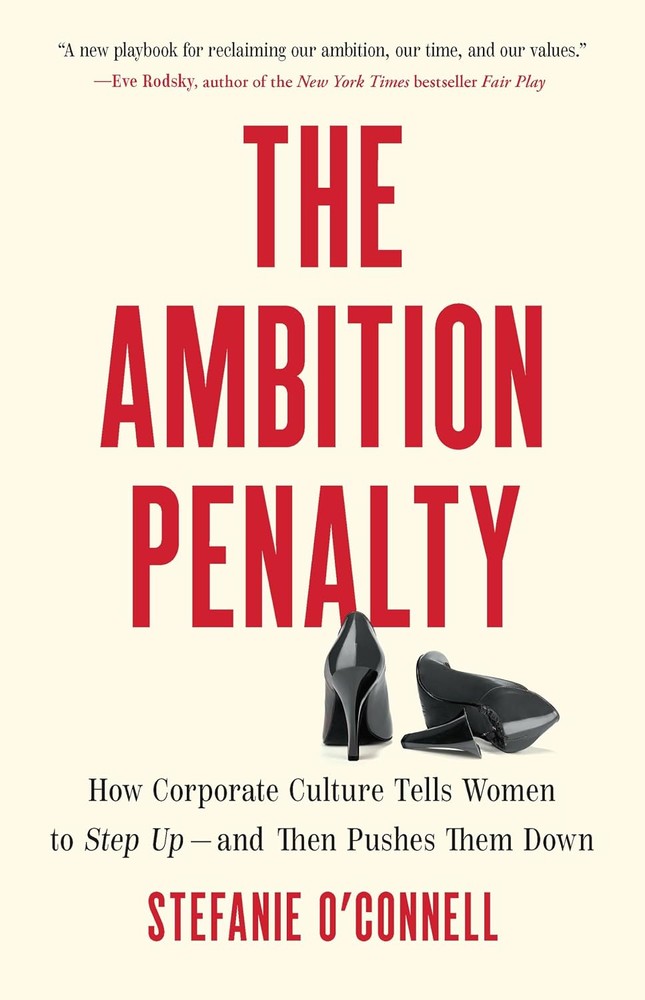
Stefanie O’Connell’s The Ambition Penalty is a book about a contradiction many women have lived but have often been encouraged to interpret as a personal failure. For years, women were told to lean in, speak up, negotiate harder, ask for more, be more confident, build the network, raise their hand, take the seat, and stop apologizing for wanting power, money, autonomy, and influence. The message sounded liberating because it was actionable. It gave women something to do. But O’Connell’s central argument is that the advice was incomplete, and sometimes deeply misleading, because it treated women’s advancement as a matter of individual behavior while leaving the surrounding system largely unexamined. Hachette describes the book as a data-driven guide to the hidden forces still fueling gender inequality at work, with O’Connell defining the “ambition penalty” as the financial, personal, and professional costs women face when they dare to want more.
BUY THIS BOOK
The book is not arguing that women lack ambition. It is arguing almost the opposite. Women are often punished not because they fail to aspire, but because they do. Publishers Weekly summarizes O’Connell’s thesis as a critique of the idea that gender gaps in pay and leadership are caused by women’s lack of confidence or negotiating skill. Instead, the book locates those gaps in structural forces that create compounding professional, financial, and personal costs for ambitious women.
The Ambition Penalty Defined
The ambition penalty is the cost women pay for wanting more. More money. More responsibility. More authority. More autonomy. More recognition. More public influence. More control over their time. More power to shape their work and lives. On the surface, corporate culture often celebrates this desire. Companies talk constantly about leadership, initiative, ownership, confidence, and growth. But O’Connell’s argument is that those traits are not interpreted equally across gender.
A man described as ambitious is often seen as driven, serious, promising, and leadership-oriented. A woman described as ambitious may be seen as difficult, aggressive, self-interested, political, or threatening. Forbes, writing about the book, notes this linguistic double standard directly: “He’s ambitious” tends to read as praise, while “She’s ambitious” can sound like a warning.
This is the heart of the book’s argument. The problem is not that women fail to perform ambition properly. The problem is that the same behavior carries different consequences depending on who performs it. Confidence, assertiveness, risk-taking, negotiation, visibility, and ambition itself can be rewarded in men while triggering suspicion or backlash in women. The result is a system that tells women to step up and then penalizes them for doing so.
The Failure of the “Fix the Woman” Playbook
One of O’Connell’s major targets is the familiar advice that asks women to fix themselves. Be more confident. Negotiate better. Use stronger language. Stop saying sorry. Take more risks. Find a mentor. Ask for the promotion. Build executive presence. Speak like a leader.
Some of this advice can be useful at the individual level. O’Connell does not appear to dismiss skill-building or self-advocacy. But she challenges the larger assumption that these individual behaviors can solve structural inequality. Publishers Weekly notes that the book debunks the idea that women can close systemic gaps through personal comportment, while documenting how gender biases reassert inequality even as women accumulate credentials.
That is an important distinction. If the system penalizes women for the very behaviors it tells them to adopt, then telling women to adjust their tone, confidence, negotiation style, or ambition level may simply move the burden onto the person already paying the cost. The advice becomes circular. Women are told they are not advancing because they are not assertive enough, then punished when they become assertive. They are told to ask for more, then treated as ungrateful or difficult when they ask. They are told to lead, then judged more harshly for exercising authority.
The “fix the woman” playbook is comforting to organizations because it does not require the organization to change very much. It keeps the problem individual, behavioral, and private. O’Connell’s book insists that the problem is also cultural, structural, and collective.
Ambition Does Not Disappear. It Gets Drained.
A powerful idea running through the book is that women’s ambition is not absent. It is often worn down. Forbes describes O’Connell’s argument that women enter the workforce with ambition for advancement, promotions, and raises, but that ambition can erode over time because of workplace conditions rather than because of inherent differences in desire.
This reframing matters because it shifts the question. Instead of asking, “Why are women less ambitious?” we should be asking, “What happens to women’s ambition after repeated exposure to unequal consequences?” If women learn that speaking up leads to backlash, that asking for pay equity leads to reputational risk, that leadership behavior is interpreted through a narrower lens, and that caregiving expectations still fall disproportionately on them, then reduced ambition may not be a trait. It may be a rational response to a punishing environment.
O’Connell’s work is therefore less interested in motivational slogans than in incentives. Ambition thrives where it is supported, rewarded, and protected. It shrinks where it is punished, ignored, or made personally expensive. This is why the book is useful for leaders as well as women navigating their own careers. If an organization says it wants ambitious women but creates conditions that make ambition costly, the problem is not a pipeline problem alone. It is an environment problem.
The Costs Are Professional, Financial, Social, and Personal
The ambition penalty is not merely emotional. It compounds across a life. Professionally, women may be passed over, second-guessed, excluded from informal networks, assigned more non-promotable work, judged more harshly for assertive behavior, or penalized for asking for what men are expected to pursue. Financially, the consequences show up in pay gaps, missed raises, slower promotion trajectories, weaker wealth accumulation, and reduced long-term security. Personally, they show up in burnout, self-doubt, exhaustion, constrained choices, and the constant calculation required to be ambitious without being labeled too ambitious.
Hachette’s book description emphasizes that the gender pay gap has barely moved in decades despite educational gains and empowerment messages, and it frames the book around why those gains have not translated into equivalent advances at work or at home.
That last phrase, “at home,” is important. O’Connell does not treat workplace inequality as something sealed inside the office. The expectations around caregiving, partnership, housework, motherhood, marriage, and domestic labor all shape what ambition costs. In an interview with Women of Letters, O’Connell discusses how gendered expectations around labor shaped her interest in work, ambition, and money, noting that even in 2026, people still feel the weight of what they are “allowed to want, or be, or do” depending on gender identity.
This gives the book a broader frame. Ambition is not only about promotions and pay. It is about what people are permitted to desire without social punishment.
The Girlboss Era and Its Limits
O’Connell’s critique sits in the aftermath of the girlboss and lean-in era. That era had real energy. It told women to stop shrinking, to claim authority, to speak boldly, and to imagine themselves as founders, leaders, investors, and power brokers. For many women, that message was genuinely energizing.
But O’Connell’s argument is that the movement overpromised because it overpersonalized. It celebrated individual women breaking through while failing to adequately confront the systems that continued to constrain women collectively. In the Women of Letters interview, O’Connell describes the early 2010s girlboss moment and notes that some celebrated female founders were elevated as symbols of women’s achievement even when they reproduced exploitative practices associated with existing power structures.
This is one of the book’s sharper points. Representation matters, but representation alone is not liberation if the system remains unchanged. One woman reaching the top does not necessarily mean the structure has become fairer for other women. A woman succeeding by conforming to the worst parts of existing corporate culture does not automatically transform that culture.
The question becomes not simply whether women can win the old game, but whether the old game should be redesigned.
Data, Stories, and the Myth of Meritocracy
According to Publishers Weekly, O’Connell draws on survey data, behavioral economics, academic research, and real-world examples to examine how gender bias continues to shape professional outcomes. This combination matters because the ambition penalty is both statistical and lived. Data can show patterns, but stories reveal what those patterns feel like from the inside.
The myth of meritocracy survives because many workplaces prefer to believe they are objective. They have performance reviews, promotion processes, compensation bands, hiring rubrics, leadership competencies, and values statements. But a system can look rational while still reflecting biased assumptions about who is seen as leadership material, who is granted the benefit of the doubt, who is penalized for ambition, and who is expected to perform invisible labor.
O’Connell’s argument is not that every disappointing outcome is caused by sexism, or that every woman experiences the workplace in the same way. It is that patterns matter. When the same kinds of penalties repeatedly appear across women’s careers, the responsible response is not to tell women to become more confident. It is to ask what the workplace keeps rewarding, what it keeps punishing, and whose ambition it is prepared to tolerate.
What Actually Helps
The book is not merely diagnostic. It also points toward solutions. Publishers Weekly notes that O’Connell discusses policy interventions such as affordable childcare and universal paid family leave, while also offering workplace scripts for changing culture from within. Forbes highlights advice around pay transparency, choosing environments that actually reward ambition, and collective action rather than relying only on individual heroics.
The most important shift is from individual performance to structural design. If organizations want women’s ambition to flourish, they need systems that reduce ambiguity and bias. That includes transparent pay practices, clear promotion criteria, accountability for non-promotable work, serious parental leave, childcare support, mentorship and sponsorship that actually leads to opportunity, and managers trained to recognize backlash patterns when women advocate for themselves.
The book also argues for better language. Women need ways to name the penalty without internalizing it. Leaders need language to distinguish confidence from consequence, ambition from backlash, and personal development from structural avoidance. Naming the pattern matters because unnamed patterns are easier to dismiss as isolated incidents.
The Larger Argument: Everyone Pays
The subtitle focuses on women, but the book’s implications are wider. When women’s ambition is punished, organizations waste talent. They lose leadership capacity, creativity, perspective, institutional memory, and trust. They burn out capable people while telling themselves the problem is confidence, fit, or pipeline. They create cultures where only certain forms of ambition are rewarded, which means the organization becomes narrower, less adaptive, and less intelligent.
O’Connell’s author site frames the book as a guide to dismantling the hidden forces that hold women back, burn them out, and “make us all pay.” That phrase matters. Gender inequality is not only a women’s issue. It is a management issue, a cultural issue, an economic issue, and a leadership issue. Any organization that systematically undervalues ambition in half its talent pool is making itself weaker.
Conclusion: Ambition Was Never the Problem
The power of The Ambition Penalty is that it refuses the usual diagnosis. Women are not failing because they lack ambition. They are often paying for ambition in ways men do not. The problem is not that women need to become louder, tougher, more confident, more polished, more strategic, or more willing to ask. The problem is that many workplaces still punish women for doing exactly what the leadership literature claims to celebrate.
O’Connell’s book is ultimately a challenge to both women and organizations. For women, it offers language for a pattern many have experienced but may have been encouraged to personalize. For leaders, it offers a mirror. If a company says it wants ambitious women, the real test is not whether it hires them, celebrates them, or puts them on panels. The real test is whether it rewards their ambition when it becomes inconvenient, visible, assertive, expensive, or powerful.
The ambition penalty is not simply a women’s burden. It is an organizational failure. And until companies become honest about that, they will keep telling women to step up while quietly preserving the conditions that push them down.
Five Key Takeaways
No. 1 — Women are not held back simply because they lack confidence, negotiation skill, or ambition. O’Connell’s argument is that ambition itself is often penalized when expressed by women.
No. 2 — The “fix the woman” playbook is inadequate because it asks individuals to adapt to systems that continue to punish them.
No. 3 — Ambition can erode over time not because women stop caring, but because repeated backlash makes ambition costly.
No. 4 — Real progress requires structural interventions, including pay transparency, childcare support, paid leave, clearer promotion systems, and shared accountability for workplace culture.
No. 5 — The ambition penalty harms organizations as well as women because it wastes talent, weakens leadership pipelines, and teaches capable people that wanting more comes at too high a price.