Listen to this Book Summary, 17 min, read by Simon
By Jess Ekstrom
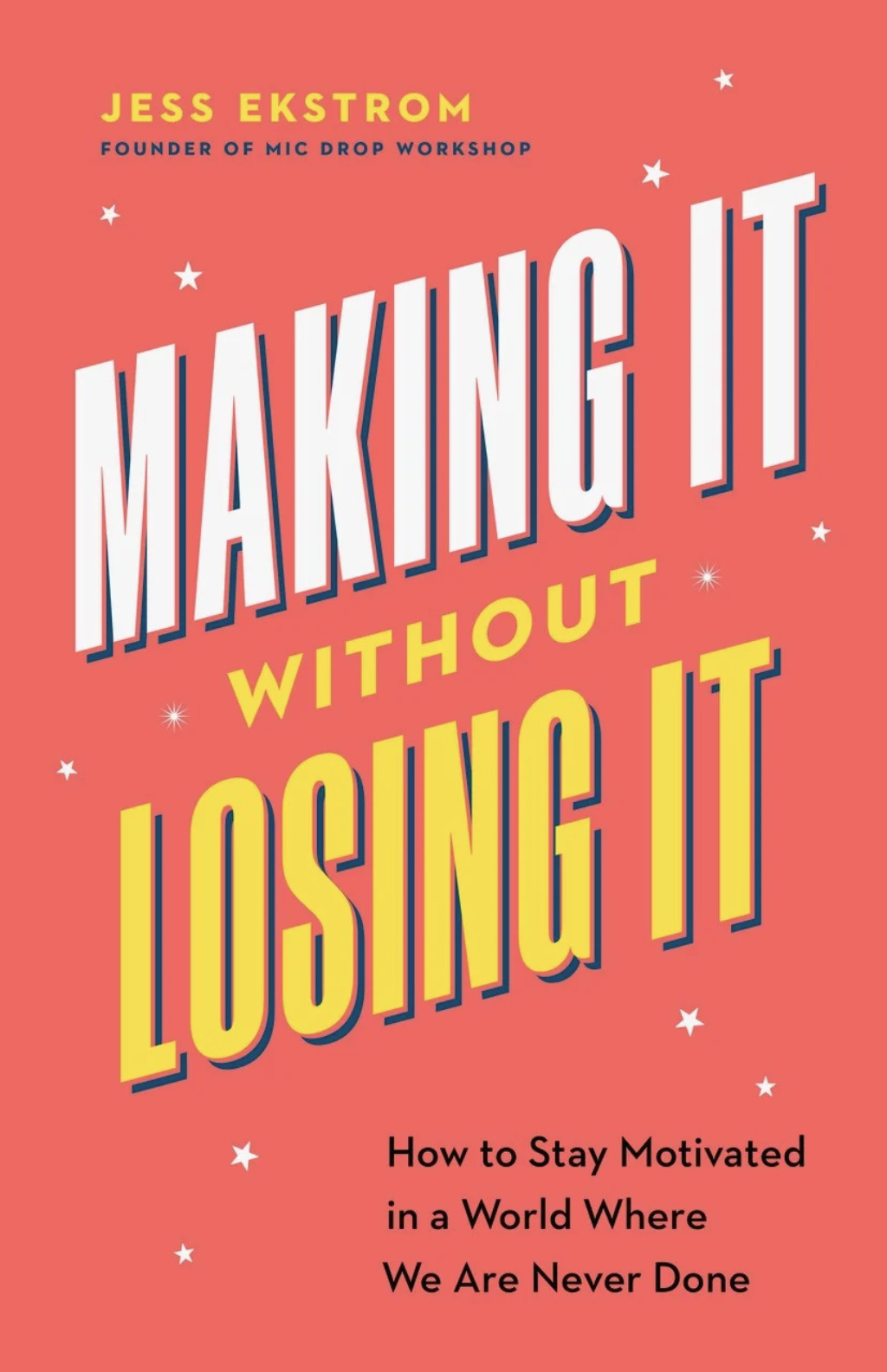
Jess Ekstrom’s Making It Without Losing It is a book for ambitious people who are tired of treating peace, joy, and self-respect as rewards they will finally earn after the next achievement. Published by Page Two on May 5, 2026, the book is positioned as a guide for people who want to pursue goals without “setting their inner peace on fire,” and it speaks directly to the modern condition of always chasing the next thing while rarely feeling fully arrived.
BUY THIS BOOK
At its heart, the book challenges one of the most seductive lies in achievement culture: that joy comes after completion. After the next milestone. After the promotion. After the launch. After the revenue target. After the book is written, the company is sold, the stage is bigger, the calendar is calmer, or the inbox is finally defeated. Ekstrom’s argument is that this bargain does not work because the finish line keeps moving. The world is built to keep us striving, comparing, scrolling, performing, improving, and refreshing. If peace depends on being done, then peace will always be postponed.
Ekstrom is not writing as someone who rejects ambition. That is part of the book’s usefulness. She is an entrepreneur, speaker, author, founder of Headbands of Hope, and founder of Mic Drop Workshop, a company that helps women become public speakers and thought leaders. Her credibility comes not from standing outside the world of achievement and criticizing it, but from having lived inside it, succeeded in it, and recognized its emotional traps.
The book’s central question is not, “How do we stop wanting more?” The better question is, “How do we keep wanting more without losing ourselves in the wanting?”
The Trap of “Making It”
The title itself contains the tension. “Making it” is the language of arrival, but Ekstrom is interested in what happens when arrival fails to feel like arrival. The book examines what Foreword Reviews describes as the tension between professional aspiration and personal fulfillment. Many people assume that hitting a certain goal will finally make them feel secure, successful, satisfied, or enough. But once the goal is reached, a new one appears. The person who once dreamed of being invited into the room now wants a bigger room. The person who wanted the client now wants the platform. The person who wanted recognition now wants proof that the recognition was not accidental.
This creates what the book calls the arrival trap, the belief that fulfillment lives somewhere just beyond the next accomplishment. Foreword notes that the book introduces concepts including the “arrival trap” and the “arrived mindset,” reframing satisfaction as something available in the present rather than a distant destination.
This is a subtle but powerful distinction. Ekstrom is not arguing that goals are bad. She is arguing that goals become emotionally dangerous when they are asked to do work they cannot do. A goal can organize effort. It can create direction. It can stretch capacity. It can produce meaningful progress. But a goal cannot permanently heal insecurity, manufacture self-worth, or make a person feel whole if the person has outsourced wholeness to achievement.
That is why “making it” can become strangely disappointing. The achievement is real, but the emotional payoff is temporary. The applause fades. The metric resets. The next comparison begins. The high-achiever is left wondering why success did not finally settle the inner question.
The Arrived Mindset
One of the book’s major ideas is the “Arrived Mindset,” which Page Two describes as the idea that readers are already enough right now, without needing a spreadsheet to prove it. This is not passivity. It is not pretending there is nothing left to build. It is not abandoning drive, excellence, or effort. It is a shift in emotional posture.
The arrived mindset says: I can pursue growth without treating my current self as insufficient. I can want more without believing I am less until I get it. I can work hard without making peace conditional on completion. I can build a future without postponing my ability to inhabit the present.
That idea is especially relevant for high achievers because ambition often depends on dissatisfaction. Many ambitious people have learned how to use dissatisfaction as fuel. They notice the gap, chase the gap, close the gap, and then search for the next gap. That can create external progress, but it can also train the nervous system to experience life as permanent incompletion.
Ekstrom’s arrived mindset offers a different kind of fuel. It does not ask people to stop moving. It asks them to stop making self-worth dependent on movement.
Your Success Fingerprint
Another important concept in the book is the “success fingerprint.” Page Two describes it as part of the book’s invitation to define success in a way that is personally meaningful rather than borrowed from the outside world. Ekstrom’s own site also describes a “Success Fingerprint GPT” resource designed to help readers understand their motivators, strengths, and conditions for doing their best work.
The phrase matters because success is often treated as universal. More money. More status. More recognition. More followers. More authority. More visible proof. But Ekstrom’s argument is that fulfillment begins when people stop chasing someone else’s version of success and start identifying what actually energizes, grounds, and motivates them.
Foreword Reviews notes that the book questions the prioritization of external rewards over internal fulfillment and encourages readers to nurture an intrinsic sense of purpose. That is one of the book’s most practical contributions. It asks readers to stop treating success as a public scoreboard and start treating it as a personal alignment question.
What kind of work makes me feel alive? What kind of pace is sustainable? What conditions help me do my best work? What am I chasing because I actually want it, and what am I chasing because it looks like the thing a successful person should want?
These questions are deceptively simple. They matter because many people do not burn out only from working too hard. They burn out from working too hard for a definition of success that was never truly theirs.
Motivation That Comes From Within
The book is fundamentally about motivation, but not the cheap kind. It is not a motivational speech stretched into 224 pages. Kirkus describes it as blending personal experience, research, and humor to help busy professionals navigate the changing world of work. Ekstrom is interested in motivation that lasts, not external hype that disappears as quickly as it arrives.
This is where the book pushes against hustle culture. The problem with hustle culture is not that it values effort. Effort matters. Discipline matters. Persistence matters. The problem is that hustle culture often confuses exhaustion with virtue and visibility with progress. It teaches people to prove their seriousness by being overextended.
Ekstrom argues for a more sustainable kind of motivation, one rooted in purpose, self-knowledge, and internal clarity. Page Two summarizes this clearly: motivation does not come from another to-do list, it comes from within.
That is a useful correction. The modern productivity industry often assumes that the problem is poor organization. Better calendar. Better app. Better morning routine. Better habit stack. Better system. Those tools can help, but they cannot answer the deeper motivational question: why does this matter to me, and who am I becoming while I pursue it?
The Role of Personal Story
Ekstrom uses her own life as evidence, not in a self-congratulatory way, but as a way to make the book emotionally accessible. Kirkus notes that the unlikely catalyst for her first business venture was Bernie Madoff swindling her family out of money, after which she founded Headbands of Hope while still in college, with each purchase tied to a donated headband for a hospitalized child. The same review traces her later path into motivational speaking, Mic Drop, motherhood, and a changing definition of what it meant to have “made it.”
That shift is important. In the early stages of ambition, success is often about proving. Proving you can build. Proving you can survive. Proving the doubters wrong. Proving the pain did not defeat you. Proving you belong.
But proving is not the same as peace.
Over time, Ekstrom’s definition of making it becomes less about external validation and more about internal steadiness. Kirkus describes her evolving metaphor as becoming a “lighthouse” rather than seeking a “spotlight.” That image captures one of the book’s central emotional movements: away from being illuminated by outside approval and toward becoming internally lit enough to guide, contribute, and endure.
Anxiety, Motherhood, and Perfectionism
The book also appears to draw heavily from Ekstrom’s personal seasons of anxiety, motherhood, and postpartum depression. Kirkus notes that her experience with postpartum depression shaped her realization that perfectionism was not always attainable, while her site quotes Publishers Weekly as saying the book is strengthened by anecdotes about motherhood and postpartum depression shaping her approach to entrepreneurship.
This gives the book more emotional depth than a standard career guide. It acknowledges that motivation is not merely a mindset issue. Human beings are not machines. They have bodies, families, hormones, grief, doubt, exhaustion, and seasons when the old tools no longer work.
That matters because many high-achievement frameworks quietly assume an uninterrupted self. They are written as if the same person with the same energy, same resources, same health, same support system, and same emotional capacity will show up every day. Real life is not like that.
Ekstrom’s work is stronger because it makes room for ambition and real life to coexist. Her own site describes her as an entrepreneur, speaker, and mom of two who believes ambition and real life can coexist. That phrase may be one of the book’s most useful emotional anchors. Success that requires the denial of real life is not sustainable success.
Curiosity, Negative Thinking, and the Mind
Foreword Reviews notes that the book discusses negative thinking in evolutionary context, helping readers understand natural thought patterns so they can shift perception, reconfigure experiences, and reduce stress and self-doubt. This is important because Ekstrom is not merely saying, “Think positive.” In fact, Kirkus notes that she describes herself as not naturally good at optimism, even though the book’s tone is encouraging.
That makes the optimism more credible. Forced positivity often fails because it asks people to deny reality. Ekstrom seems more interested in usable optimism, the kind that acknowledges difficulty without becoming consumed by it. She encourages readers to see problems not necessarily as evidence that life is failing, but as signs that life is active, moving, and asking something of them.
Foreword also notes that the book favors curiosity over certainty. That is a mature insight. Certainty can feel comforting, but curiosity keeps people open, adaptive, and less brittle. In a world where we are never done, certainty may actually become a trap. Curiosity allows us to keep learning without treating every unknown as a threat.
The Book’s Practical Value
Making It Without Losing It is not a book against ambition. It is a book against self-erasure in the name of ambition. It speaks to the person who wants to build something meaningful but no longer wants to trade sanity for performance. It gives language to a particular kind of exhaustion: the fatigue of always being in pursuit, always improving, always optimizing, always one step away from finally feeling settled.
Kirkus calls the advice sound though somewhat scattershot, while still praising its motivational tone, personal stories, humor, and organized layout. Foreword Reviews calls it an encouraging self-help resource about achieving personal success without losing sight of one’s values. Those assessments feel aligned with the book’s apparent purpose. It is not trying to be a dense academic treatise. It is trying to be a practical, emotionally honest companion for people who are ambitious enough to keep going but wise enough to ask what the going is costing them.
The strongest message is that motivation cannot be built on perpetual lack. Eventually, people need a source of drive that does not depend on self-rejection. They need ambition that does not require postponing joy. They need success that includes the life being lived on the way to success.
Conclusion: Making It Must Include Not Losing Yourself
The central lesson of Making It Without Losing It is simple, but not easy: making it cannot require losing yourself. Not your peace. Not your joy. Not your body. Not your relationships. Not your sense of purpose. Not your ability to be present for the life you are supposedly working so hard to build.
Jess Ekstrom invites readers to stop treating happiness as the prize at the end of productivity and start building a version of success that includes satisfaction now. That does not mean settling. It means refusing to let ambition become a treadmill that never allows arrival. It means defining success personally. It means cultivating internal motivation. It means noticing when productivity is becoming burnout in better clothes. It means remembering that life is not something we earn after the work is done.
Because the work is never fully done.
That is not a reason to despair. It is a reason to change the bargain.
The point is not to stop becoming. The point is to stop postponing being.
Five Key Takeaways
No. 1 — The book challenges the belief that joy and peace are rewards waiting on the other side of the next achievement.
No. 2 — Ekstrom’s “Arrived Mindset” reframes success as something we can experience now, not only after a future milestone.
No. 3 — The “success fingerprint” encourages readers to define achievement according to their own motivators, values, strengths, and life conditions.
No. 4 — The book argues for internal motivation over external validation, hype, comparison, or hustle culture.
No. 5 — Its deepest message is that ambition and peace can coexist, but only when success is no longer built on self-abandonment.