By Michael Gene Housman
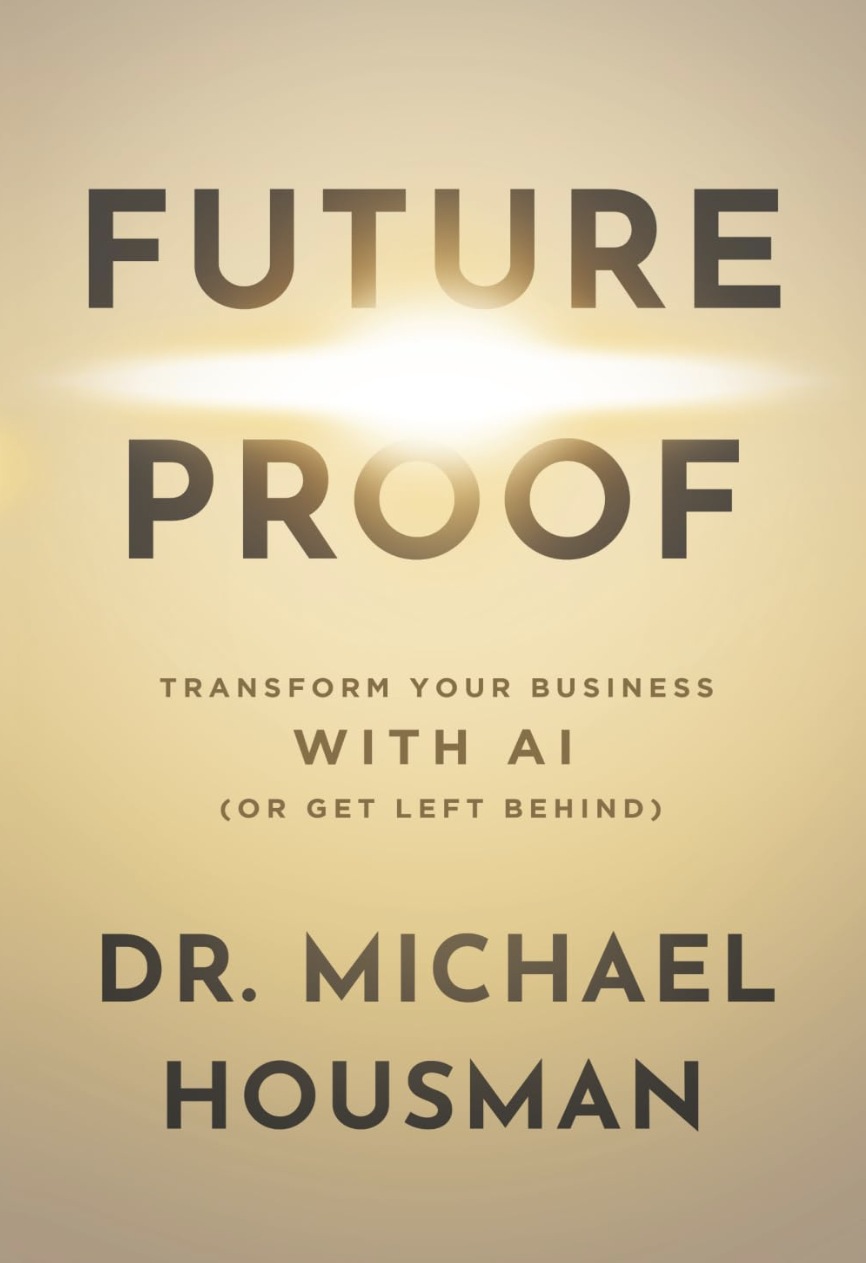
Michael Housman’s Future Proof begins with a warning that will be uncomfortable for executives who still regard artificial intelligence as an interesting technology to investigate when circumstances permit. In his view, AI represents the third great digital disruption of modern business, following the internet and social media, and its consequences will be considerably more profound than either.
BUY THIS BOOK
The internet transformed access to information. Social media transformed how people connect, communicate, and influence one another. Artificial intelligence, Housman argues, is transforming our ability to apply intelligence itself. Tasks that previously required substantial human expertise can increasingly be completed, accelerated, or supported by machines.
For business leaders, the implications extend well beyond productivity improvements. AI challenges assumptions about organizational structure, labor, competitive advantage, customer relationships, and even what constitutes a viable business model.
Housman’s central argument is straightforward. Companies that treat AI as an optional technology upgrade risk discovering that their competitors have fundamentally changed the economics of their industries.
The book is deliberately written for executives rather than technical specialists. Drawing on more than fifteen years developing and implementing machine learning systems, Housman translates complex technology into practical business decisions. His objective is to move leaders from intellectual curiosity to measurable action. Housman talks through the book and how leaders can get started on the Institute of Management Accountants podcast episode Thriving in the AI Era: Change, Skills, and Opportunity.
The Danger of Thinking Linearly
One of the book’s most important ideas concerns the difficulty human beings have understanding exponential change.
Most business planning assumes relatively predictable progress. Organizations establish annual objectives, assess incremental improvements, and make investments based on historical patterns. This approach works reasonably well when the underlying environment changes gradually.
AI challenges that assumption.
Housman illustrates the point through the Human Genome Project. Early progress appeared painfully slow, leading some observers to question whether mapping the human genome could ever be completed within a useful timeframe. Yet improvements in computing and sequencing technology accelerated progress dramatically. The National Human Genome Research Institute’s Human Genome Project Fact Sheet tells the story of how the project finished in 2003, ahead of schedule.
The lesson is that early progress in an exponentially advancing technology can appear insignificant until the cumulative effect becomes impossible to ignore.
Housman applies this reasoning to artificial intelligence. Businesses waiting for technological maturity may find that the competitive environment changes faster than their traditional planning cycles can accommodate.
There is, however, an important distinction between technological capability and business adoption. AI models may improve rapidly, but organizations still face constraints involving data, regulation, employee skills, integration, and organizational behavior.
The practical implication is not that leaders should abandon disciplined decision-making. It is that they need to shorten the distance between recognizing an opportunity, testing it, and learning whether it creates value.
From Technology to Measurable Commercial Results
Housman illustrates this approach through his work with PetLab, a rapidly growing pet supplement company confronting operational and competitive challenges.
PetLab initially needed stronger technology infrastructure to support its expanding business. But the emergence of generative AI created an additional opportunity to transform its marketing operations.
By introducing accessible AI tools into its creative workflow, the company significantly increased the speed at which it could develop and launch advertising campaigns.
Housman reports that campaign preparation time fell from approximately forty minutes to five minutes, while monthly campaign volume increased from roughly 500 to 2,200. He also reports improvements in conversion performance and substantial revenue growth during the broader transformation.
The example is useful because it moves the discussion beyond generic claims about AI productivity.
The commercial opportunity was not simply saving thirty-five minutes on an individual task. It was increasing the organization’s capacity to experiment, generate creative alternatives, test campaigns, and learn from customer responses.
The distinction matters.
A company that uses AI merely to perform existing activities more cheaply may improve efficiency. A company that uses AI to increase the speed and quality of experimentation may create an entirely different competitive advantage.
At the same time, executives should be careful about assuming that all reported business improvements were caused by AI alone. Infrastructure modernization, marketing execution, market conditions, and organizational capability can contribute to the same outcome.
The strongest lesson from PetLab is therefore about the relationship between AI adoption and measurable commercial performance, rather than any assumption that technology independently produces growth.
The Five Stages of AI Transformation
Housman organizes his implementation approach around five stages designed to move organizations from basic understanding toward sustained competitive capability.
No. 1 — Understand the Landscape
The first requirement is developing sufficient technological literacy to make sensible business decisions.
Executives do not need to become data scientists, but they must understand the differences between traditional machine learning, generative AI, large language models, and increasingly autonomous AI agents.
These technologies have different capabilities, limitations, costs, and risks.
Without basic understanding, leaders become dependent on vendors, consultants, or internal specialists to define the opportunity. They may approve expensive initiatives they cannot evaluate or dismiss valuable applications because the underlying concepts appear intimidating.
Housman argues for practical literacy. Leaders should understand what the systems can accomplish, where they are unreliable, and which capabilities are relevant to their business.
The objective is informed judgment, not technical mastery.
No. 2 — Identify the Opportunities
Housman’s second stage involves identifying the workflows where AI can deliver the greatest value.
His approach reflects the familiar Pareto principle: a relatively small proportion of organizational activities may contain a disproportionate share of the potential benefit.
Rather than trying to automate everything, executives should examine their operations and identify recurring bottlenecks, expensive manual activities, slow decision processes, and areas where greater speed or intelligence could improve outcomes.
For a hospitality business, this might involve reservation conversion, personalized guest communication, demand forecasting, or customer service analysis. In another industry, the opportunity may lie in product development, document processing, financial analysis, or quality control.
The point is to begin with the business problem rather than the technological solution.
Too many organizations reverse that sequence. They purchase AI tools and then search for reasons to use them.
Housman’s framework encourages leaders to establish the commercial objective first and determine whether AI provides a credible means of achieving it.
No. 3 — Build the Roadmap
Once opportunities have been identified, the next challenge is converting possibilities into execution.
Housman emphasizes small, measurable wins that demonstrate value while creating organizational confidence.
This is particularly important because large technology transformations often become trapped in prolonged planning, complicated governance structures, and ambitious commitments that take months or years to produce visible results.
A more practical approach involves selecting a limited number of meaningful use cases, establishing performance baselines, running controlled experiments, and measuring the outcomes.
The relevant metrics should reflect the business objective. Time saved may be important, but so are cost per transaction, conversion rates, customer satisfaction, revenue contribution, accuracy, and employee productivity.
A pilot that generates enthusiasm but cannot demonstrate measurable improvement is not necessarily a success.
The roadmap should also recognize that early wins and long-term transformation serve different purposes. Small projects build capability and confidence. Larger initiatives reconsider how the business should operate when intelligent technology becomes widely available.
Both deserve attention.
No. 4 — Overcome the People Problem
Perhaps the book’s most important leadership argument is that the greatest obstacles to AI transformation are frequently human rather than technical.
Employees worry about job security, changing expectations, unfamiliar tools, and whether management genuinely understands the consequences of the technology it wants them to adopt.
Resistance is not always irrational. Employees may have legitimate concerns about accuracy, fairness, surveillance, workload, or the possibility that productivity improvements will simply result in fewer jobs. Boston Consulting Group’s research, AI Adoption in 2024: 74% of Companies Struggle to Achieve and Scale Value, found that about 70 percent of the challenges companies face with AI stem from people and processes rather than technology.
Housman argues that leaders must address these concerns directly rather than treating adoption as a technical instruction.
People need opportunities to experiment, develop skills, understand the organization’s intentions, and participate in redesigning their work.
Managers also need to demonstrate the behavior they expect. An executive who talks enthusiastically about AI but never uses it personally is unlikely to inspire widespread adoption.
The cultural shift requires curiosity, psychological safety, practical education, and visible leadership commitment.
This is where many organizations underestimate the work involved. Installing software is relatively straightforward. Changing the habits, incentives, and assumptions of an established workforce is considerably more demanding.
No. 5 — Govern, Scale, and Lead
The final stage addresses the transition from isolated experimentation to an organization capable of using AI consistently and responsibly.
As adoption expands, companies need appropriate controls around data security, privacy, reliability, accuracy, intellectual property, and decision-making authority.
Housman advocates governance that balances safety with speed rather than allowing excessive bureaucracy to prevent innovation.
This is an important distinction. Weak governance can expose an organization to substantial risk, while overly restrictive governance may encourage employees to use unauthorized tools outside established systems.
Responsible implementation requires clear ownership, sensible safeguards, performance monitoring, and defined escalation procedures.
Successful experiments must also become repeatable organizational capabilities rather than remaining dependent on a few enthusiastic individuals.
The ultimate objective is to make AI adoption part of how the company learns, improves, and operates.
The Difference Between Efficiency and Reinvention
An especially valuable theme in Future Proof is the distinction between improving existing operations and fundamentally reconsidering them.
Many organizations begin with efficiency because it is familiar and relatively easy to measure. They automate reports, draft communications, summarize meetings, and reduce administrative effort.
These improvements matter. But they may represent only a small fraction of AI’s potential.
Housman encourages leaders to consider whether intelligent systems could change the underlying business model.
What services become economically possible when expertise can be delivered at dramatically lower cost? What customer experiences become feasible when personalization can occur at scale? What processes would we design differently if intelligent automation were available from the beginning?
These questions are strategically more significant than asking how to make today’s processes slightly faster.
They also require intellectual honesty. Some existing business practices survive primarily because organizations have become accustomed to their limitations.
AI provides an opportunity to challenge those assumptions.
Human Intelligence Still Matters
Despite the book’s urgency, Housman’s broader perspective recognizes that AI transformation raises questions extending beyond efficiency and profitability.
What happens to employment as intelligent systems become more capable? How should organizations prepare employees for changing roles? What happens to human relationships when increasingly sophisticated machines participate in communication, decision-making, and service delivery?
The book also considers the possibility of artificial general intelligence and the implications of systems possessing capabilities extending across many intellectual domains.
These questions remain uncertain, and leaders should resist treating technological forecasts as established facts.
What is already clear is that implementing AI requires human judgment about objectives, consequences, accountability, and organizational values.
The competitive advantage does not emerge automatically from possessing sophisticated technology. It comes from combining technological capability with better decisions, better processes, and people who understand how to use it.
That distinction is particularly important because AI can amplify poor judgment just as readily as sound judgment. Automating a badly designed process may simply allow an organization to make mistakes more efficiently.
Conclusion: Future Proofing Is a Leadership Responsibility
The greatest contribution of Future Proof is its insistence that artificial intelligence should be approached as a business transformation challenge rather than a technology procurement exercise.
Housman makes a persuasive case for beginning now, learning through practical experimentation, and connecting investment to measurable commercial outcomes. His five-stage framework provides a sensible progression from understanding the technology to identifying opportunities, building a roadmap, addressing human resistance, and establishing responsible organizational capability.
The book’s sense of urgency is useful, although executives should be careful not to confuse speed with strategic wisdom. Some AI applications will create significant value. Others will disappoint, prove unreliable, or introduce more complexity than they eliminate.
What matters is developing the organizational ability to tell the difference.
In that respect, future proofing is less about predicting exactly what artificial intelligence will become and more about creating a company capable of adapting as its capabilities evolve.
That requires leadership curiosity, operational discipline, intelligent experimentation, and a willingness to reconsider assumptions about how work should be organized.
The most important question for executives is no longer whether AI deserves their attention. It is whether they are building an organization capable of turning that attention into sustained competitive advantage.
Five Key Takeaways
No. 1 — AI represents a fundamental business disruption. Its importance extends beyond productivity into competitive economics, organizational design, and business model innovation.
No. 2 — Begin with measurable business opportunities. Identify the workflows where AI can make the greatest difference rather than adopting technology without a clearly defined commercial purpose.
No. 3 — Balance immediate improvements with long-term reinvention. Efficiency gains create momentum, but the largest strategic opportunities may require redesigning how the business operates.
No. 4 — The people problem is a leadership problem. Employee trust, skills, incentives, and organizational culture largely determine whether AI investments produce lasting value.
No. 5 — Future proofing requires an ongoing capability, not a completed project. The objective is to build an organization that can experiment, evaluate, adapt, and scale responsibly as technology changes.