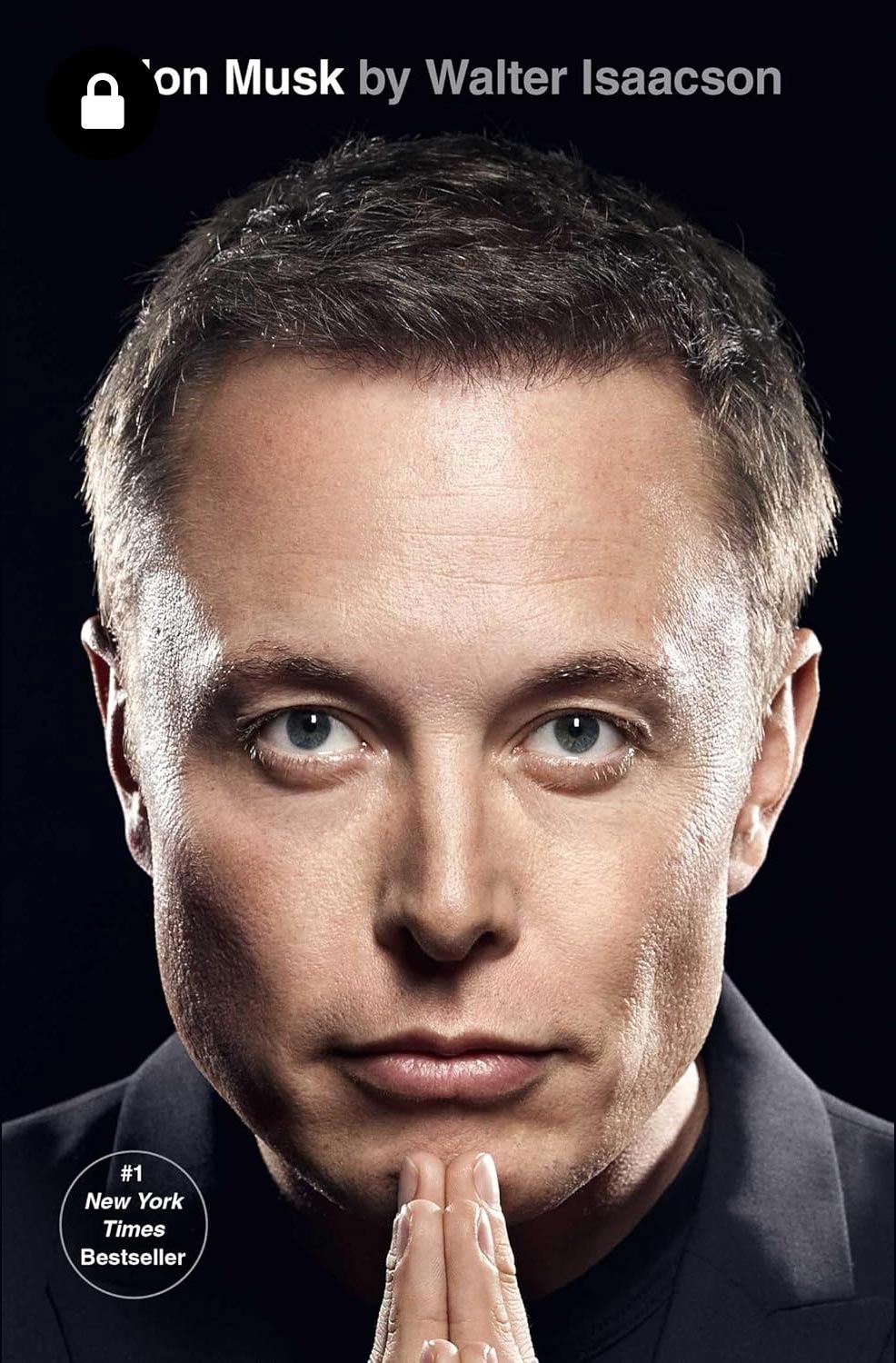
By Walter Isaacson
When Walter Isaacson set out to write this biography of Elon Musk, he committed to shadowing Musk across many facets of his life: within his companies, in his relationships, through his emotional highs and lows. The result is a full-bodied portrait of someone who is as captally ambitious as he is deeply flawed. Isaacson doesn’t shy away from the contradictions. What you get is a window into what makes Musk tick—and also what makes him crash.
Early Years: Roots of Obsession and Resistance
Elon Musk was born in Pretoria, South Africa. His childhood was troubled—marked by bullying at school, family tension, and an emotionally distant father. Isaacson paints a picture of a young boy who was socially isolated yet intensely curious, especially about technology. He taught himself programming, devoured science fiction, and imagined big. The early sense of wanting to escape—to push boundaries—not just for personal achievement, but to reshape the world, emerges here.
One of the threads Isaacson highlights is Musk’s complex relationship with his father. The biography makes clear that part of Musk’s drive is rooted in a desire not to become the man he feared his father could be. That tension—between what you want to reject and what you paradoxically carry inside you—haunts much of his life.
From the start, Musk viewed empathy as a weakness. In fact, the book often underscores how he seems “not hardwired” to have normal emotional responses. This isn’t just narrative flourish—it’s a recurring tone, that Musk’s strengths derive from emotional distance as much as from progress.
In his late teens and early twenties, Musk left South Africa (partly to avoid mandatory service) and eventually landed in North America. He studied at the University of Pennsylvania, then briefly in graduate school, before dropping out to dive headlong into entrepreneurship.
Building the Machines: Zip2, PayPal, and the “PayPal Mafia”
Isaacson then walks through Musk’s early ventures, which laid the foundation for his reputation as a relentless builder. His first significant business was Zip2, an early city guide software that he co-founded with his brother. They sold it eventually, and Musk parlayed that into his involvement in X.com, which evolved into PayPal.
The PayPal era introduced what many call the “PayPal Mafia”—a network of talented founders and engineers who would go on to start major companies. But Musk’s involvement was often combative. He clashed with cofounders, made bold decisions, and proved himself willing to push in ways others balked at.
The sale of PayPal to eBay in 2002 gave Musk capital and legitimacy. But as Isaacson shows, the payoff wasn’t just financial: it was the freedom to take bigger bets. Many of the themes that define Musk from here forward—risk, leadership by extremes, friction with partners—became more intense after this point.
The Rocket and the Car: SpaceX, Tesla, and the High Stakes
Once Musk had the resources, he aggressively plunged into two of his most famous ventures: SpaceX and Tesla.
SpaceX
He launched SpaceX with an audacious goal: make reusable rockets, reduce the cost of space travel, and someday send humans to Mars. The early days were brutal. Contracts were thin, deadlines were slipping, and every launch was do-or-die. Isaacson spends time going into the technical challenges, the near misses, and the brink-of-bankruptcy moments.
One of the key takeaways is how Musk’s attention to detail, willingness to push engineers, and refusal to accept conventional constraints helped SpaceX succeed. But they also came at the expense of loyalty, burnout, and tension.
Tesla
Tesla’s story is equally dramatic. Musk threw himself into the company—immersing in engineering, design, manufacturing, and even the minutiae of supply chain issues. He famously worked in factories, slept in offices, and demanded “production hell” from teams.
Tesla had successes, but also many near-catastrophes. Battery shortages, quality issues, model delays—all tested Musk’s temperament. Isaacson does a good job chronicling how Musk’s intensity could be engine and burden simultaneously.
One recurring theme: Musk often seemed to believe that constraints are there to be broken. Many innovations in Tesla trace back to him pushing against the “impossible” rather than settling for gradual improvement.
Personality & Management Style: The Gift and the Burden
As the narrative develops, Isaacson delves deeper into Musk’s personality. Here are some traits that stand out:
- Mood swings & volatility. Musk has been known to swing between optimism, manic activity, and dark despair. Isaacson doesn’t sugarcoat this. At times the swings affect decision-making, communications, and relationships.
- High risk tolerance. Musk lives on the edge. Whether launching rockets, building cars, or buying Twitter, he’s willing to stake large bets. The stakes are existential rather than incremental.
- Emotional detachment / low empathy. As noted earlier, Musk often treats emotional nuance as an impediment. That trait helps him make cold-hearted decisions but leaves a trail of personal casualties.
- Love for drama and crisis. Crisis isn’t something Musk avoids—it sometimes appears to draw him in. Isaacson suggests that Musk feels more energized when stakes are high and chaos is possible.
- Demanding loyalty & friction. He demands extraordinary performance and commitment from teams. As one would expect, many push back. Some fall out.
- Narrative-building & self-mythologizing. Over time, Musk curates his image as a visionary, a disruptor, almost a messianic figure for humanity’s future. He leans into grand language (“saving humanity,” “multiplanet future”).
Isaacson doesn’t present Musk as a villain or hero; instead he offers the portrait of someone whose strengths and weaknesses are deeply intertwined. The push for greatness often carries collateral damage.
The Personal Life: Love, Loss, and the Unsteady Center
Beyond rockets and electric cars, the biography spends considerable space on Musk’s personal life. Relationships with partners, children, and family are sources of both pain and insight.
One dramatic chapter is his relationship with actress Amber Heard. The book portrays periods of intense romantic highs and lows, culminating in deep heartbreak and emotional turbulence. Isaacson frames it as one of Musk’s more revealing periods—when emotional vulnerability meets a personality accustomed to control.
After that, Musk’s more public relationship with the musician Grimes is explored, complete with its own eccentricities, tensions, and moments of harmony. The way Musk balances large ambitions with intimate relationships becomes a recurring struggle.
His relationship with his children is, in some respects, left ambiguous or distant. His parenting is largely subsumed by his work and public identity. Isaacson presents moments where Musk seems to regret that—but also often seems unable to slow down enough to bridge the gap.
The tension between the public visionary and the private human is a major thread throughout. Musk often constructs a persona of being above the fray. But Isaacson shows the costs of that construction.
Twitter / X: The Gamble of Discourse & Influence
One of the most scrutinized parts of the biography is Musk’s acquisition of Twitter (which he later rebranded as X). He saw the platform as a stage for free speech, a tool for influence, and a way to preserve his narrative in the digital public sphere.
Isaacson describes how Musk’s impulsivity, mood swings, and ambition collided with the complex realities of a social media platform. He underestimated moderation challenges, employee resistance, and the public backlash. The book doesn’t depict him as entirely out of his depth but shows how decisions made in high emotion sometimes had big consequences.
A controversial claim in the book involved Musk ordering Starlink access turned off during a Ukrainian drone offensive over Crimea. That claim was later partly retracted or clarified by Isaacson himself, acknowledging the complexity and some misreporting in the original version.
The Twitter/X chapter is one of the clearest examples of where Musk’s boldness and volatility meet the messy world of public goods, platform governance, and societal norms. The missteps are often as illuminating as the vision.
Leadership Takeaways: What to Admire, What to Question
By the time you finish Elon Musk, you can’t help but come away changed. Here are some of the key leadership lessons (and warnings) that emerge:
What to Admire
No. 1 — Vision + Audacity
Musk thinks in enormous time horizons: colonizing Mars, renewable energy at global scale, AI, neural interfaces. He models for leaders the power of a big mission.
No. 2 — Relentless execution
He never lets go. If something is half-built, he leans in. He doesn’t settle for mediocrity.
No. 3 — Tolerance for risk & failure
Many of his ventures would be too scary for most people. He shows that embracing failure as possibility can catalyze breakthroughs.
No. 4 — Hands-on engineering empathy
Despite his persona, Musk often knows the technical details. He doesn’t just lead from the top; he intervenes deeply in engineering. That gives him credibility—though also friction.
No. 5 — Willingness to disrupt existing institutions
He pushes against industry inertia, regulation, and norms. That disruption often causes discomfort, but sometimes is essential for progress.
What to Question or Critique
No. 1 — Human cost and burnout
People close to Musk often speak of exhaustion, emotional toll, and relationships sacrificed. Leadership by extremes carries collateral damage.
No. 2 — Emotional volatility as strategy
Mood swings and pressure may work in some moments—but can alienate teams or lead to poor decisions.
No. 3 — Lack of emotional connection / empathy
Musk’s low empathy and difficulty relating matter in leadership. Rational decisions can neglect human costs.
No. 4 — Hubris risk
The more audacious the vision, the greater the risk of overreaching. Some ventures (or platform governance choices) suffer from this.
No. 5 — Narrative vs nuance
The myth-making around Musk often overshadows subtlety. Isaacson’s book, despite its ambition, sometimes leans into presenting a heroic arc—even while acknowledging flaws.
In the end, Musk is a study in tension. He’s not wholly a villain or a saint. He’s someone who leans hard on his strengths, gambles with everything, and forces us to wrestle with what happens when audacity meets human limitation.
Final Reflections: A Portrait That Demands Judgment
Walter Isaacson’s Elon Musk is expansive — over 600 pages — and it’s messy, courageous, and arresting. Isaacson succeeded in weaving together public achievements, private failures, and internal contradictions into a single portrait. The author didn’t hide what Musk said, even if it made him uncomfortable. Isaacson later acknowledged corrections, particularly around the Starlink / Ukraine chapter, underscoring how difficult it is to get the full truth in a subject as complex and guarded as Musk.
Reading this biography is less about concluding whether Musk is “good” or “bad,” and more about inhabiting the tension of a figure who pushes boundary after boundary—sometimes successfully, sometimes disastrously. It leaves you thinking: what do we celebrate as greatness? At what point does ambition become recklessness? And to what extent can one human bear the weight of multiple world-scale dreams?
10 Key Lessons from Elon Musk
No. 1 — Think in Decades, Not Quarters
Musk doesn’t just ask, “What will make money this year?” He asks, “What will change the world in 20 years?” Colonizing Mars, electrifying transport, building AI interfaces—his bets are multi-decade visions.
Lesson. Aim at something so big it forces you to play a different game.
No. 2 — Constraints Are Breakable
Engineers often told Musk something was “impossible.” His default answer? “Show me the math.” Often the impossibility was just convention. By refusing to accept given limits, he sparked innovation in rockets, batteries, and car design.
Lesson. Treat “that’s not possible” as the start of the conversation, not the end.
No. 3 — Skin in the Game Creates Urgency
Musk poured his own fortune into Tesla and SpaceX when both were on the brink of collapse. He literally risked everything. That sharpened focus and rallied his teams.
Lesson. Leadership hits different when your own future is tied to the outcome.
No. 4 — Details Matter at the Top
Musk knows wiring diagrams, rocket nozzles, and manufacturing flow charts. He can drill down with engineers at a granular level. That combination of vision + detail sets him apart.
Lesson. Don’t just sell the dream — know the bolts and circuits that make it real.
No. 5 — Crisis Is Fuel
Musk seems most alive when things are falling apart. Isaacson notes he almost creates crisis to keep adrenaline flowing. His companies often hit breakthroughs under immense pressure.
Lesson. Some leaders thrive under fire — but beware of manufacturing chaos as a default mode.
No. 6 — Risk Big, Fail Fast, Repeat
SpaceX rockets blew up. Tesla had “production hell.” Twitter turned into chaos. But Musk iterates fast, learns, and goes again. For him, risk isn’t to be managed away—it’s the path forward.
Lesson. Normalize failure as tuition. The faster you cycle, the stronger you get.
No. 7 — Storytelling Drives Capital & Talent
Musk is a master myth-maker. “Saving humanity,” “making life multiplanetary”—these big narratives draw investors, employees, and believers. Without story, the risk would look insane.
Lesson. People don’t rally to spreadsheets. They rally to stories.
No. 8 — Intensity Is Contagious—and Dangerous
Musk demands almost superhuman effort from his teams. It breeds breakthroughs, but also burnout and turnover. His mood swings amplify this intensity.
Lesson. Energy sets culture. Be deliberate about the intensity you broadcast.
No. 9 — Flawed Humanity Doesn’t Cancel Greatness
Musk’s lack of empathy, volatility, and personal struggles are undeniable. But those flaws coexist with his world-changing achievements. Isaacson shows both are true.
Lesson. Leadership is rarely clean. Strengths and flaws are often the same traits in different doses.
No. 10 — Legacy Is Built in Real Time
From rockets to EVs to social media platforms, Musk’s choices are shaping industries and cultures now—not later. The biography reminds us: history is written in the mess, not in hindsight.
Lesson. Every decision you make today is already part of the story people will tell tomorrow.
Big Picture Takeaway. Musk is a paradox. His brilliance is inseparable from his volatility. You don’t have to copy his extremes to learn from him. But his life shows what’s possible when you refuse to accept limits—and what it costs when you do it without balance.