Listen to this Book Summary, 9 min, read by Simon
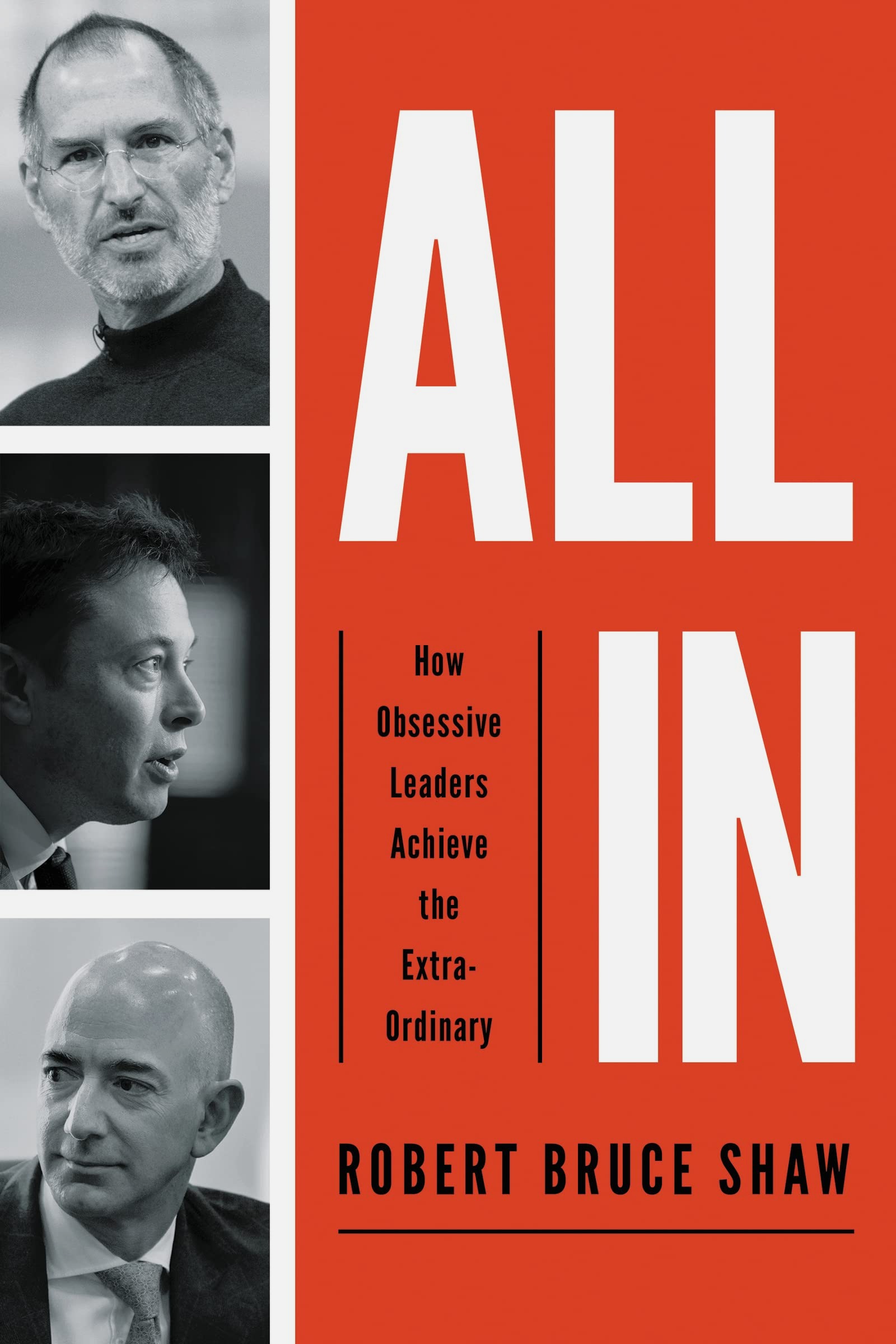
By Robert Bruce Shaw
An executive can say that customers come first and still spend most of the week discussing costs, staffing and next quarter’s numbers. Everyone in the business hears the declaration. They also see which problems get a meeting on short notice and which ones have been on the agenda since April. Robert Bruce Shaw’s All In is about leaders whose priorities are considerably easier to identify. Jeff Bezos wanted Amazon to make life easier for customers. Elon Musk wanted Tesla to build an electric car people would actively choose to drive. Travis Kalanick wanted Uber to grow at a speed that made it extraordinarily difficult to catch. Each fixation helped build a business that changed its industry. Each also determined what the people around the leader could afford to take seriously.
BUY THIS BOOK
What Obsession Adds to Grit
Shaw begins by distinguishing obsession from grit. Grit helps explain why someone persists when the work gets hard or tedious. Obsession helps explain why one particular undertaking keeps claiming their attention in the first place. The person may be quite capable of working hard at other things, yet this is the problem they keep coming back to, often at the expense of other reasonable demands on their time. For an organisation trying to do something difficult, that concentration can be valuable. A leader who is willing to stay with a problem through successive disappointments gives a team time to get past the obvious solutions and discover what the work actually requires.
The distinction matters because plenty of demanding bosses spread their demands around indiscriminately. Everything needs attention, every project is urgent, and everyone leaves the meeting with more work than they came in with. Shaw’s examples make it possible to see a different kind of intensity. An obsession gives people an idea of which work deserves the extra effort. It also raises a question the rest of the book keeps returning to. If one goal has enough authority to settle most arguments, what happens when somebody has a good reason to challenge it?
Amazon and the Discipline of Starting With the Customer
In Shaw’s account of Amazon, Bezos’s achievement was to make customer obsession part of how the company made decisions. Amazon’s early shareholder letter explicitly linked the creation of an enduring business to the value it could deliver to customers and made clear that the company would judge investments over a long horizon. Those commitments reinforced each other. Improving the experience of buying online could take years of spending and experimentation, with returns that were hard to see in the quarter when the money went out. A leadership team interested chiefly in immediate results would have had plenty of opportunities to lose patience.
Amazon’s practice of working backwards makes the idea concrete. Before building a service or feature, a team writes a prospective press release and a set of frequently asked questions. The exercise forces people to explain what will improve for the customer and deal with awkward questions while changes are still relatively cheap. You can imagine how useful that is in a room full of people who are keen to build something and understandably inclined to overestimate how much anybody else will care. It also shows how an obsession can survive the founder’s absence from a meeting. People have a way to examine the proposal and ask for better answers without waiting for the most powerful person in the company to show up.
Tesla and the Product People Had to Want
Tesla gives Shaw a different example of focus. Musk’s early plan called for starting with a high-performance electric sports car and using that foothold to develop increasingly affordable vehicles. The Roadster had a job to do beyond selling a certain number of cars. It had to give buyers a reason to want an electric vehicle on its merits and demonstrate what one could be capable of. Starting at the expensive end made more sense once you understood the sequence. An early product with limited reach could help make a much broader ambition credible.
Shaw uses Musk to show what happens when a leader cares enough about the product to get deeply involved in the decisions that shape it. There is obvious value in having someone with authority insist that a technical problem is worth solving when everyone else has good reasons to settle. There’s a harder judgment about which problems deserve that treatment. An executive can see a compromise as a failure of imagination while an engineer sees the consequence of a real constraint. What makes the case interesting is that both people may be doing their jobs well. A company benefits from the pressure to find out what is possible, and it needs the person who can explain what the latest idea will cost in time, money or work elsewhere.
Uber and What Growth Could Justify
Uber’s story gives the book much of its tension. Kalanick’s appetite for expansion was well suited to a business that needed enough drivers and passengers in each market to make the service useful. A rider offered a car in a few minutes has a reason to use the app again, and drivers have a reason to stay available if requests arrive regularly. Speed could help the company create those conditions. Shaw takes that achievement seriously, which makes his account of the damage more persuasive. Growth had a commercial logic, and its success made it harder for people inside the company to argue that particular ways of getting it were unacceptable.
In 2017, Uber’s board adopted recommendations arising from an outside investigation into its culture and practices. Kalanick subsequently resigned as chief executive under pressure from investors. One implication of Shaw’s account is that by the time a board has to intervene, people inside a company may have spent years learning which concerns they can raise without being treated as obstacles. Rapid expansion can make those lessons especially difficult to undo. The numbers are visible and arrive regularly. Getting a sound account of what people have had to put up with to produce them takes considerably more work, particularly if the people involved have little reason to expect a sympathetic hearing.
What the Company Can Carry Forward
Steve Jobs appears in the book as a point of comparison and as an example of a founder whose ambitions extended to the institution itself. Shaw regards Apple as Jobs’s most consequential creation because a particular way of thinking about products and making choices continued after his death. That puts a different emphasis on the familiar account of Jobs’s tastes and temperament. There is a limit to how much a company can do with one person’s extraordinary judgment if every difficult choice has to go through that person. Its more lasting accomplishment is to develop people who understand why a decision was made and are capable of applying that understanding to a problem the founder never encountered.
Shaw closes by looking at the bargain from both sides. An individual has to decide whether a particular pursuit is worth the demands it will make, including demands that colleagues and family members may have little say in accepting. An organisation has to give unusually driven people room to do serious work and decide how it will handle the friction their intensity can create. One distinction I took from this is between asking people to care deeply about excellent work and assuming they should organise their lives around it as the founder has. An employee can bring superb judgment to a project and still want to go home at a reasonable hour. If the company takes that as a sign of indifference, it may overlook some of the people best equipped to help.
The question I was left with is what a leader does when someone brings evidence that the pursuit is costing more than they thought. A customer complaint may expose a flaw in a much-loved product. An engineer may show that one more feature will jeopardise the deadline. An employee may have something to say about how a high performer gets results. These are different conversations, but each asks the leader to hear something unwelcome about work they care a great deal about. Shaw makes a good case for what can happen when people give an extraordinary amount of themselves to a worthwhile problem. I’d pay particular attention to the colleagues who can look at the same work, see what the leader has missed and still feel free to say it.