Listen to this Book Summary, 17 min, read by Simon
By Josh Dean
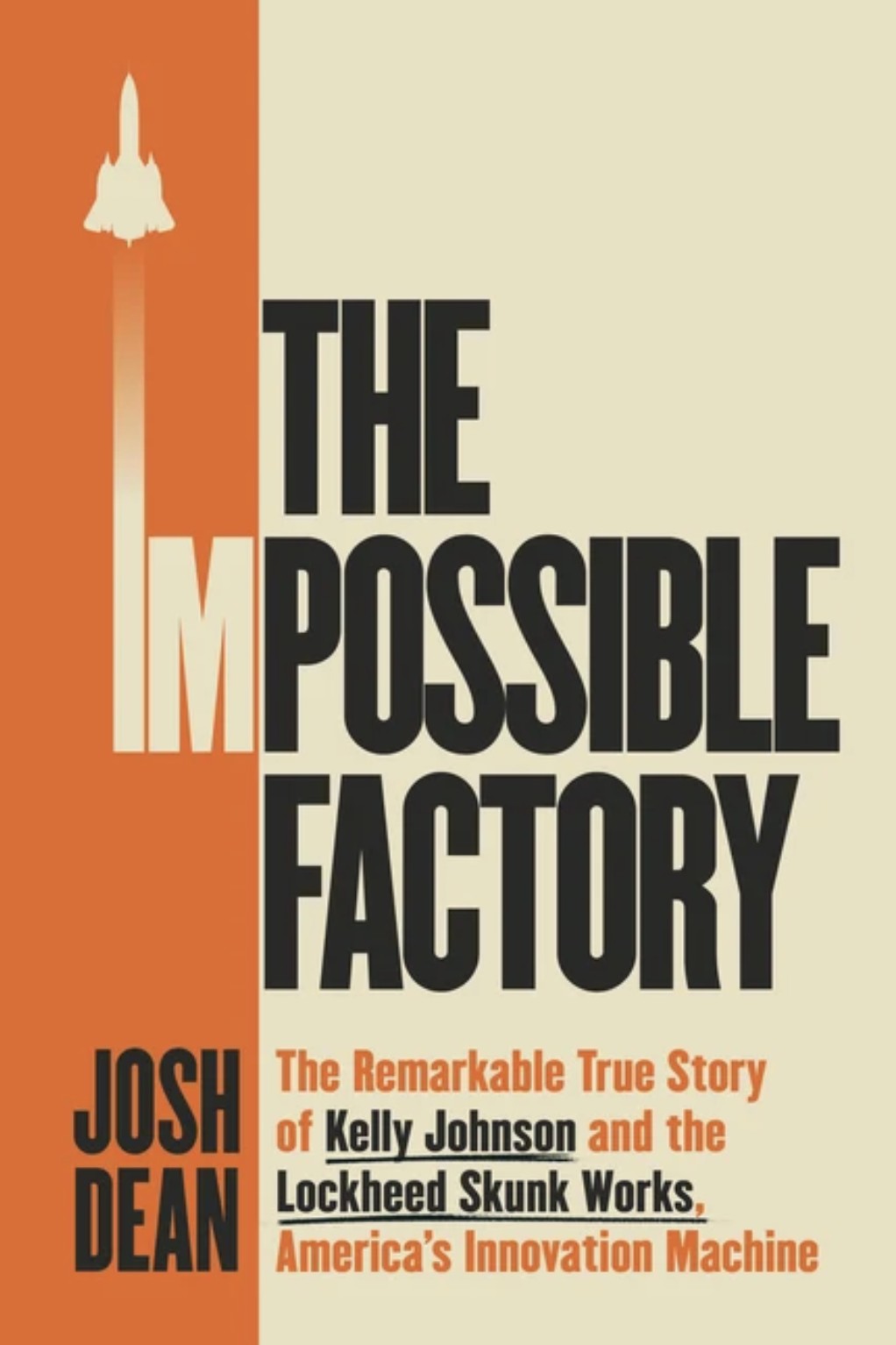
Josh Dean’s The Impossible Factory is both a biography of Clarence “Kelly” Johnson and a history of Lockheed’s legendary Skunk Works, the secretive innovation shop that helped define twentieth-century aerospace engineering. Published by Dutton in May 2026, the book runs 496 pages and tells the story of how one unusually gifted engineer, working with unusually small teams under unusually intense constraints, helped produce some of the most consequential aircraft in modern history.
BUY THIS BOOK
The book’s deeper subject is not simply airplanes. It is the conditions under which extraordinary technical work becomes possible. Dean uses Johnson’s life and career to explore how speed, secrecy, simplicity, trust, technical obsession, and disciplined autonomy can create breakthroughs that conventional organizations often smother. The Skunk Works was not just a department. It became a working philosophy.
The publisher describes the Skunk Works as the radical Lockheed Martin innovation hub that designed many of the greatest airplanes of the twentieth century, beginning in a modest Burbank warehouse and growing into a model for fast, flat, high-consequence engineering. The book therefore operates on two levels. It is a sweeping aviation history, but it is also a study in leadership, organizational design, and the rare discipline of making impossibly hard work feel almost inevitable.
Kelly Johnson: The Engineer as Force of Nature
Kelly Johnson was not a self-promoter. Kirkus notes that he rarely sought publicity, even though Dean credits him with having origins in “no fewer than 40 aircraft” across his Lockheed career. That gap between public modesty and historical influence is part of what gives the book its force. Johnson’s life was not built around celebrity. It was built around output.
Born near the beginning of the aviation age, Johnson grew up fascinated by science, engineering, and flight. Kirkus describes him as an avid reader of science and engineering books, someone drawn early to the spirit of invention and technical mastery. He was the kind of figure who seemed almost designed for the age he entered: aviation was young, the limits of aircraft performance were still being discovered, and the world would soon need machines that could fly higher, faster, farther, and under conditions that would have sounded absurd only a few years earlier.
His early Lockheed career began humbly. Kirkus notes that he started at the revived Lockheed firm as an $83-per-month tool designer, but quickly became part of a group of engineers who could do many things at once. That breadth mattered. Johnson was not simply a theorist. He understood design, manufacturing, testing, performance, and the practical realities of turning technical ambition into working aircraft.
The Birth of the Skunk Works
The origin story of the Skunk Works is one of the book’s central episodes. According to Penguin Random House, Johnson had the idea in 1938 for a small, agile engineering shop that could help America innovate more quickly. By 1943, during World War II, Lockheed’s Advanced Development Projects, later nicknamed the Skunk Works, was born.
The timing mattered. War compressed timelines. Bureaucratic caution became dangerous. The United States needed aircraft development at a pace normal corporate structures were not designed to deliver. Johnson’s insight was that a smaller, more autonomous unit could move faster than the parent company’s traditional processes. The Skunk Works became a place where engineers and builders worked close together, where paper was minimized, where decisions were made quickly, and where the people closest to the problem were trusted to solve it.
This was not chaos disguised as speed. It was disciplined informality. Johnson believed in lean teams, direct communication, minimal interference, and fierce technical accountability. The book’s official site highlights several of the operating ideas associated with Johnson’s world: move fast, keep things simple, accept only one miracle per project, reduce walls, and minimize paperwork.
Those phrases can sound like startup mythology now. Dean’s achievement is to show that in Johnson’s case they were not branding. They were operating rules forged under extreme pressure.
The Planes That Changed History
The book’s narrative moves through a remarkable sequence of aircraft. Penguin Random House lists several of the great achievements associated with Johnson and Lockheed: the P-38 Lightning, the XP-80, the Constellation, the U-2, and the A-12/SR-71 Blackbird. Each aircraft represents a different kind of breakthrough.
The P-38 Lightning became one of the signature American fighters of World War II. The XP-80 was America’s first operational fighter jet and represented the urgent transition from propeller aircraft into the jet age. The Constellation helped revolutionize commercial air travel with its pressurized cabin and long-range capability. The U-2 spy plane took the story into the Cold War, flying at extraordinary altitude for covert reconnaissance missions. The A-12 and SR-71 Blackbird pushed performance into an almost mythic category, combining speed, altitude, materials science, aerodynamics, and intelligence requirements in ways that still command awe.
What ties these machines together is not only engineering brilliance, but organizational method. Dean presents the Skunk Works as a place built to take on impossible specifications. Fly higher than anyone thinks possible. Build faster than normal procedures allow. Deliver under secrecy. Solve problems others believe cannot be solved.
The title The Impossible Factory is therefore not romantic exaggeration. It captures the recurring pattern. Johnson’s teams repeatedly took requirements that sounded unreasonable and turned them into aircraft that changed military, commercial, and technological history.
Speed, Secrecy, and Trust
The Skunk Works model depended on speed, but speed alone would have been dangerous without trust. Johnson could move quickly because the teams were small, skilled, and unusually empowered. Engineers did not need to navigate endless layers of approval. Builders and designers worked closely enough that problems could be addressed as they appeared. The organization reduced the distance between idea, prototype, correction, and execution.
This is one of the most useful lessons of the book for modern leaders. Bureaucracy often presents itself as risk management. Sometimes it is. But too much bureaucracy creates its own risk: the risk that the organization becomes too slow to meet the moment. Johnson’s genius was not merely technical. It was structural. He understood that certain kinds of innovation require different organizational conditions.
The publisher emphasizes that under Johnson, Skunk Works became known for flat management, minimal red tape, and extraordinary speed, eventually influencing later ideas about nimble innovation and startup culture. That comparison is not perfect, because Skunk Works operated in a high-stakes defense environment with technical, geopolitical, and national security consequences. But the underlying principle remains relevant: innovation is not just an attitude. It is an architecture.
The Discipline Behind the Myth
The danger with Skunk Works mythology is that it can be reduced to slogans. Move fast. Break rules. Cut red tape. Trust geniuses. Leave them alone.
Dean’s book appears to complicate that myth. Johnson’s method was not a license for reckless improvisation. It was demanding, exacting, and intensely disciplined. The Skunk Works moved fast because it removed waste, not because it ignored consequences. It took risks, but the risks were anchored in technical rigor. It operated outside normal bureaucracy, but not outside accountability.
This is the distinction many organizations miss. They want innovation without discipline, autonomy without standards, speed without technical excellence, and freedom without responsibility. Johnson’s world did not work that way. His teams could be fast because they were deeply competent. They could be autonomous because they were accountable. They could simplify because they understood complexity well enough to know what could safely be removed.
That is a different lesson from the one often celebrated in modern innovation culture. The Skunk Works was not a playground for unfocused creativity. It was a high-performance environment where urgency, skill, trust, and consequence were tightly linked.
Johnson’s Leadership
Johnson emerges as a demanding, brilliant, sometimes difficult leader whose standards shaped the culture around him. Kirkus describes him as both a genius and intensely driven, while Penguin’s description emphasizes that his management style became as important as the planes themselves.
His leadership was based on proximity to the work. He was not an executive abstracted from technical reality. He understood the machines, the constraints, the tradeoffs, and the people doing the work. That gave him unusual authority. People followed not merely because of title, but because he could see what mattered.
At the same time, the book’s story is also about the team Johnson assembled. The Skunk Works was not a one-man miracle. It required engineers, test pilots, machinists, military leaders, intelligence officials, manufacturers, and successors. Praise from Katherine Sharp Landdeck on the publisher’s page notes that the book reveals Johnson as a person while also showing the broader group of people essential to building the world shaped by these aircraft.
That is important. Great innovation often gets simplified into hero biography. Dean’s subject is Johnson, but the Skunk Works story also reminds us that the best leaders create environments where extraordinary people can do extraordinary work together.
The Cold War Context
The Cold War gives much of the book its geopolitical weight. Aircraft such as the U-2 and SR-71 were not merely feats of engineering; they were instruments of intelligence, deterrence, and strategic advantage. The U-2’s ability to fly at extremely high altitude made it valuable for dangerous covert missions during the height of Cold War tension.
This context matters because it raises the stakes. The Skunk Works was not building clever products for a market niche. It was building machines tied to national security, secrecy, espionage, and the balance of power. That pressure created urgency, but it also demanded reliability. Failure was not simply commercial embarrassment. It could have diplomatic, military, or human consequences.
Dean’s book seems to place Johnson’s career inside the broader arc of American twentieth-century power: World War II, the rise of the defense industry, the Cold War, the jet age, commercial aviation, reconnaissance, stealth, and the institutionalization of advanced aerospace engineering.
The Legacy: More Than Aircraft
The central lesson of The Impossible Factory is that Johnson’s legacy was not only the aircraft. It was the method. Penguin’s description explicitly states that the planes were only part of his legacy and that his management style shaped organizations for decades.
That may be the book’s greatest relevance now. At a time when governments and companies are again asking how to accelerate innovation, rebuild industrial capacity, and solve complex technical problems, the Skunk Works story feels freshly important. It suggests that breakthrough work requires more than talent and money. It requires operating principles that protect speed, clarity, trust, competence, and accountability.
The Skunk Works model also reminds us that not all bureaucracy is neutral. Some processes protect quality. Others protect comfort. Some governance reduces risk. Too much governance can make risk invisible by preventing serious innovation from happening at all.
Conclusion: The Human System Behind the Machine
The Impossible Factory is ultimately a story about the human system behind impossible machines. Kelly Johnson mattered because he combined engineering genius with an instinct for how work should be organized. He understood that extraordinary output requires a different kind of environment: smaller teams, fewer layers, direct communication, technical seriousness, urgency without chaos, and enough trust to let capable people solve hard problems without being buried in process.
The book also offers a warning. Organizations often celebrate innovation while building structures that make innovation almost impossible. They say they want speed, then require endless approvals. They say they want accountability, then separate decision makers from consequences. They say they want breakthrough thinking, then bury technical people under status meetings and paperwork.
Johnson’s Skunk Works cut through that. It did not make the work easy. It made the work possible.
That is why the story remains so compelling. The aircraft were extraordinary, but the deeper achievement was cultural. Johnson built a place where impossible assignments could be approached with discipline rather than drama. He turned urgency into method. He turned secrecy into focus. He turned small teams into national capability. And in doing so, he helped create not only airplanes, but a lasting model of what extreme innovation can look like when brilliant people are trusted, pressured, protected, and held to the highest possible standard.
Five Key Takeaways
No. 1 — The Skunk Works was not just an engineering group. It was an operating model built around speed, secrecy, autonomy, simplicity, and technical accountability.
No. 2 — Kelly Johnson’s genius was organizational as well as technical. He knew that impossible engineering challenges required a different structure from conventional corporate bureaucracy.
No. 3 — The aircraft mattered enormously, but the method may be Johnson’s most enduring contribution.
No. 4 — True speed is not the absence of discipline. In the Skunk Works model, speed came from competence, proximity to the work, clear authority, and reduced waste.
No. 5 — The book is highly relevant for modern leaders because it shows that innovation is not created by slogans. It is created by designing conditions where serious people can solve serious problems quickly.