Listen to this Book Summary, 16 min, read by Simon
By Arun Gupta and Thomas J. Fewer
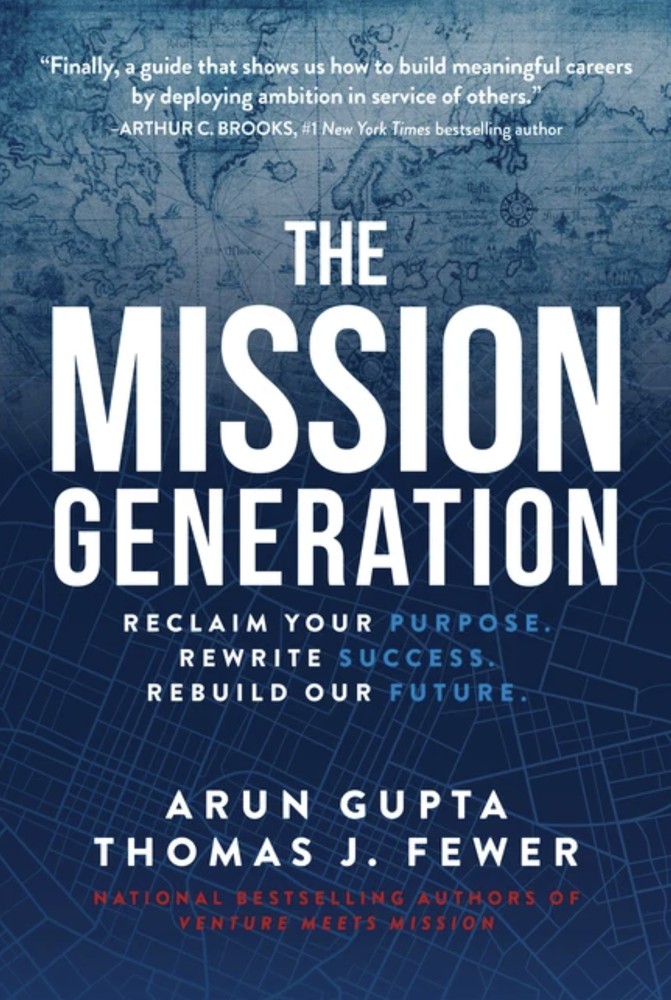
The Mission Generation by Arun Gupta and Thomas J. Fewer is a career book, but not in the narrow sense of helping people climb faster, network better, or find the next title. It is a book about what happens when the old bargain between work and meaning begins to fall apart. Published by Wiley in May 2026, the book is aimed at people across career stages, from early career professionals to midlife pivoters and later career leaders asking how they can keep contributing in a world that no longer rewards linear planning the way it once did.
BUY THIS BOOK
The premise is simple, but unsettling. The old scripts are broken. The book argues that the “Mission Generation” is not defined by age, but by conviction. It includes people who are no longer content to ask only, “What job should I take?” or “How do I advance?” They are asking a deeper question: “What problem am I here to solve?” That shift turns career planning into something larger than personal optimization. It becomes a way to align ambition, capability, contribution, and public purpose.
Gupta brings the perspective of a venture capitalist, Stanford lecturer, Georgetown professor, and CEO of NobleReach Foundation, while Fewer brings an academic lens as an Assistant Professor of Management at Rutgers University School of Business, Camden, with research focused on business, government, civic institutions, politics, purpose, and public impact. The book sits at that intersection: personal career development, civic responsibility, entrepreneurship, institutional change, and mission driven leadership. Wiley’s page for The Mission Generation: Reclaim Your Purpose, Rewrite Success, Rebuild Our Future includes the full description and both author biographies.
The Old Career Bargain Has Broken
The first major argument of the book is that many people are still organizing their lives around a career model built for a more stable world. The old model assumed a relatively predictable sequence. Learn in youth, earn in midlife, return later through philanthropy, mentoring, service, or legacy work. The authors argue that this sequencing no longer fits the world people are actually living in. Technological disruption, AI, geopolitical uncertainty, environmental pressure, political polarization, and institutional weakening have made the thirty-year career plan far less reliable.
This does not mean the authors are pessimistic. In fact, the book appears to be built around a more hopeful claim: instability can become a call to agency. Gupta argues in his McKinsey interview that systems designed for stability can now hold people back, and that in a rapidly changing world, stability itself can become risky. The point is not that chaos is good. The point is that clinging to old maps may be more dangerous than learning to build a new compass. The full conversation is in McKinsey’s Author Talks: Feeling stuck? Turn uncertainty into purpose.
That compass is mission. For Gupta and Fewer, mission is not a job description, a slogan, or a vague feeling of personal fulfillment. It is a durable problem you choose to stay with over time, matched with the skills, values, background, relationships, and resources you can bring to bear. Mission gives people a way to navigate when roles change, institutions weaken, and credentials alone no longer guarantee security.
Purpose Is Not a Luxury. It Is Navigation.
One of the book’s strongest ideas is that purpose should not be treated as a decorative layer added after success. The authors challenge the notion that people should first secure themselves financially and professionally, then later worry about meaning. In their view, the old separation between earning and contributing no longer works.
This is where the book becomes more provocative. It does not ask readers to choose between making money and making meaning. It argues that the choice itself is often false. Purpose and profit, mission and ambition, contribution and career stability can belong in the same conversation. Porchlight’s overview describes the book as offering a blueprint that does not force people to choose between money and meaning. Porchlight’s page for the book, The Mission Generation by Arun Gupta, carries that overview along with the publisher’s description.
That matters because many people hear “mission” and assume sacrifice. They imagine nonprofit work, lower pay, or a noble but impractical life. Gupta and Fewer appear to argue the opposite. Mission can become a source of strategic clarity. It can help people decide what to learn, which relationships to build, what risks to take, which roles to pursue, and where to invest their energy. In an unstable world, purpose becomes less like a luxury and more like a navigation system.
The book’s practical question is therefore not “What is my dream job?” but “What problem feels personal enough for me to keep serving it over time?” That formulation is important because dream jobs can disappear, change, disappoint, or be automated. Problems endure. A person who knows the problem they want to serve can move across sectors, roles, organizations, and life stages without losing the thread.
Resistance Is Part of the Work
The book’s second major movement focuses on resistance. According to the listed table of contents and publisher materials, the authors identify four forms of resistance that block meaningful work: psychological, relational, cultural, and systemic.
Psychological resistance is the voice inside the head that asks whether we are good enough, ready enough, qualified enough, or brave enough. It is the inner saboteur that turns uncertainty into paralysis. Relational resistance comes from people around us, often people who care about us, who may see mission driven choices as risky, impractical, or strange. Cultural resistance comes from the prestige signals around us, the invisible ranking system that tells us which careers count and which paths should be admired. Systemic resistance comes from institutions designed for predictable, long-term stability, even though many people now need more flexible, cross-sector, portfolio-based careers.
The authors’ answer to resistance is not heroic certainty. It is motion. Gupta argues that being stuck is not failure, but a signal to act. The antidote to paralysis is not waiting for perfect clarity. It is running small experiments, having conversations, building relationships, testing assumptions, and allowing action to create information.
This is a useful correction to the way many people think about purpose. They assume purpose must arrive as a revelation before action begins. The book argues that purpose often emerges through action. You do not think your way fully into a meaningful life. You move, test, learn, adjust, and discover where your energy, skills, and contribution begin to compound.
The Six Compass Capitals
One of the book’s central frameworks is “Compass Capital.” The publisher description identifies six forms of capital: mission, trust, health, learning, experience, and financial. These capitals are presented as a broader way to think about career security and long-term contribution.
This is one of the book’s most important contributions. Traditional career advice often overweights financial capital and credentials. Gupta and Fewer argue that people also build assets that may not appear on a financial balance sheet but become decisive over time. Trust capital is the reputation and credibility that allow people to work across boundaries. Health capital is the physical and emotional capacity to continue doing meaningful work. Learning capital is the habit of remaining adaptable as technology, industries, and institutions change. Experience capital is the wisdom earned through lived exposure, mistakes, pattern recognition, and context. Mission capital is the clarity and conviction that help people choose where to deploy themselves. Financial capital still matters because it creates autonomy and optionality.
The authors intentionally use the word capital because these assets can compound. Relationships built early can open doors decades later. Health maintained over time expands the range of possible future contributions. Learning capacity becomes more valuable as skills become obsolete faster. Experience becomes powerful when applied to new problems.
This framework is especially useful for midcareer and later career readers. It reframes transition not as starting over, but as reallocating capital. A person who changes sectors, takes a career break, cares for a loved one, or moves into mission driven work has not necessarily paused their development. They may be building different forms of capital that conventional career language does not properly value.
The Mission Flywheel
Another core model in the book is the Mission Flywheel. The table of contents describes it as a process that begins with recognizing your mission, reframing your experiences, running experiments, recruiting allies, reinvesting to scale, and regenerating well being.
The flywheel metaphor matters because it moves the discussion away from one dramatic breakthrough. The book argues that meaningful careers are built through small, strategic actions that compound. A side project, a course, a conversation, a volunteer role, a new relationship, a prototype, or a small professional bet can begin to generate information and momentum. Over time, those actions clarify direction.
The model is pragmatic because it recognizes that people rarely get total certainty before moving. Instead, they need enough direction to take the next experiment seriously. They then learn from the experiment, recruit people who can help, build credibility, reinvest resources, and protect their energy so the mission remains sustainable.
The inclusion of regeneration is particularly important. Mission driven people are vulnerable to overextension. When work feels meaningful, it becomes easier to ignore exhaustion. The book’s framework therefore treats well being not as a separate personal issue, but as part of the operating system of long-term contribution.
The Dual Citizen Advantage
Part III of the book is titled “The Dual Citizen Advantage,” and the chapter titles suggest that the authors apply their ideas across career stages: early bets, midcareer pivots, and late career reinvention. The point appears to be that mission driven careers often require crossing boundaries. Between public and private sectors. Between profit and purpose. Between one discipline and another. Between what a person has already learned and what the world now needs.
For early career readers, the book seems to encourage the courage to be wrong and to take small bets before all the signposts are visible. For midcareer professionals, the message is that a pivot does not have to mean abandonment. Gupta explicitly says the authors are not telling midcareer workers to start over; they are encouraging reorientation, using existing skills toward a problem that matters more deeply.
For later career readers, the book challenges the assumption that legacy work begins only after the main career is over. The listed chapters refer to the beginner’s mindset, translation, mentorship, and the idea that mission does not have to end. This is a valuable idea in an aging society where experience is often underused, and where many older leaders still have energy, wisdom, networks, and judgment that can be redirected toward public impact.
Rewriting Success
The final section of the book turns from individual navigation to broader systems. The table of contents includes chapters on “The Portfolio of You” and “Civic Platforms,” suggesting that the authors want readers to rethink both personal career architecture and the institutions that shape work.
The phrase “portfolio” is central. Careers are no longer simply ladders. They are portfolios of skills, relationships, missions, experiments, roles, and forms of capital. That shift requires people to know their role, not just their title. It asks them to measure what actually matters, design for how they work best, and build momentum through intentional choices rather than passive advancement.
The civic platform idea expands the book’s ambition. Gupta and Fewer are not merely telling individuals to find more meaningful work. They are arguing that societies need better pathways for talent to move toward public problems. Education, industry, government, and local communities must become more adaptive if people are going to braid learning, earning, and returning across the whole of life rather than keeping them in separate phases.
Conclusion: A Manual for Agency
The Mission Generation is ultimately a book about agency in a world where many people feel disoriented. It says that uncertainty does not have to produce drift. It can produce direction, if people are willing to stop waiting for institutions to assign meaning and begin authoring a life around problems that matter.
Its most powerful idea is that mission is not a luxury reserved for the privileged, the young, the retired, or the already successful. Mission is a practical compass. It helps people decide what to learn, where to serve, who to work with, what to stop chasing, and how to build a life that can adapt without losing its center.
The book does not romanticize purpose as a lightning strike. It treats purpose as a discipline. You build it through experiments, relationships, capital allocation, health, learning, trust, and repeated action. You do not need perfect clarity to begin. You need enough conviction to move, enough humility to learn, and enough courage to keep aligning your ambition with something larger than yourself.
In that sense, the Mission Generation is not a demographic. It is a choice. It is the choice to stop asking only whether your career is advancing and start asking whether your life is contributing. It is the choice to treat disruption not merely as threat, but as an invitation to rebuild the relationship between success and service.
The old ladder may have collapsed. Gupta and Fewer’s answer is not despair. It is a compass, a portfolio, and a flywheel. Find the problem that matters, bring what you have, keep moving, recruit others, compound your capitals, and build a career that does not merely survive uncertainty, but turns it into purpose.