By Daniel H. Pink
For much of the twentieth century, organizations, schools, governments, and even families operated under a relatively simple assumption about human motivation: reward good behavior and punish bad behavior. The belief was straightforward. If you want people to perform better, offer incentives. If performance falls short, impose consequences.
This approach became deeply embedded in modern management. Bonuses, commissions, merit pay, employee-of-the-month programs, performance rankings, and countless other systems were built upon the idea that external rewards drive human behavior.
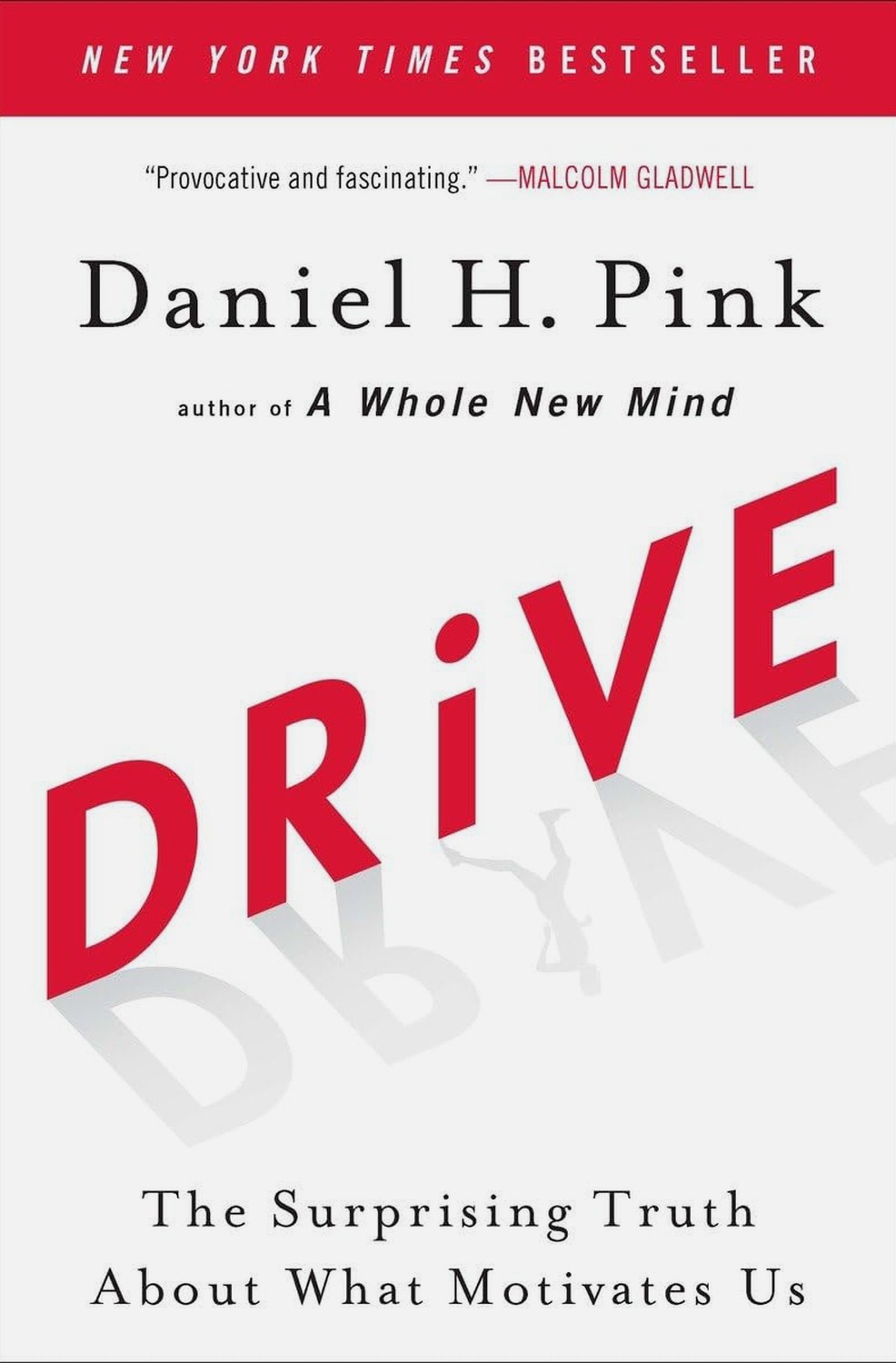
In Drive: The Surprising Truth About What Motivates Us, Daniel Pink argues that this model is increasingly outdated and, in many cases, counterproductive.
BUY THIS BOOK
Drawing on decades of research in psychology, behavioral science, and economics, Pink presents a compelling case that traditional reward-and-punishment systems often fail to motivate people in today’s knowledge-based economy. More importantly, he argues that the highest levels of performance, creativity, engagement, and satisfaction emerge from a very different source: intrinsic motivation.
The book challenges conventional wisdom and offers a new framework for understanding what truly drives human behavior.
Motivation 1.0, 2.0, and 3.0
Pink begins by describing the evolution of human motivation through three stages.
Motivation 1.0 refers to humanity’s earliest operating system: biological survival. Humans were motivated primarily by basic needs such as food, shelter, safety, and reproduction.
Motivation 2.0 emerged as societies became more complex. This operating system was based on rewards and punishments. Individuals worked to obtain rewards and avoid negative consequences. For centuries, this approach proved effective in agricultural, industrial, and manufacturing environments where work was largely routine and repetitive.
The problem, according to Pink, is that much of today’s work is no longer routine.
Modern economies increasingly depend on creativity, innovation, problem-solving, collaboration, and knowledge work. Yet many organizations continue to use motivational systems designed for factory floors rather than knowledge workers.
Pink argues that we need a new operating system: Motivation 3.0.
This system recognizes that people are naturally driven by deeper psychological needs and that sustainable motivation often comes from within rather than from external incentives.
The Problem with Carrots and Sticks
One of the book’s central arguments is that external rewards can actually reduce performance in certain situations.
Pink cites research from psychologists such as Edward Deci, Richard Ryan, and others who discovered that rewards can undermine intrinsic motivation. This phenomenon became known as the “overjustification effect.”
When people enjoy an activity for its own sake and then begin receiving rewards for doing it, their internal motivation often declines.
In one famous study, participants who enjoyed solving puzzles became less interested in the activity after being paid to complete it. Once the rewards disappeared, their engagement dropped significantly compared to those who were never rewarded.
The implication is profound.
Rewards can be effective for simple, routine tasks that require compliance. However, when tasks involve creativity, innovation, judgment, or complex problem-solving, rewards may actually narrow focus and reduce performance.
Pink references numerous studies demonstrating that larger rewards do not necessarily lead to better outcomes. In some cases, they lead to worse outcomes because they increase pressure, reduce experimentation, and encourage short-term thinking.
This challenges one of the most deeply held assumptions in modern management.
The Sawyer Effect
Pink introduces what he calls the “Sawyer Effect,” inspired by a scene from Mark Twain’s The Adventures of Tom Sawyer.
Tom is tasked with painting a fence, which initially feels like work. Through clever manipulation, he convinces other boys that painting the fence is enjoyable and desirable. Soon, they are eager to do it themselves.
The lesson is simple.
Work can become play, and play can become work, depending on how people perceive the activity.
Organizations often unintentionally transform meaningful activities into obligations by over-relying on rewards, controls, and external incentives.
People who once loved their work may begin viewing it as merely a means to obtain compensation.
The challenge for leaders is creating environments where individuals maintain a sense of ownership, purpose, and enjoyment in what they do.
The Three Elements of Motivation 3.0
Pink argues that true motivation rests on three fundamental pillars: autonomy, mastery, and purpose.
Autonomy
The first pillar is autonomy.
Human beings have a deep desire to direct their own lives. People want control over their work, their decisions, and how they spend their time.
Traditional management systems often assume that employees require constant supervision and control. Pink argues that this assumption is both outdated and inaccurate.
Research consistently shows that people perform better when they experience greater autonomy.
Pink highlights examples such as Google’s famous “20 Percent Time,” which allowed employees to spend part of their workweek pursuing projects of personal interest. Products such as Gmail reportedly emerged from this practice.
Autonomy does not mean the absence of accountability.
Rather, it means providing individuals with meaningful control over four key dimensions: what they do, when they do it, how they do it, and with whom they do it.
The more autonomy people experience, the more engaged and motivated they tend to become.
Mastery
The second pillar is mastery.
Human beings possess a natural desire to improve.
People enjoy making progress, developing skills, and becoming better at things that matter to them.
Pink argues that mastery is a powerful source of motivation because it satisfies a fundamental psychological need for growth.
However, mastery has several important characteristics.
First, mastery is never fully achieved. It is a journey rather than a destination. No matter how skilled someone becomes, there is always another level to pursue.
Second, mastery requires effort and deliberate practice. Growth occurs when people are challenged just beyond their current abilities.
Third, mastery depends on what psychologist Mihaly Csikszentmihalyi calls “flow.”
Flow occurs when the challenge of a task is perfectly matched to a person’s skill level. If a task is too easy, people become bored. If it is too difficult, they become anxious.
The sweet spot lies between those extremes.
Organizations that create opportunities for employees to develop mastery often experience higher levels of engagement, innovation, and retention.
Purpose
The third pillar is purpose.
People want to believe their work matters.
Beyond financial compensation, individuals seek meaning and significance. They want to contribute to something larger than themselves.
Pink argues that modern organizations often underestimate the importance of purpose.
Many companies focus heavily on profits, efficiency, and performance metrics while neglecting the human desire for meaning.
Yet research consistently demonstrates that people become more motivated when they understand how their work contributes to a broader mission.
Purpose transforms tasks into contributions.
It connects daily effort to larger outcomes.
Whether the mission involves improving customers’ lives, advancing knowledge, solving societal problems, or building something valuable, purpose provides emotional energy that external rewards alone cannot generate.
Type X and Type I Behavior
Pink distinguishes between two motivational orientations.
Type X behavior is driven primarily by external rewards.
People operating from this mindset focus on money, status, recognition, and other external outcomes.
Type I behavior is driven primarily by intrinsic motivation.
These individuals are motivated by learning, growth, contribution, curiosity, and personal satisfaction.
Pink does not argue that money is unimportant.
People need fair compensation. Financial security matters.
However, once compensation reaches a level perceived as fair, additional rewards often produce diminishing motivational returns.
Long-term fulfillment and exceptional performance tend to emerge more consistently from Type I behavior than Type X behavior.
Implications for Organizations
The book has significant implications for leaders and organizations.
Many traditional management practices are rooted in assumptions that no longer align with the realities of modern work.
Organizations seeking higher levels of innovation and engagement should focus less on controlling behavior and more on creating conditions where intrinsic motivation can flourish.
This means designing jobs that provide autonomy, opportunities for mastery, and a clear sense of purpose.
It means shifting from supervision to empowerment.
It means trusting employees more and controlling them less.
It means recognizing that human beings are not machines responding mechanically to incentives.
They are complex individuals seeking meaning, growth, and contribution.
Implications for Education
Pink also critiques traditional educational systems.
Many schools rely heavily on grades, rankings, rewards, and punishments to motivate students.
While these methods may encourage compliance, they often undermine curiosity and a love of learning.
The principles of autonomy, mastery, and purpose apply equally to education.
Students learn best when they experience ownership over their learning, opportunities to develop competence, and a clear understanding of why their education matters.
Educational systems that cultivate intrinsic motivation are more likely to produce lifelong learners.
Key Lessons from Drive
The book ultimately challenges readers to rethink what motivation truly means.
First, rewards are not always motivating. In creative and knowledge-based work, they can sometimes reduce performance.
Second, people have an innate desire for autonomy. Giving individuals greater control over their work often increases engagement and productivity.
Third, mastery is a fundamental human drive. People want to improve, grow, and become excellent at meaningful pursuits.
Fourth, purpose matters. Individuals perform at their best when they believe their work contributes to something larger than themselves.
Finally, organizations that embrace Motivation 3.0 are better positioned to succeed in an economy increasingly driven by creativity, innovation, and knowledge work.
Conclusion
Drive is ultimately a book about human potential.
Daniel Pink argues that the traditional systems used to motivate people were designed for a different era. While rewards and punishments may still work for simple, routine tasks, they often fail in environments that require creativity, judgment, collaboration, and innovation.
The future belongs to organizations and leaders who understand a deeper truth about human behavior.
People are not motivated solely by money.
They are motivated by the opportunity to direct their own lives, improve their capabilities, and contribute to something meaningful.
Autonomy, mastery, and purpose are not merely management concepts. They are fundamental human needs.
When those needs are met, people become more engaged, more creative, more productive, and ultimately more fulfilled.
That is the surprising truth about what motivates us.
If You Liked This Article, You May Also Like …
- American Psychological Association, Self-Determination Theory: A Quarter Century of Human Motivation Research
- American Psychological Association, The Intrinsic Motivation of Richard Ryan and Edward Deci
- Stanford University, Bing Nursery School, Mark Lepper: Intrinsic Motivation, Extrinsic Motivation and the Process of Learning