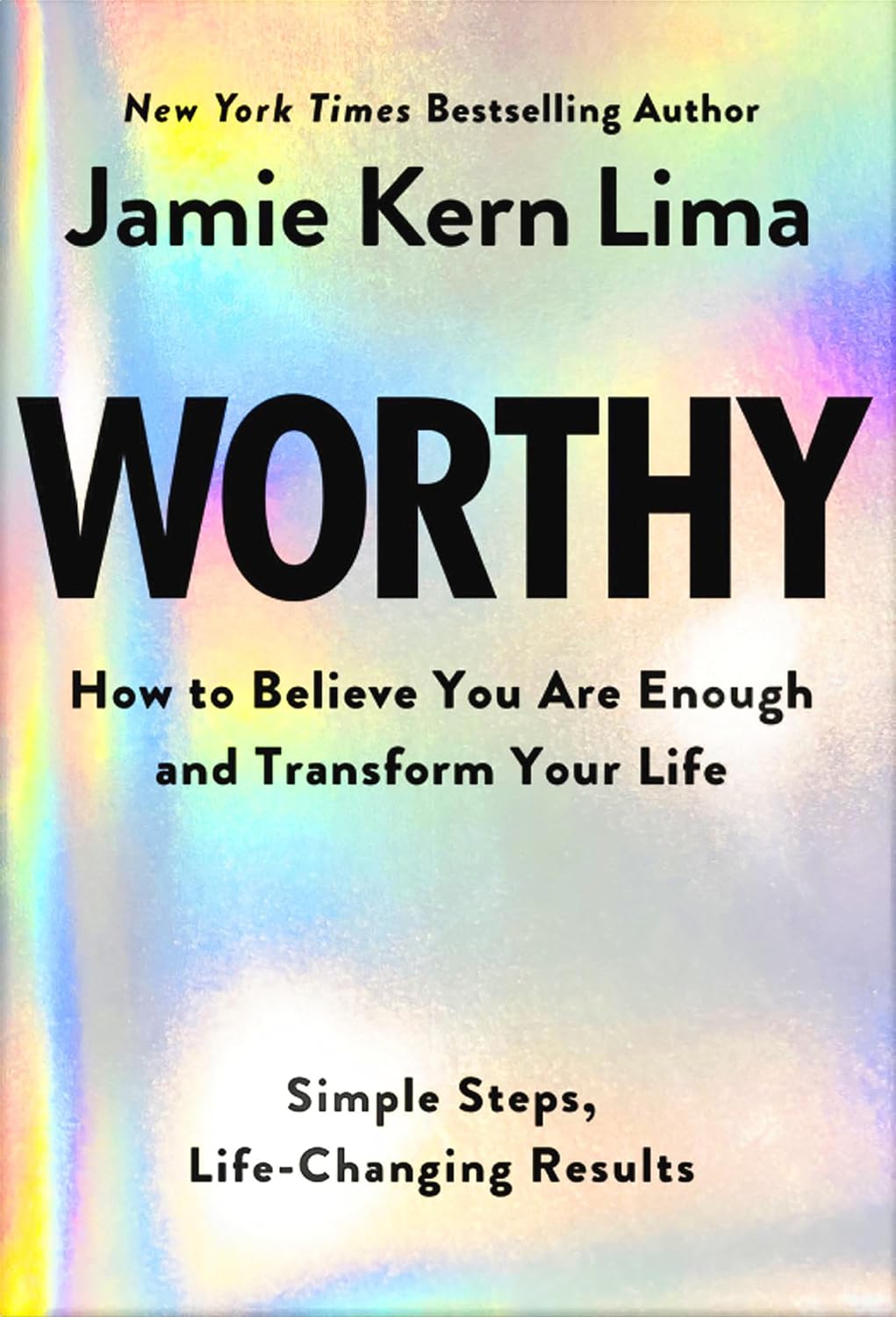
By Jamie Kern Lima
You know that moment when you’re so close to “making it,” yet something still nags at you—like a whisper that you’re not enough? Jamie Kern Lima knows that feeling intimately. After becoming a celebrated entrepreneur—founding IT Cosmetics, overcoming rejections, selling her company to L’Oréal for over a billion dollars, and becoming their first female CEO—she still wrestled with deep unworthiness.
In Worthy, she flips the script: fulfillment doesn’t come from what you do—it comes from knowing who you are. That “knowing” is self‑worth, unflappable and innate, not shaken by achievements or opinions.
The Heart of the Message
Self‑Worth vs. Self‑Confidence
Jamie draws a sharp line between self‑confidence (which is earned through success) and self‑worth (which is inherent). She drives home that “You don’t become what you want, you become what you believe you’re worthy of.” The formula she shares is powerful but simple: fulfillment = self‑confidence × growth × contribution × self‑worth—and if any factor, especially self‑worth, is zero, the fulfillment tank runs dry.
Imagine building a skyscraper on sand. No matter how carefully you stack the bricks, if the foundation (your worth) isn’t solid, the structure won’t stand.
Where the Stories Shine
Embracing Authenticity. One of her most soul-stirring points? We’re each a one-of-a-kind masterpiece: “You are the only person in the entire universe who has your fingerprints… your irises…” When we dim our uniqueness to “fit in,” we sacrifice connection, growth, and joy. In Worthy, Jamie welcomes us to unapologetically be ourselves—even when that means being “first” or different.
Rejection as Redirection. Rejection isn’t a door slamming in your face—it’s redirecting you to a better place. Rewrites like “Rejection is God’s (or the Universe’s) protection” remind us that when one path ends, another begins. Jamie reframes each “no” as a stepping‑stone, not a setback.
Label Liberation. Labels—“lazy,” “not enough,” “failed”—stick hard. But Jamie dismantles them, urging readers: “Labels are made up. And they can be unmade up.” She guides you to identify labels that hold you back and rewrite them—like “I’m not smart” becomes “I’m learning, growing, capable.”
Your Circle Matters. People around us can either offer wings or chains. Jamie distinguishes “cages” from “circles”—choosing relationships that lift you rather than drain you. Seek those who empower, understand, and celebrate your growth.
Inner Dialogue Reset. Ever noticed how your own voice often becomes your harshest critic? Jamie teaches how to interrupt that—even in front of the mirror! She recommends mirror work, affirmations, visual reminders, and positive self-talk to re-program your brain’s wiring.
Finding Worth Through a Higher Lens. For those with spiritual leanings, Jamie centers the truth that your Creator (or whatever divine force you resonate with) defines your worth—your doubts do not. “Who am I really doubting?” becomes a tool when self-doubt creeps in.
Chapter No. 1 – The Dream Begins – A Life Lived on Tiptoe
Imagine this: you’re a little girl growing up in a world that seems to have already made up its mind about you—before you’ve even had the chance to speak your truth. That’s how Jamie opens her story.
This chapter is raw. It doesn’t start with the boardroom or billion-dollar beauty brand — it starts with insecurity, the kind that runs deep. Jamie introduces us to the inner terrain of her early years, growing up in a family that didn’t have much money, where approval had to be earned, and fitting in felt like a job.
The “I’m Not Enough” Tape Begins Rolling Early
Jamie explains how her “worthiness wound” began—not from one big trauma, but from repeated experiences that quietly chipped away at her belief in herself. She talks about being bullied for her weight, how she never saw anyone on TV who looked like her, and how she felt like she had to shrink—literally and emotionally—to be accepted.
“I learned early that my body wasn’t considered beautiful, my voice wasn’t always welcomed, and my dreams were too big.”
What’s heartbreaking is how normal this story feels. Many of us carry our own version of it. Maybe it was a coach who said we’d never make varsity, a parent who never said “I’m proud of you,” or just a lack of representation that whispered we didn’t belong. Jamie names that unspoken wound.
The Broadcast Dream
Despite the internal doubts, Jamie dared to dream of becoming a TV news anchor. It wasn’t about fame or money—it was about being seen, having a voice, and making a difference. But the irony? Even when she made it into broadcasting, the insecurity didn’t go away.
The industry reinforced what she’d learned as a child: she was too curvy, too real, too different.
“I spent so much time and energy trying to become what I thought the world wanted me to be. But the more I did that, the more disconnected I felt from myself.”
It’s the classic trap—trying to earn worthiness by becoming something else.
Core Insight from Chapter No. 1
You don’t start believing you’re worthy once you achieve your goals. If you don’t believe you’re enough before you get there, you won’t feel enough when you do. In fact, chasing success from a place of unworthiness is like running a marathon on a treadmill—exhausting, and you never actually arrive.
Chapter No. 2 – Building the Foundation – The Seeds of a Billion-Dollar Brand Were Planted in Insecurity
This chapter shifts from Jamie’s childhood into her entrepreneurial origin story—IT Cosmetics. But again, the theme of worthiness remains front and center.
Jamie reveals how the idea for her brand was born not in confidence, but in desperation. As a news anchor, she struggled with rosacea—a chronic skin condition that made her self-conscious on air. She tried every foundation out there, and none of them worked. So she did what most people wouldn’t: she decided to create her own.
When Purpose Is Fueled by Pain
What’s so refreshing about Jamie’s narrative is that she never pretends to have it all figured out. She admits she had zero experience in the cosmetics industry, no investor network, and no idea how to build a product—let alone a company. But what she did have was:
- A deep personal mission to help other women feel beautiful in their real skin.
- A partner in her husband Paulo who believed in her.
- A growing sense that maybe, just maybe, her pain could serve a purpose.
But even with all of that, the voices of doubt screamed louder.
“I kept thinking, ‘Who do you think you are?’ That voice didn’t go away—it just changed costumes as I hit new milestones.”
Rejections and Reality Checks
Over and over, Jamie pitched her product to retailers and investors—and got rejected. Some of the reasons?
- “Women won’t buy makeup from someone who looks like you.”
- “You’re not the right face for beauty.”
That’s not just rejection—that’s someone poking at your identity.
And yet, she kept going. Not because she felt 100% worthy or certain, but because she started tapping into something stronger than doubt: a belief in her mission. She says this is where she first began to understand that self-worth isn’t the absence of fear—it’s the decision to move anyway.
Core Insight from Chapter No. 2
You can’t wait to feel “ready” to take the leap. Self-worth is often built in motion. It’s not a prerequisite—it’s a product of courage and consistency. You build it as you show up for the mission, not the mirror.
Chapter No. 3 – The Turning Point – The Power of a 10-Minute TV Slot
Now we hit the chapter that reads like a movie climax: Jamie’s debut on QVC. After years of rejection, financial strain, and second-guessing, Jamie lands a coveted 10-minute live slot on the home shopping network. She knows this is make-or-break. If it flops, her company—and her dream—is done.
10 Minutes to Prove Her Worth (and Sell Out the Product)
She sets the stage: in the green room, stylists try to replace her diverse model lineup with traditional beauty standards. Jamie pushes back. She insists on real women—wrinkles, rosacea, freckles, age, curves. Why? Because that’s who she made this for. That’s who she is.
“For the first time, I stood my ground not because I wasn’t scared—but because I knew my worth couldn’t be based on someone else’s rules.”
With her palms sweating and heart racing, Jamie goes live. She wipes her makeup off on-air to reveal her rosacea—something unheard of in beauty TV. And… the product sells out. Viewers light up the phone lines. Authenticity wins.
Why This Moment Mattered So Much
It wasn’t just the revenue (though that was critical). It was the reclamation. Jamie had made a choice to show up as herself—flaws, fear, and all—and it paid off. That one moment rewrote the story she’d been told: that she wasn’t enough. She’d proven, on a national stage, that real is beautiful.
“That day wasn’t just a business victory. It was a spiritual one. It was me choosing to believe my worth didn’t need to be proven—it needed to be owned.”
This chapter is where the shift starts to crystallize. Jamie begins to decouple her worth from others’ approval. She steps into a space of inner authority.
The Inner Tug-of-War
Jamie admits that even in this moment of triumph, part of her still felt like an imposter. But she didn’t let that feeling define her actions. She shows how acting from worthiness, even if you don’t feel it yet, allows you to grow into it.
It’s like a muscle—every time you choose authenticity over approval, the “worthiness” muscle gets stronger.
Core Insight from Chapter No. 3
Sometimes your breakthrough moment is on the other side of your most terrifying risk. Your worthiness isn’t earned in comfort—it’s revealed in courage. And often, the world doesn’t change its mind about you until you do first.
Chapter No. 4 – Scaling Up – When the External Grows Faster Than the Internal
So here’s the scene: IT Cosmetics is taking off. Jamie’s been on QVC, sales are booming, retailers are finally calling her back, and the team is growing fast.
Sounds amazing, right?
But success, ironically, is when imposter syndrome often hits the hardest.
“Just because I was making more money or getting more recognition didn’t mean I felt more worthy. In fact, sometimes the more I achieved, the more fraudulent I felt.”
This chapter is such a powerful wake-up call. Jamie exposes something most successful people don’t talk about publicly: The more you rise externally, the more unworthiness can sneak in through the back door.
The Inner Conflict: Success vs. Self-Concept
Jamie started noticing a disconnect: on paper, she was crushing it. But emotionally, she still questioned her value. This chapter explores that tension.
Why?
Because when you don’t believe you’re fundamentally enough, no amount of external validation will fill that hole. In fact, success can sometimes amplify the doubt. You start thinking, “What if they find out I’m not actually good enough?”
This leads to overcompensating, people-pleasing, working longer hours, and constantly needing to prove yourself—not to others, but to that doubting voice in your own head.
Jamie writes:
“I felt like I had to earn my place in every room I walked into. I kept waiting for someone to say, ‘There’s been a mistake, you’re not actually supposed to be here.’”
Sound familiar?
Redefining Power
This chapter also redefines what it means to be powerful. It’s not bravado. It’s not perfection. It’s not control.
“True power isn’t about having all the answers. It’s about being deeply rooted in your own enoughness, no matter who’s watching.”
Jamie began to practice “leading while healing”—growing her business while unlearning all the old patterns of fear-based leadership.
She talks about early missteps as a boss: trying to make everyone happy, not setting boundaries, feeling guilty delegating, or being afraid to say no.
Why? Because she didn’t want to seem “mean” or “too much.” She wanted to be liked.
But she realized: trying to be liked is the fast track to burnout. Being liked is fleeting. Being authentic is sustainable.
Core Insight from Chapter No. 4
Growth on the outside will always feel fragile if you haven’t done the work on the inside. Scaling your life—your business, influence, income—requires you to also scale your self-worth. Otherwise, the weight of success will crush your peace.
Chapter No. 5 – The Power of Authenticity – Wiping Off the Mask (Literally and Metaphorically)
This is arguably one of the most pivotal chapters in the book.
Jamie tells the behind-the-scenes story of her most famous QVC moment—the one where she wiped off her makeup live on air, revealing her bare skin, rosacea and all, in front of millions of viewers.
“I felt like I was standing naked in front of the world. But I also felt free.”
This moment wasn’t a PR stunt. It was a revolution.
For Jamie, it was the culmination of years of shame, hiding, and trying to meet impossible beauty standards—suddenly being burned away in 60 seconds of terrifying vulnerability.
Real Over Perfect
This chapter is about choosing real over perfect—and understanding how that choice is the gateway to connection, joy, and impact.
Jamie writes about how we’re trained to show up with a mask: the polished LinkedIn version of ourselves, the filtered selfie, the corporate veneer. But what people are really hungry for? Truth.
“When I wiped the makeup off my face, I was also wiping off all the lies I’d been telling myself about needing to look a certain way to be worthy.”
That’s deep.
It’s easy to imagine ourselves needing to “look the part” before we step into big rooms—whether that’s a meeting, a stage, or a relationship. But Jamie shows that the most magnetic power comes when you bring your whole self.
Yes, the excellence. But also the imperfections.
Audience Response: Proof That Truth Resonates
QVC viewers didn’t just buy the product. They felt seen.
Women called in sobbing. Not because of the makeup—but because someone on TV finally looked like them. Wrinkles, redness, textured skin, humanity.
This was the turning point not just for IT Cosmetics, but for Jamie’s own belief system. She realized:
- She didn’t need to conform to be successful.
- She didn’t need to be flawless to be loved.
- She didn’t need to hustle for approval—she only needed to be herself.
And the truth? That applies to all of us.
Authenticity in Leadership and Life
Jamie challenges us to examine where we’re still hiding.
- What masks are we wearing?
- Where are we choosing performance over presence?
- Where are we dimming our truth to fit in?
She calls authenticity “a superpower”—not just a value.
“It’s not your polish that makes you powerful—it’s your presence.”
Core Insight from Chapter No. 5
Vulnerability is magnetic. Authenticity is not about being unfiltered for attention—it’s about being aligned for connection. You don’t have to wipe off your literal makeup to be seen—but you do have to stop hiding behind emotional concealer.
Chapter No. 6 – Facing Adversity – Trusting Yourself When Everything’s on the Line
Now that the spotlight is on and the company is flying, you’d think Jamie could coast, right?
Nope.
This chapter is all about adversity—real, painful, soul-testing adversity that hits even after you “make it.”
Jamie walks us through some of the hardest moments she faced after success: losing team members, facing lawsuits, the weight of a thousand decisions, personal health scares, and deep fatigue.
“I thought once I was successful, life would get easier. But it just got different.”
The Illusion of Arriving
This chapter is a dismantling of the myth that “one day, when I’ve made it, I’ll finally feel good about myself.”
Jamie reveals that adversity doesn’t disappear with success. In fact, the stakes just get higher.
But the game-changer? How you meet adversity shifts when your identity is no longer up for negotiation.
She describes how, in the past, every setback would shatter her. She would interpret rejection as proof that she wasn’t good enough. But now? With more self-worth under her belt, she began to see challenges as external events—not internal verdicts.
“Hard things no longer had the power to undo me, because I stopped outsourcing my worth to outcomes.”
Let that sink in.
From Reactivity to Resilience
This chapter teaches emotional resilience—not the kind where you “suck it up” or pretend everything’s fine, but the kind where you acknowledge the pain without becoming the pain.
Jamie began to shift from reaction mode to response mode—and that’s a massive upgrade.
She shares the tools that helped her through tough times:
- Silence and solitude instead of panicked decision-making
- Spiritual anchoring—asking for wisdom, not just willpower
- Journaling her feelings, not suppressing them
- Letting go of perfection, especially in leadership
She also reminds readers: adversity reveals your foundation. If your worth is built on sand (titles, money, applause), the storm will wreck you. But if it’s built on something deeper—something unshakable—then no setback gets the final say.
Core Insight from Chapter No. 6
Adversity isn’t proof that you’re failing—it’s the proving ground of your self-worth. It shows you what you believe about yourself when no one’s clapping. Real freedom is when hard seasons don’t define your value—they just reveal your strength.
Chapter No. 7 – The Billion-Dollar Decision – Letting Go (and the Fear That Comes With It)
This chapter opens with a paradox: the moment Jamie had dreamed of—the billion-dollar acquisition of IT Cosmetics by L’Oréal—wasn’t just a triumph. It was one of the most emotionally complex decisions of her life.
You’d think selling your company for $1.2 billion (the largest acquisition in L’Oréal’s history at the time) would feel like a fairytale ending. But Jamie takes us behind the scenes and reveals how it also brought up massive grief, identity loss, and fear.
The Grief of Success
Jamie built IT Cosmetics from her living room floor. Every product, every team member, every decision—it was hers. It wasn’t just a business; it was a soul project. And when the offer came in, she faced the question every entrepreneur secretly dreads:
“What does it mean to let go of the thing that gave me purpose?”
She shares how hard it was to even consider selling, because so much of her identity had become wrapped up in the brand. It wasn’t just about money—it was about meaning.
This chapter is a masterclass in healthy detachment. Jamie reminds us that clinging—even to something beautiful—can become a cage.
“Just because something is good doesn’t mean it’s meant to go with you into your next season.”
The Emotional Cost of Growth
Letting go can feel like betrayal. To your past self. To your team. To the version of you that hustled and sacrificed to build something from nothing.
Jamie wrestles with the guilt of “abandoning” her baby. But she also recognizes something deeper:
- Staying would mean stagnation.
- Letting go would mean growth.
Even if it meant not knowing what came next.
“If you want to step into your future, you have to be willing to grieve your past—even the parts that were good to you.”
The Key Lesson: Trust the Transition
Jamie doesn’t sugarcoat how messy transitions can be. She describes the moment she signed the deal, feeling both victorious and hollow. She encourages readers to feel the full spectrum of their emotions, especially in endings. That’s how you integrate change.
Core Insight from Chapter No. 7
You can be grateful for a chapter and still know when it’s time to turn the page. Worthiness means trusting yourself—not just when you’re building something, but when you’re brave enough to let it go.
Chapter No. 8 – Beyond Business – Rewriting the Labels and Listening to the Divine Whisper
This chapter is a spiritual homecoming. After the sale of IT Cosmetics, Jamie found herself in a rare place: financially secure, widely respected, and… lost.
“I’d spent so long proving myself that I forgot how to just be myself.”
This chapter shifts into deeper waters. Jamie opens up about her relationship with God—not in a dogmatic way, but in a deeply personal, soulful sense. She shares how faith, intuition, and surrender became her new compass.
From Hustle to Hearing
One of the most powerful takeaways in this chapter is Jamie’s realization that the voice of unworthiness is loud—but the voice of God (or your highest self, if you prefer) is usually quiet. It’s a whisper.
And the only way to hear it?
Slow down. Get still. Listen.
“We can’t hear truth when we’re running on noise and proving energy.”
This is where Jamie started journaling more, praying differently, and detaching from outcomes. She began to understand that her worth was not something she had to earn—it was something already divinely assigned.
Whether you call it God, Source, or Love, Jamie says:
“I started realizing I was already seen. Already chosen. Already enough.”
The Labels We Inherit (and Carry)
Jamie also devotes time in this chapter to the toxic labels we collect—lazy, emotional, not good enough, too sensitive, not smart, not pretty, not successful.
But here’s the twist:
Labels are man-made. And they can be unmade.
Jamie encourages us to rewrite the script. To ask:
- Who gave me this label?
- Is it true?
- What would my life look like if I stopped believing it?
“I thought I was ‘too emotional’ until I realized my sensitivity is my superpower.”
This isn’t just a mindset shift—it’s a soul reclamation.
Faith as Foundation, Not Decoration
Jamie shares moments where she was at her lowest—physically sick, emotionally wrung out—and how reconnecting with her spiritual identity saved her. Not because she had all the answers, but because she surrendered the need to control.
“Faith doesn’t make the fear go away. It gives you the courage to move forward anyway.”
This chapter invites us to live led, not just driven. And to let our worth be sourced from something unshakable.
Core Insight from Chapter No. 8
When you quiet the noise of your unworthiness, you start hearing the whisper of your worth. You are not who the world says you are. You are who your Creator says you are—and that version of you has always been enough.
Chapter No. 9 – Lessons Learned – Owning Your Story (Flaws and All)
This chapter is both a reflection and a rally cry. Jamie looks back at the arc of her journey—from bullied kid, to rejected founder, to billion-dollar CEO, to spiritual seeker—and distills it down to a truth many people never fully embrace:
“You don’t have to be flawless to be worthy. You just have to be real.”
She invites the reader to do what she did: own your whole story. Not just the highlight reel, but the messy middle. The mistakes. The heartbreaks. The moments you’d rather forget.
Because here’s the secret: those are the very moments that make you human—and they’re where your real power lives.
Radical Self-Acceptance
Jamie says:
“If you’re constantly editing your story to make it more palatable, you’ll never feel peace.”
This chapter is about full integration. She describes how she used to hide the parts of her journey that felt “weak”—like the breakdowns, the therapy, the failures. But when she started sharing those things, she connected with people more deeply than ever.
Your shame cannot survive being seen with love.
Jamie encourages readers to:
- Tell the whole truth to yourself.
- Name the parts of your life you’ve tried to skip over.
- Love the “cringe chapters” as much as the celebrated ones.
Living Out Loud
Jamie isn’t asking us to overshare or spill our guts to everyone we meet. But she is asking us to stop hiding who we are in order to be more “acceptable.”
“If you’re hiding, the people who need what you carry can’t find you.”
This is especially important for women, BIPOC, neurodivergent people, and anyone whose story hasn’t historically been platformed. Jamie’s message is clear: Your voice matters. Show up.
This chapter also touches on imposter syndrome—but reframes it beautifully:
“You’re not an imposter. You’re a pioneer.”
You’re not out of place—you’re just the first one. That’s leadership.
Core Insight from Chapter No. 9
You’re not here to be perfect. You’re here to be powerful—and that power comes when you own your full, flawed, beautiful story without apology.
Chapter No. 10 – Looking Forward – The Daily Practice of Living Worthy
By this point in the book, Jamie has peeled back every layer—of shame, self-doubt, hustle, and hiding. So what now?
This chapter is her answer to that question.
She begins by reminding us that self-worth is not a finish line. It’s a practice. A rhythm. A relationship with yourself that needs nurturing. Just like brushing your teeth or going to the gym, worthiness requires repetition.
“You don’t just ‘feel’ worthy one day and stay that way. You live worthy. You choose it. Again and again and again.”
And that’s where Chapter 10 shines: It gives us the tools and habits to live into our worth, not just read about it.
Worthiness is a Daily Decision
Jamie describes how old stories don’t vanish overnight. Even after selling her company, becoming a bestselling author, and speaking to millions, the whispers of unworthiness still showed up:
- “Did I say too much?”
- “Was I too much?”
- “Was that interview good enough?”
- “Will they think I’m bragging?”
Sound familiar?
She calls this the old voice. And it’s like an ex that keeps texting. Sometimes, you want to respond. But what you must do is remember—it’s just a voice. It’s not you.
“Worthiness isn’t about never hearing the voice again. It’s about not believing it when you do.”
So how do we stop believing it?
By choosing—daily—to come back to truth.
Jamie’s Worthiness Toolbox
Here, she gives practical practices—daily, simple, and repeatable. Let’s unpack a few of her go-to tools:
No. 1 — Mirror Work
Yes, it might feel awkward at first. But Jamie swears by this.
Each morning, she looks herself in the mirror and says:
- “You are worthy of love.”
- “You are enough.”
- “You are not your mistakes.”
- “You are more than your productivity.”
And sometimes, she doesn’t believe it at first. But that’s not the point. The point is: say it until you start to believe it again. Not because it becomes true—but because it always was.
“You’ve talked to yourself like you’re unworthy long enough. It’s time to talk to yourself like someone you love.”
No. 2 — Name the Lies (Then Rewrite Them)
Jamie walks us through a journaling technique:
- Write down the thought or belief keeping you stuck. (e.g., “I’ll never be as successful again.”)
- Ask: Whose voice is this? Is it yours? A parent? A boss? A culture?
- Rewrite it as a truth. (e.g., “My past success proves I am capable of creating again.”)
This “label unlearning” technique helps retrain your brain to stop letting fear narrate your future.
No. 3 — Stillness and Listening
This is where her spiritual practice returns.
Jamie talks about how the world is loud—but wisdom is quiet.
“Your worth doesn’t shout. It whispers.”
So she builds in time every day—whether 5 minutes or 30—for prayer, meditation, or simply sitting in silence.
No scrolling. No fixing. No producing.
Just being.
It’s in this stillness that she reconnects with her source of truth—whether you call that God, intuition, inner knowing, or divine love.
Rewriting What “Success” Means
Jamie challenges the reader to redefine success—not as:
- How much money you make
- How many followers you have
- How many people approve of you
—but as:
- How fully you show up as you
- How well you sleep at night knowing you stayed in integrity
- How much joy and peace you live with, regardless of metrics
“Success without worthiness feels like emptiness.”
This is profound. She reminds us that no external reward can override internal unrest. You can’t fake fulfillment.
And so, the new success equation she leaves us with?
Self-worth x Self-Trust = Lasting Peace
Forgiveness is a Worthiness Practice, Too
Jamie gets real here: You cannot walk in worthiness if you’re still carrying shame from your past—or anger at someone else who made you feel unworthy.
This doesn’t mean pretending the past didn’t happen. It means releasing its hold on your identity.
She gives us these reframes:
- “I forgive myself for believing I had to be perfect to be worthy.”
- “I forgive the version of me who didn’t know any better.”
- “I forgive the people who projected their pain onto me.”
“Forgiveness doesn’t say they were right. It just says I’m free.”
Powerful.
What Happens When You Really Start Living Worthy?
Jamie closes the chapter with a vision. She invites us to imagine:
- What happens when you walk into a room and no longer shrink?
- What if you no longer audition for love, approval, or inclusion?
- What if you led your team, family, or business from enoughness instead of insecurity?
“Worthy people change rooms. Worthy people change cultures. Worthy people change the world—because they no longer wait for permission to be who they already are.”
And the best part?
It’s not reserved for special people.
It’s for you.
Right now.
Final Takeaways from Chapter No. 10
This isn’t a conclusion. It’s an invitation.
Jamie makes it clear: Worthy isn’t just a book to finish. It’s a way of being to live.
If you take nothing else from Chapter 10, take this:
Your job is not to prove your worth.
Your job is to remember it — and then live like it’s true.
Worthy isn’t just a memoir or self‑help book—it’s an invitation. An invitation to believe that your story is valid, your presence matters, and your worth isn’t up for debate. She shows how self‑worth is like sunlight: you can’t bottle it with accomplishments or accolades—it must rise from within.If you’re on the journey from hiding your uniqueness to celebrating it, this book is a faithful guide. Whether you skim, journal alongside, or do those mirror affirmations—listen closely to Jamie’s message: You are worthy, right now, just as you are.