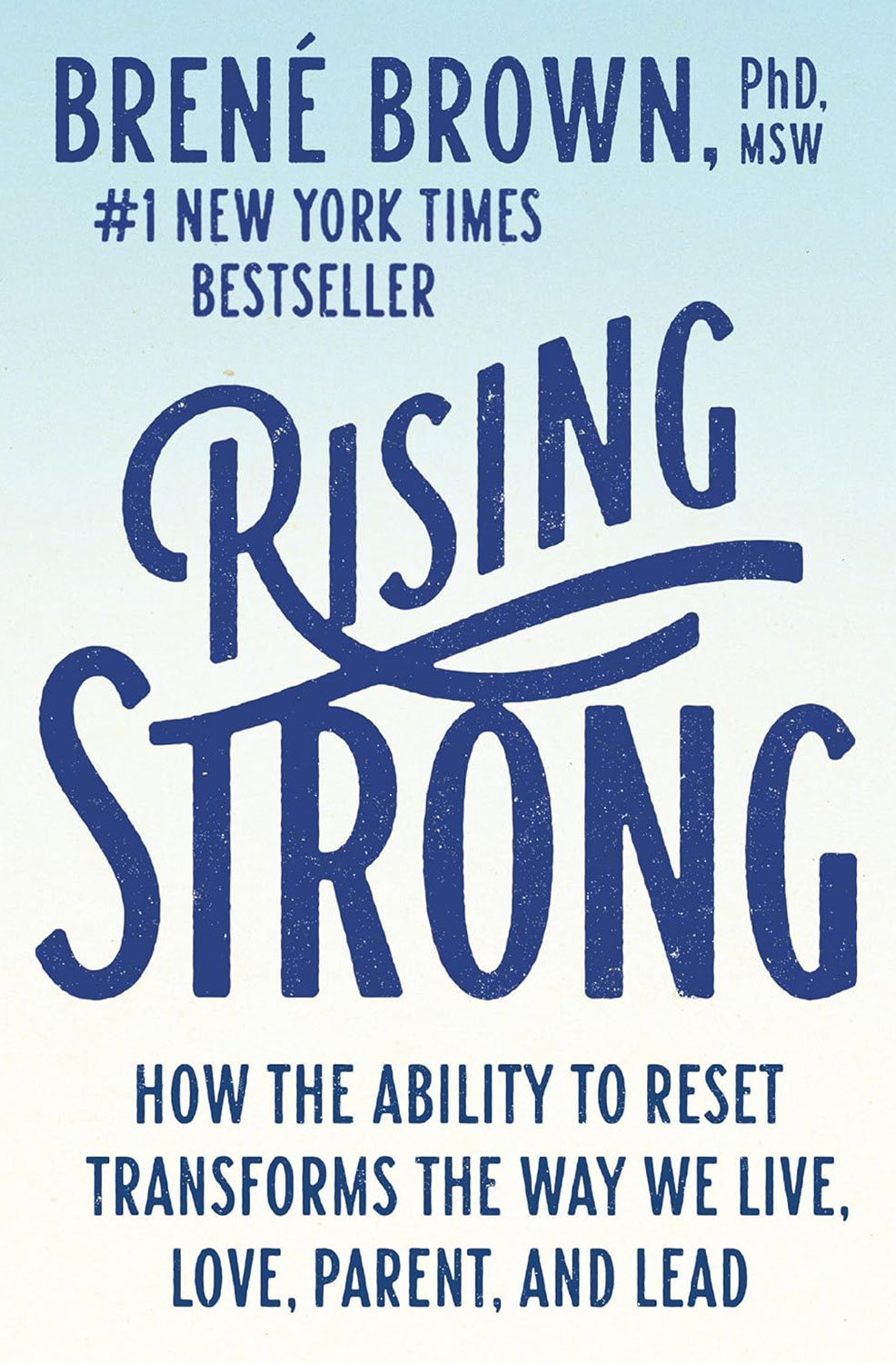
By Brené Brown
Brené Brown’s Rising Strong is not a book about avoiding failure, mastering confidence, or staying positive at all costs. It is a book about what happens after we fall — after disappointment, shame, failure, conflict, or loss knocks the wind out of us.
Brown argues that courage is not proven in moments of success. It is revealed in how we reckon with our emotions, rumble with our stories, and rise stronger when things don’t go as planned. Rising Strong is the missing manual for the middle of the struggle — the messy space between impact and recovery where most people either shut down, armor up, or retreat.
At its core, the book introduces a repeatable framework for resilience rooted in emotional honesty, psychological ownership, and meaning-making.
The Central Premise: You Can’t Rise Strong If You Don’t Get Honest About the Fall
Brown’s research shows that the most resilient people are not those who avoid hardship, but those who are willing to face it honestly.
Most of us fall into one of three post-failure patterns:
- We deny what happened
- We blame ourselves harshly
- We blame others to protect our ego
All three prevent growth.
Rising Strong proposes a different approach: acknowledge the pain, examine the story you’re telling yourself about it, and choose a more truthful narrative grounded in values rather than self-protection.
Resilience, Brown insists, is not a personality trait. It’s a practice.
The Rising Strong Process: Reckoning, Rumble, Revolution
The book is structured around a three-part framework that maps how people move from emotional impact to meaningful growth.
No. 1 — The Reckoning — Acknowledging the Emotional Impact
The reckoning is the moment when we realize we’ve been emotionally hijacked.
Something happens:
- A failure
- A betrayal
- A conflict
- A disappointment
- A moment of shame
And before we know it, we’re flooded with emotion.
Brown emphasizes that emotions are physiological before they are cognitive. Our bodies react first. Heart rate changes. Muscles tense. Breath shortens. This is not weakness — it’s biology.
The reckoning requires us to:
- Notice when we’re emotionally hooked
- Pause instead of reacting
- Name what we’re feeling accurately
Most people skip this step and jump straight into rationalization or defense. But without reckoning, everything that follows is distorted.
Brown introduces the idea of the “SFD” — the Shitty First Draft of the story we tell ourselves. It’s fast, biased, and usually self-protective. Recognizing that you’re operating from an SFD is the first act of emotional courage.
No. 2 — The Rumble — Questioning the Story You’re Telling Yourself
The rumble is the hardest part.
This is where we interrogate our assumptions instead of accepting them as truth.
Humans are meaning-making machines. When something goes wrong, we instinctively fill in gaps:
- “They did this because…”
- “This means I’m not…”
- “I always…”
- “This proves that…”
Brown calls these stories protective narratives. They shield us from vulnerability, but they also disconnect us from reality.
The rumble asks uncomfortable questions:
- What am I assuming?
- What do I actually know versus what am I inventing?
- How does this story serve me?
- How does it limit me?
A key insight here is Brown’s distinction between guilt and shame:
- Guilt: I did something bad.
- Shame: I am bad.
Shame collapses identity. Guilt opens the door to accountability and repair.
Rumbling requires curiosity, humility, and the willingness to be wrong—especially about ourselves.
No. 3 — The Revolution — Writing a New Ending Based on Truth and Values
The revolution is not about rewriting history or forcing optimism.
It’s about integrating what we’ve learned and choosing a more honest, courageous way forward.
Brown emphasizes that rising strong doesn’t mean “bouncing back” to who you were before. That version of you existed without the insight gained through failure.
Instead, you rise stronger, more grounded, and more aligned with your values.
This stage involves:
- Owning your role without self-flagellation
- Making amends where needed
- Setting boundaries where appropriate
- Choosing behavior consistent with your values rather than your fear
This is where resilience becomes transformative.
The Physics of Vulnerability: Why Falling Is Unavoidable
One of Brown’s most powerful metaphors in the book is the idea of physics.
If you’re daring greatly — leading, creating, loving, or risking — you will fall. Period.
You cannot opt out of vulnerability and still live a courageous life. The only way to avoid falling is to never step into the arena.
Rising Strong reframes failure as a byproduct of engagement, not a flaw.
The question is not if you will fall.
The question is how you will respond when you do.
Leadership and Rising Strong
Brown devotes significant attention to leadership, particularly how leaders model resilience.
Leaders who cannot rise strong:
- Blame instead of owning
- Armor up instead of listening
- Avoid accountability conversations
- Create cultures of fear and silence
Leaders who practice Rising Strong:
- Own mistakes publicly
- Normalize learning over perfection
- Separate identity from performance
- Create psychological safety
Brown argues that organizational culture mirrors leadership behavior. Teams do not rise stronger than their leaders — they rise to them.
Resilient leadership is less about charisma and more about emotional literacy and integrity.
The Role of Shame and the Importance of Language
A recurring theme throughout the book is the power of language.
Many people lack the vocabulary to describe what they’re feeling, so they default to:
- Anger instead of fear
- Numbness instead of grief
- Judgment instead of vulnerability
Brown stresses that naming emotions accurately reduces their power. It moves experiences from the limbic system into conscious awareness.
She also emphasizes the danger of “stealth shame” — subtle internal narratives that sound like self-criticism but function as identity attacks.
Rising Strong is, in many ways, a book about reclaiming authorship over your inner dialogue.
Midlife, Identity, and Meaning-Making
Brown’s research reveals that many people encounter Rising Strong moments in midlife — not because life suddenly falls apart, but because old stories stop working.
Roles shift. Success loses its shine. Identity contracts break.
This can feel destabilizing, but Brown frames it as an invitation:
- To question inherited definitions of success
- To choose values consciously
- To let go of narratives that no longer serve
Rising Strong becomes a process of identity refinement, not reinvention.
Integration: Rising Strong as a Lifelong Practice
Brown is clear that Rising Strong is not a one-time epiphany.
It’s a practice you return to repeatedly:
- After conflict
- After failure
- After loss
- After misalignment
Each cycle builds emotional resilience, clarity, and courage.
The goal is not emotional mastery. It’s emotional honesty.
And that honesty — paired with accountability and compassion—is what allows people to live braver, more connected lives.
Key Takeaways from Rising Strong
- Falling is inevitable for anyone living courageously
- Emotions must be acknowledged before they can be processed
- The stories we tell ourselves after failure shape our recovery
- Shame thrives in secrecy; resilience grows in truth
- Leaders set the emotional tone for their organizations
- Rising strong is about values-based integration, not perfection
Why Rising Strong Matters
Rising Strong fills a critical gap left by most personal development and leadership literature.
It doesn’t teach you how to win.
It teaches you how to recover with integrity.
In a world obsessed with performance, Brown offers something far more sustainable: a roadmap for resilience rooted in courage, accountability, and meaning.It is a book not about avoiding the fall — but about learning how to get back up without losing yourself in the process.
If You Liked This Article, You May Also Like …
- Dare to Lead: Brave Work. Tough Conversations. Whole Hearts.
- Emotional Agility: Get Unstuck, Embrace Change, and Thrive in Work and Life
- The Anxious Achiever: Turn Your Biggest Fears into Your Leadership Superpower