
Deep Dives Articles
DEEP DIVES ARTICLE — EMOTIONAL INTELLIGENCE

When Smart Meets Overconfident: How AI Turns the Dunning-Kruger Effect Upside Down
This is a sneak peek of this week’s Deep Dives article — published today!
We’re living in the era of algorithmic overconfidence — where humans and machines both think they’re smarter than they are. In this Deep Dive, we explore how AI has flipped the classic Dunning-Kruger Effect on its head, why “false mastery” is spreading faster than ever, and what emotionally intelligent leaders can do to stay grounded in real wisdom.
DEEP DIVES ARTICLE — PERSONAL DEVELOPMENT

Why Fear of Failure Is the Secret Fuel of the Ultra-Successful (And How You Can Harness It Without Burning Out)
This is a sneak peek of this week’s Deep Dives article — published today!
What if fear wasn’t your enemy — but your engine? This Deep Dive unpacks the hidden psychology behind how elite performers use fear of failure as strategic fuel. You’ll learn how to reframe anxiety into ambition, pressure into precision, and fear into a compass for growth.
DEEP DIVES ARTICLE — LEADERSHIP

When Strength Becomes Cruelty: The Hidden Trap of “Stoic Sadism”
This is a sneak peek of this week’s Deep Dives article — published today!
Modern stoicism was meant to make us stronger — but somewhere along the way, it made many of us harder instead. In this Deep Dive, we uncover how emotional suppression, disguised as discipline, turns leaders into the very thing they were trying not to be. Learn how to cultivate resilience without losing compassion — and power without losing presence.
Deep Dives Book Summary
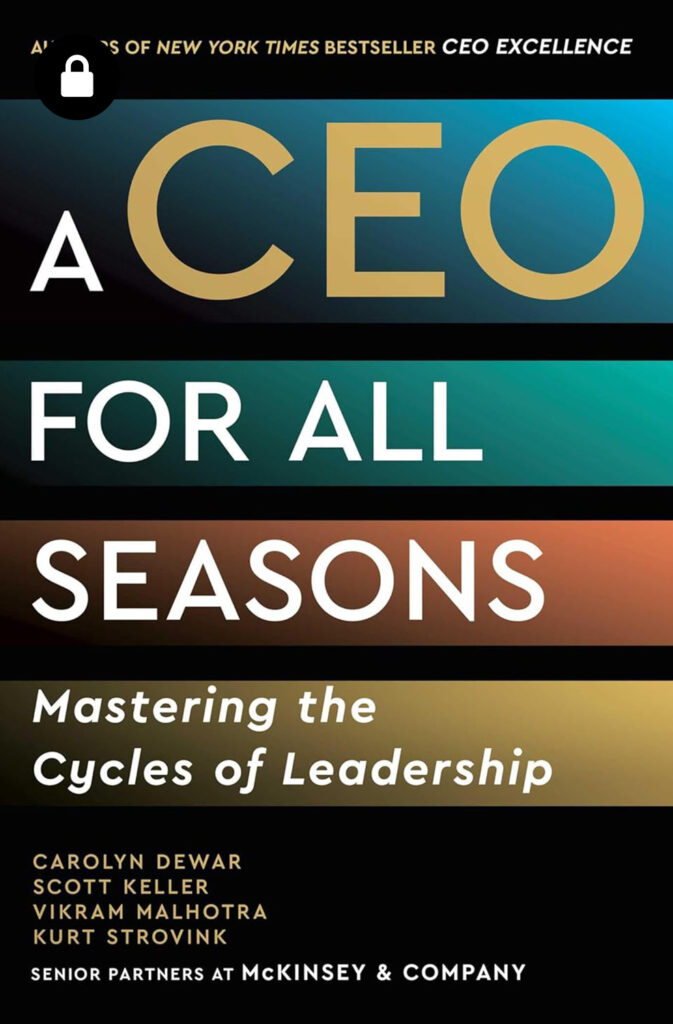
A CEO for All Seasons: Mastering the Cycles of Leadership
By Carolyn Dewar, Scott Keller, Vikram Malhotra, and Kurt Strovink
This is a sneak peek of this week’s Deep Dives Book Review — published today!
Leadership doesn’t happen in a straight line — it happens in seasons. In our latest Deep Dive, we unpack A CEO for All Seasons — McKinsey’s groundbreaking blueprint for mastering the full lifecycle of leadership. From the ambition and adrenaline of your first 100 days to the wisdom of succession and legacy, this summary reveals what separates CEOs who merely survive the role from those who evolve through it.
Quick Reads
quick read — Emotional intelligence

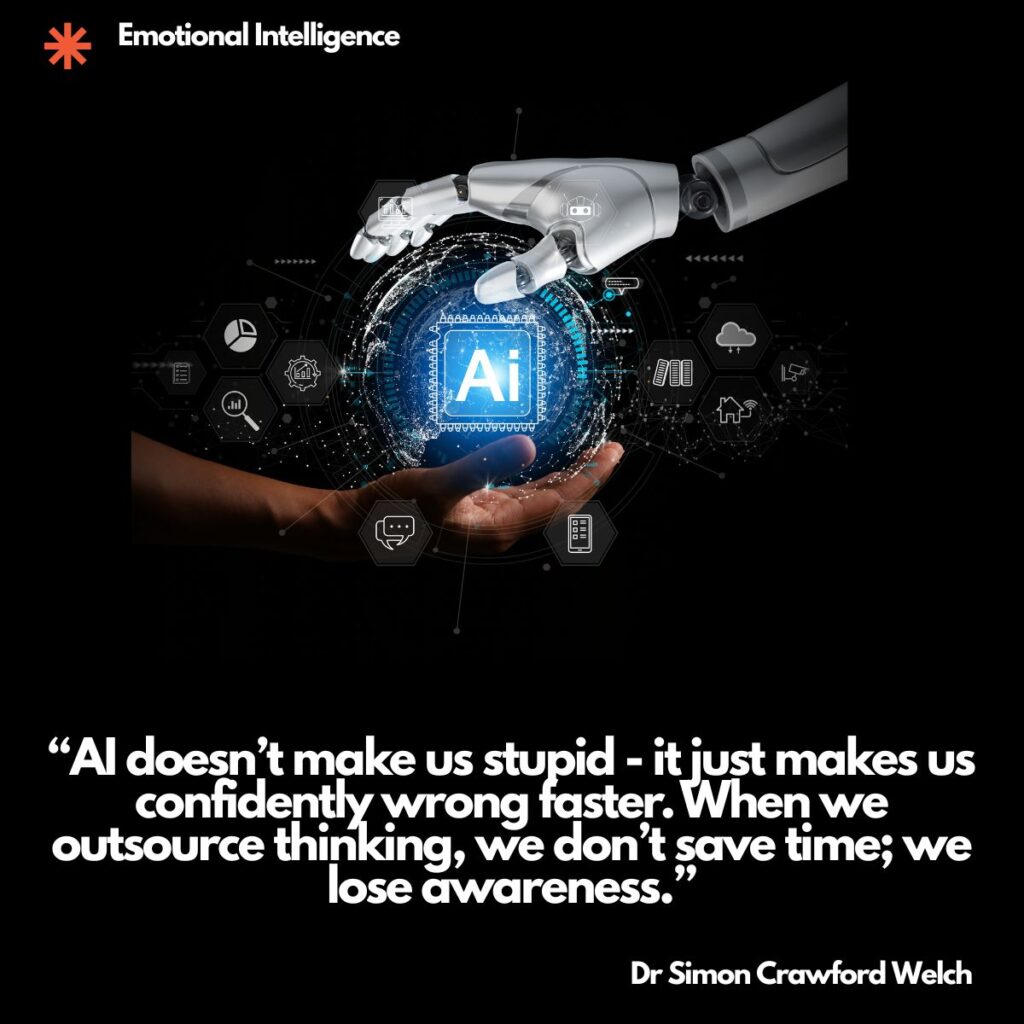
The Impact of AI on Human Reasoning & Autonomy
When was the last time you truly wrestled with a problem — alone? No Google search, no ChatGPT, no Reddit thread whispering suggestions?
If you’re like most of us, probably not recently. The rise of AI tools has given us instant answers. But here’s the paradox: the more we outsource our thinking, the less capable we become of doing it ourselves.
The New Cognitive Shortcut
AI has become our intellectual autopilot. According to a 2024 Pew Research study, 62% of U.S. professionals now use AI tools weekly for work-related tasks.
But convenience comes at a cost. As Daniel Kahneman wrote, “The ease with which an answer comes to mind is often a misleading cue for its validity.” AI amplifies this trap — giving us fluent, confident, and often wrong answers.
University of Pennsylvania research (2023) found that participants using AI tools were more likely to accept incorrect information if phrased confidently. That’s not artificial intelligence — it’s artificial persuasion.
The Erosion of Autonomy
Autonomy isn’t just about doing things yourself — it’s about deciding for yourself. Yet AI systems quietly chip away at that independence.
A 2023 MIT study found people exposed to AI-generated suggestions were 23% less likely to challenge recommendations, even when shown evidence of bias. The researchers called it “automation persuasion.”
But algorithms aren’t neutral. When you let AI write your strategy memo, you’re not getting a neutral view — you’re getting someone else’s worldview, distilled and digitized.
Why It Matters
When AI performs the hard parts of thinking — structuring arguments, weighing tradeoffs, filtering data — we lose the micro-frictions that build intellectual resilience. Those frictions are where creativity lives.
Nick Carr warned in The Shallows: “What the Net seems to be doing is chipping away my capacity for concentration and contemplation.” Now imagine that on steroids, powered by AI.
If every idea begins with “Ask ChatGPT,” what happens to originality? Harvard cognitive scientist Steven Pinker said, “Cognitive effort is the price we pay for autonomy.” AI promises to make us smarter, but it might just be making us more passive.
The False Comfort of Certainty
AI’s biggest seduction is certainty. It never says, “I’m not sure.” But real reasoning thrives in uncertainty.
A 2024 Stanford survey found over 70% of college students used AI for writing assignments, but only 18% cross-checked factual claims. The generation raised on “check your sources” is now outsourcing truth itself.
What We Can Do
The answer isn’t rejection — it’s reflection. AI is a tool, not a truth.
Five mental habits:
No. 1 — Pause before you prompt. Ask: “Do I already have an idea here?”
No. 2 — Interrogate the output. Ask: “What data trained it?” “What’s missing?”
No. 3 — Use it as a mirror, not a crutch. Let AI test your logic—don’t let it form your logic.
No. 4 — Preserve your struggle. That uncomfortable feeling of not knowing? It’s the birthplace of learning.
No. 5 — Reclaim authorship. Rewrite AI drafts in your own words.
As futurist Kevin Kelly put it: “You’ll be paid in the future for how well you work with AI — not how often you obey it.”
The Bottom Line
The next decade will redefine what it means to think. Knowledge will be abundant, but wisdom will be rare.
Our challenge isn’t to outsmart AI — it’s to stay human. That means valuing curiosity over convenience, judgment over jargon, discernment over data.
So the next time an AI gives you a slick answer, take a breath. Then do what only humans can do — question it.
Because the future of thinking depends on whether we still know how.
quick read — Personal development

Why Working Less Often Means Producing More: The Paradox of Work-Life Balance
If you’ve ever bragged about pulling 70-hour weeks, this might sting: The data says you’re probably less productive than someone clocking out at 4 PM to pick up their kids.
According to the Global Life-Work Balance Index 2025, countries that give workers more time off — like New Zealand, Denmark, and Germany — also top the world in productivity per hour worked.
The Lie We Inherited
For decades, we’ve glorified the grind. But here’s the truth: burnout is not a badge of honor — it’s an invoice.
When you consistently exceed 50 hours per week, your brain’s prefrontal cortex begins to slow down. Beyond 55 hours, productivity per hour falls off a cliff.
Stanford research found that employees working 70 hours achieve roughly the same output as those working 55. The last 15 hours are essentially wasted effort.
What the World’s Happiest Workers Know
Take Norway: The average Norwegian works 1,384 hours per year — one of the lowest totals in the developed world. Yet their GDP per hour worked is among the highest — around $87 USD.
Compare that to the United States, where the average person works 1,791 hours a year and produces roughly the same GDP per hour — sometimes less.
Norwegians produce as much or more in 400 fewer hours. That’s like working 10 fewer weeks a year with no loss in output.
The Science of Rest
Here’s what happens when you rest:
- Cognitive reset. Time away restores creative problem-solving.
- Better decisions. Sleep replenishes your prefrontal cortex.
- Stress hormones drop. Overwork literally shrinks the hippocampus.
- Motivation rebounds. Rest rekindles intrinsic motivation.
The Productivity Flywheel
When companies prioritize work-life balance, they create a compounding cycle:
- Fewer hours = more focus
- Better rest = better decisions
- Security = engagement
- Autonomy = accountability
- Retention = compounding knowledge
Denmark’s workweek averages 33 hours — yet they consistently score top marks on both happiness and productivity. Their secret? They chase efficiency, not hours.
Real-World Examples
- Germany. 34-hour workweeks, 30 vacation days annually. Still Europe’s manufacturing powerhouse.
- New Zealand. Four-day workweek experiments saw 20% productivity boosts.
- Iceland. Shorter workweeks (35-36 hours, no pay cut). Result? Productivity stayed the same or improved. Burnout plummeted.
The American Irony
Despite being one of the richest nations, the U.S. ranks poorly for work-life balance. No federally mandated paid leave, minimal maternity support, long hours.
Yet productivity growth has stagnated.
We confuse busyness with effectiveness. While we pride ourselves on being the “hardest-working nation,” other countries quietly do more by doing less.
The Productivity Equation, Rewritten
Old model.Time × Effort = Output.
New model. Energy × Focus = Output.
Time is finite. Energy is renewable.
High-performing nations design systems around human energy optimization, not exhaustion.
What Businesses Can Learn
You don’t get loyalty or creativity by extracting every ounce of time from your people. You get it by giving them their lives back.
- Shorten the workweek
- Encourage real disconnection
- Prioritize outcomes, not optics
- Normalize rest as a skill
- Lead by example
The Bottom Line
Work-life balance isn’t just about happiness — it’s about economic performance and sustainable growth.
The best work comes from people who have time not to work.
That’s not laziness. That’s wisdom.
The nations at the top of the 2025 index are proving what we all secretly know:
When life works, work works better.
quick read — LEADERSHIP

Energy Is the New ROI: Why Elite Leaders Guard Capacity More Than They Demand Hustle
Leadership used to be measured by how hard you could drive a team. Long hours were a badge. Burning the midnight oil was proof of commitment.
But the best leaders today are playing a very different game. They’ve learned a simple but powerful truth: it’s not effort that wins over time — it’s energy.
Or as one CEO put it, “I don’t pay people to be tired. I pay them to be sharp.”
Effort vs. Energy: What’s the Difference?
Effort is how much work someone is doing. Energy is the quality of what they’re doing.
You can have someone putting in 10 hours of low-energy effort and producing less than someone who gives 3 hours of high-energy, focused work.
Research backs this up. A University of London study found that multitasking and fatigue can lower IQ scores as much as staying up all night. A Gallup report noted that highly engaged teams see 21% higher profitability—not because they work more hours, but because they work with more discretionary energy.
Here’s the leadership shift: you can’t extract peak performance from depleted people. You can force effort in the short term, but you can only unleash excellence by protecting energy.
The Energy-Performance Curve
Think about your own life. You’ve had days where you worked 12 hours and moved the needle an inch. And you’ve had a 90-minute sprint where you solved a problem stuck for weeks.
Psychologist Jim Loehr said, “Energy, not time, is the fundamental currency of high performance.”
Why? Because time is fixed. Energy is variable.
- Time: you get 24 hours
- Energy: you get what you create, protect, and restore
What Drains Energy in Organizations?
Most drains aren’t about workload—they’re about friction.
Common energy killers:
Unclear priorities. People burn energy guessing what matters Context switching. Reduces productivity by up to 40% Emotional labor. Toxic teammates, drama, unclear communication Pointless meetings. 68% of people lack uninterrupted focus time No recovery. Always on, always urgent, no off-ramp
When leaders only push for “more,” they accidentally build cultures of exhaustion. When they protect energy, they build cultures of excellence.
The Myth of “Try Harder”
Pushing is lazy leadership. Protecting energy is strategic leadership.
Telling people to work harder assumes they weren’t trying, that more time equals better output, and that burnout is a personal problem.
But high performers are rarely slacking. The people you most depend on are most likely to burn out because they care, say yes, and keep carrying the load.
The World Health Organization classifies burnout as an occupational phenomenon caused by chronic workplace stress. That’s not an employee problem. That’s a leadership problem.
What Protecting Energy Actually Looks Like
Energy protection is operational, structural, and cultural. Here’s what the best leaders do:
No. 1 — They prioritize ruthlessly.
Great leaders kill projects, narrow focus, and give people permission to do the most important work, not all the work.
No. 2 — They build in recovery.
Elite athletes don’t train at 100% every day. Employees who take regular breaks report willingness to put in 40% more effort afterward.
No. 3 — They reduce noise.
Fewer meetings, clearer communication. It takes over 23 minutes to fully refocus after an interruption.
No. 4 — They model it.
If the boss emails at 11:30 PM celebrating “grind,” the team will mirror it. Leaders set the cultural ceiling.
No. 5 — They create psychological safety.
Google’s Project Aristotle found this to be the #1 factor in high-performing teams. Safety = energy released.
Why Energy Beats Effort in the Long Game
Here’s the core reason: effort maxes out, energy compounds.
- A tired person can’t innovate
- A stressed person can’t empathize
- A burnt-out person can’t sell vision
At senior levels, it’s judgment, creativity, and relational capital that move companies forward. All require energy.
Prolonged stress impairs the prefrontal cortex—the part responsible for planning and problem-solving. Exhausted teams make expensive mistakes.
Smart leaders ask: “What did it cost us to get it done? And can we do it again next quarter without breaking people?”
“But We Have Big Goals…”
Exactly. That’s why you protect energy.
Big goals require sustained effort over time. Anyone can sprint. Only healthy, energized teams can sustain.
As the Navy SEALs say, “Slow is smooth, and smooth is fast.” Protecting energy isn’t softness—it’s how you keep people in the game long enough to win.
The Leadership Mindset Shift
At its heart, this is a mindset shift from extraction to stewardship.
Old mindset: “How much can I get out of people?” New mindset: “How do I keep people powerful?”
When you steward energy, you raise performance, loyalty, creativity, and retention. People stay where they feel seen and protected.
Protected teams will give you more than pushed teams ever will. Not because they have to—but because they want to.
Or as one employee said: “He didn’t burn us out. He built us up. And because of that, we would run through walls for him.”
That’s the point.
Effort wins days. Energy wins decades.
Quotes of the Week
QUOTE — EMOTIONAL INTELLIGENCE
QUOTE — PERSONAL DEVELOPMENT

QUOTE — LEADERSHIP

Reframe
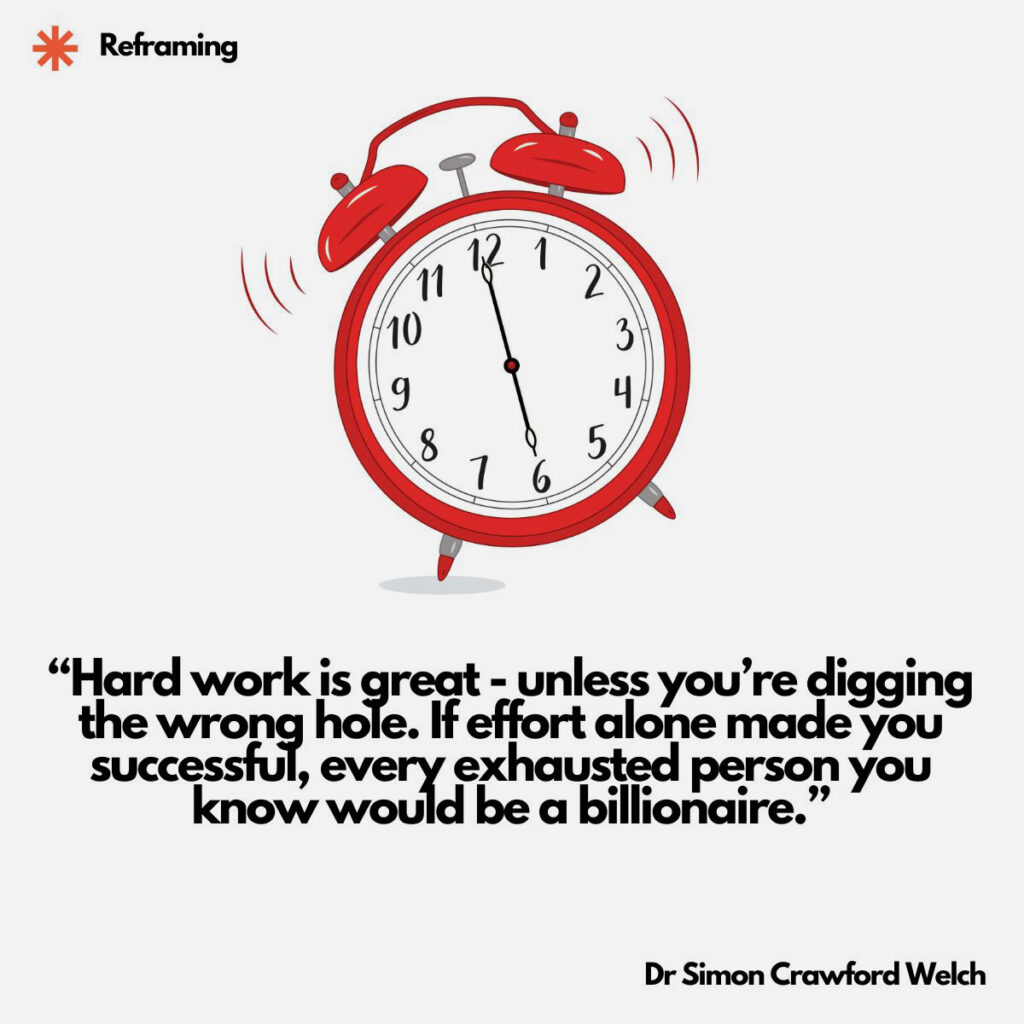
Working Harder Is Never the Answer
Why Effort Alone Has Become the Most Overrated Currency in Business and Life
We’ve been taught since childhood that hard work is the ultimate virtue — the one-size-fits-all answer to every problem. Fall behind? Work harder. Not seeing results? Push more.
But somewhere along the line, effort stopped being the path to progress and became a distraction from it.
Today, in a world that rewards leverage, creativity, and clarity of thought, “working harder” isn’t the answer — it’s often the very thing keeping us stuck.
The Myth of the Effort-Output Equation
For most of the industrial era, effort and output were tightly linked. The equation made sense because work was linear.
But the modern economy is exponential. You can’t “grind” your way to creativity or brute-force insight.
Yet we cling to the old narrative because it feels righteous. But effort without intelligence isn’t noble — it’s inefficient. It’s like sprinting on a treadmill and confusing sweat for progress.
Working harder shields us from the harder work: thinking deeply, prioritizing honestly, and saying no.
Busyness Is the New Laziness
The people who look the busiest are often doing the least that actually matters.
Ask yourself: if your effort disappeared tomorrow, would your system continue to deliver results? If not, you’re not building — you’re laboring.
Real progress is measured not by hours invested but by how little your success depends on constant exertion.
The Marginal Decline of Effort
There’s a point where more effort actually reduces results.
Athletes call it overtraining. Investors call it overtrading. Creatives call it burnout. Beyond a certain point, additional effort leads to worse decisions, lower creativity, and emotional fatigue.
The harder you push, the duller you become.
The Effort Trap
Why do we keep pushing when it’s clearly not working? Because hard work is socially rewarded. We fear being seen as lazy more than we fear being ineffective.
Overworking is often insecurity disguised as ambition. But there’s a deeper fear: if we stop working, what’s left? Rest feels like erasure. Stillness feels like failure.
We double down — working harder not because it’s effective, but because it’s familiar.
The Paradox of High Performance
The most successful people rarely work the hardest in the conventional sense. They’re designing systems that compound results without constant strain.
They operate with leverage: ideas, technology, people, and time.
Leverage separates the exhausted striver from the strategic performer. It’s the difference between rowing harder and building a sail.
Intelligence Over Intensity
The most underappreciated skill is discernment — telling the difference between what’s important and what’s merely urgent.
Effort can’t compensate for misalignment. If you’re sprinting in the wrong direction, speed just ensures you end up further from where you wanted to go.
Warren Buffett said, “Very successful people say no to almost everything.” Every “yes” costs attention, energy, and creative bandwidth.
The Shift from Effort to Energy
The quality of your energy matters more than the quantity of your effort.
When you’re energized, focused, and inspired, an hour of work can accomplish what ten tired hours cannot.
Energy comes from alignment. When your work resonates with your purpose and strengths, output flows almost effortlessly. You can’t brute-force passion.
The Courage to Stop
Perhaps the most radical act in a culture addicted to hustle is to pause.
Stopping gives perspective. Perspective reveals leverage. And leverage multiplies everything.
The people who achieve extraordinary results ask:
- What if I stopped doing this altogether?
- What if I’m working on the wrong thing?
- What if the next level requires less effort—but less friction?
Hard work feels noble. But wisdom feels lighter.
The Future Belongs to the Unbusy
The world doesn’t reward the most exhausted — it rewards the most effective.
As AI handles more mechanical work, what remains irreplaceable is judgment, creativity, empathy, and vision — the things that emerge from clarity, not grinding.
The new elite will protect their attention like capital and work with intention, not intensity.
Closing Thought
Hard work is beautiful — when it’s directed, meaningful, and finite. But as a default strategy, it’s broken.
Before you double your hours, ask: What if the problem is that you’re doing too much of what doesn’t matter?
Success isn’t about who works the hardest — it’s about who works with the most clarity, courage, and leverage.
Working harder is easy. Working intentionally is rare. And that’s why it’s the only kind of work that truly changes the game.