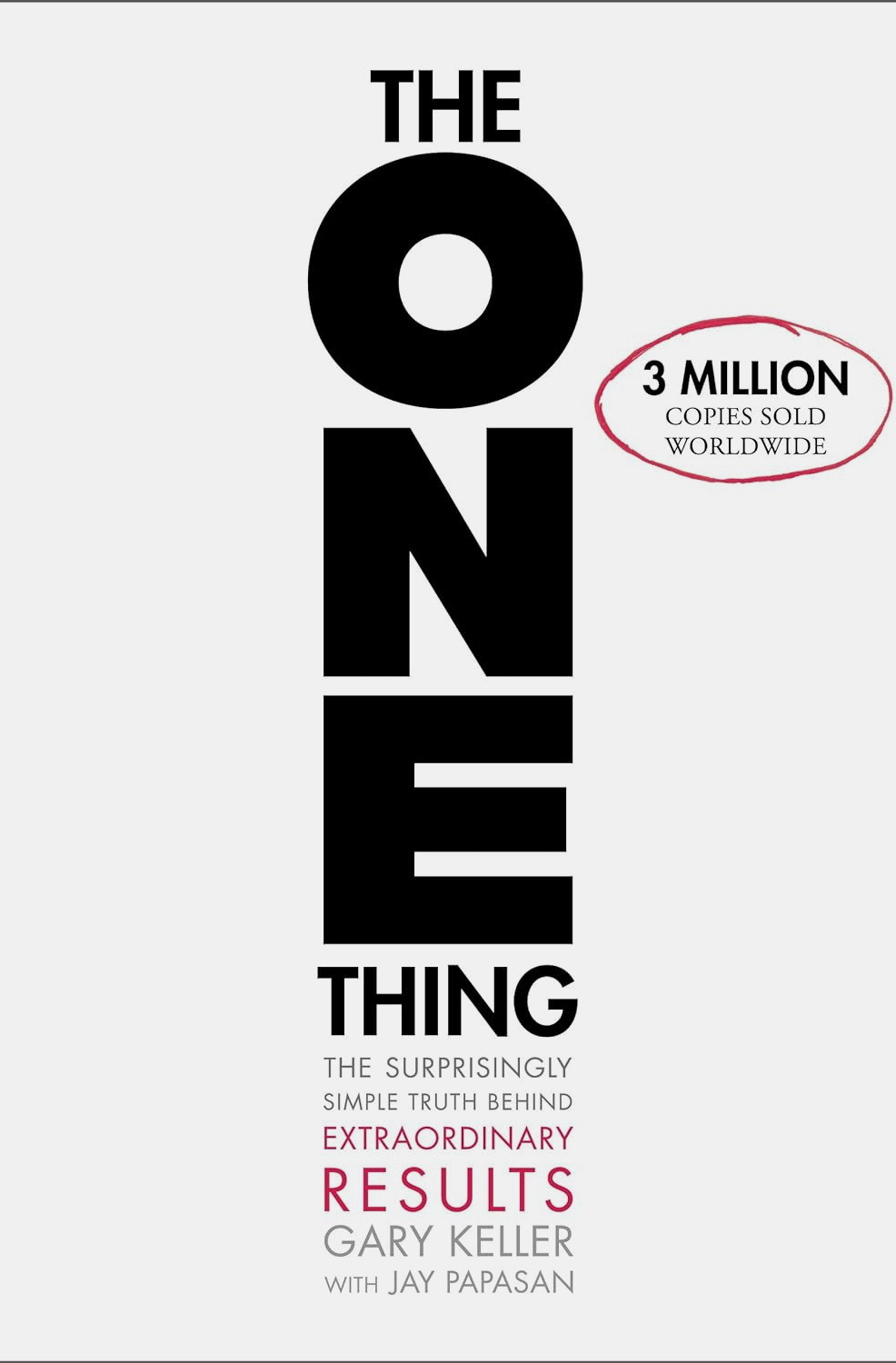
By Gary Keller & Jay Papasan
At the heart of The ONE Thing, Gary Keller and Jay Papasan make an argument that is almost aggressively simple: extraordinary results do not come from doing more things. They come from doing the right thing, consistently, with enough focus that everything else either becomes easier or unnecessary.
BUY THIS BOOK
The book challenges one of the most celebrated assumptions of modern work and life, the belief that successful people are great multitaskers. We are taught to admire people who juggle complex schedules, respond quickly to everything, pursue multiple goals at once, and remain endlessly available. Busyness has become a kind of status symbol. A full calendar can make us feel important. A long task list can make us feel productive. Constant motion can create the appearance of progress.
Keller and Papasan argue that much of this is an illusion.
Their central claim is that most meaningful achievement comes from identifying the single most important action in a given moment, then giving it disproportionate attention. The goal is not to ignore every other responsibility forever. The goal is to recognize that, at any point in time, some activities matter far more than others. The people and organizations that achieve unusual results are usually not doing everything equally well. They are directing their best time, energy, and attention toward the work that creates the greatest downstream effect.
The book is about productivity, but it is also about decision making, leadership, personal discipline, and the courage to disappoint lesser priorities in order to protect greater ones.
The Focusing Question
The book revolves around a single question: “What is the one thing I can do such that by doing it, everything else will be easier or unnecessary?”
This is not intended as a clever productivity slogan. It is meant to become a decision making tool. When you are overwhelmed, distracted, or unsure where to begin, the question forces you to separate activity from importance.
Most people begin their days by asking, “What do I need to get done?” That question produces a list. The list may be long, urgent, and entirely reasonable. But it does not necessarily reveal what matters most. Keller and Papasan argue that a better question is, “What is the one task that would create the biggest positive effect if I completed it?”
The answer might be a sales call, a difficult conversation, a strategic plan, a key hire, a health decision, a financial commitment, or a decision you have been avoiding. It may not be pleasant. In fact, the most important thing is often the thing people delay because it requires focus, courage, or discomfort.
The Focusing Question is designed to create leverage. It asks people to stop treating every task as equally valuable. A leader who spends an entire day responding to routine messages may feel busy, but may have done little to move the organization forward. A founder who continuously tweaks a product while avoiding customer acquisition may be working hard while neglecting the actual constraint on growth. A person who spends months researching a decision without taking action may be confusing preparation with progress.
The right question does not eliminate complexity. It helps identify the point of greatest leverage within complexity.
The Domino Effect
Keller and Papasan use the image of a row of dominoes to explain how focused action compounds. One domino can knock over another. A series of relatively small actions, when arranged in the right sequence, can create a surprisingly large outcome.
The key is not simply working hard. It is identifying the first domino.
In practical terms, this means recognizing that one achievement often makes the next achievement more possible. A strong sales process can create more revenue. More revenue can allow for better hiring. Better hiring can improve execution. Better execution can improve the customer experience. A better customer experience can drive referrals, retention, and reputation.
The same is true in personal life. A regular sleep routine may improve energy. More energy may improve exercise habits. Better physical health may improve concentration, emotional stability, and decision making. One important change can affect several areas at once.
The book argues that extraordinary results are often sequential, not simultaneous. People tend to look at successful outcomes and assume they were produced through a balanced effort across every category of life. But major accomplishments are usually built through focused periods of disproportionate attention.
This is why the authors discourage the idea that a person can achieve everything at once. Focus requires tradeoffs. To push one domino forward, something else may need to wait.
The Myth of Multitasking
One of the book’s clearest arguments is that multitasking is largely a myth. Human beings do not truly perform multiple demanding cognitive tasks at the same time. Instead, they switch rapidly between tasks. Each switch creates a cost. Attention fragments. Errors increase. The brain needs time to reorient itself.
This is particularly relevant in modern workplaces, where people are expected to respond instantly to messages, attend back to back meetings, monitor multiple channels, and remain available throughout the day. The result is not necessarily higher productivity. Often, it is shallow work performed across too many fronts.
Keller and Papasan argue that people should protect blocks of time for their most important work. They call this time blocking. The principle is straightforward: schedule uninterrupted time for the one task that matters most, and treat that time as a serious commitment.
For many people, this requires a change in identity. They have become accustomed to being reactive. They answer messages as they arrive. They allow other people’s urgency to determine the shape of their day. They confuse availability with usefulness.
The authors argue that protecting focus is not selfish. It is often the only way to produce meaningful work. A person who gives every interruption equal importance may satisfy others temporarily, but will struggle to create anything substantial.
The Lie of Balance
Another major theme in the book is the idea that balance is often misunderstood. People speak about work life balance as though every area of life should receive equal attention every day. Keller and Papasan reject this approach. They argue that meaningful progress requires people to be intentionally out of balance at times.
This does not mean neglecting family, health, relationships, or personal responsibility. It means accepting that priorities shift. There may be seasons when a business requires unusually intense focus. There may be periods when health needs to become the central priority. There may be moments when family needs must outweigh professional ambition.
The goal is not permanent imbalance. The goal is purposeful prioritization.
Keller and Papasan distinguish between a balanced life and a counterbalanced life. A counterbalanced life recognizes that some areas require immediate attention while others can wait temporarily. The challenge is to avoid allowing temporary imbalance to become permanent neglect.
This is a more realistic model of adult life. People rarely have the ability to give every meaningful priority equal energy at the same time. The attempt to do so often creates guilt, exhaustion, and mediocrity across the board.
The book encourages readers to accept that excellence requires selective focus. The key is to choose deliberately rather than allowing circumstances to choose for you.
Willpower Is Limited
The authors also emphasize the importance of willpower. They argue that willpower is not an unlimited resource. It can be depleted by decisions, stress, distraction, poor sleep, emotional conflict, and the ordinary demands of daily life.
This has an important implication: do your most important work early, before your attention has been fragmented by meetings, messages, and other people’s priorities.
Many people reserve their most consequential tasks for later in the day, after routine work is complete. But by then, their mental energy has often been spent. They may still be physically present, but they are less capable of thinking clearly, resisting distraction, or engaging deeply.
The book’s advice is practical. Build your day around your priority rather than trying to fit your priority into the leftover space of your day.
This may require saying no to meetings, delaying low value tasks, changing routines, or creating stronger boundaries. But the authors argue that the results justify the discomfort. When a person consistently protects time for what matters most, they begin to build momentum. Their work becomes more focused, their progress becomes more visible, and their confidence becomes grounded in evidence rather than intention.
Goals Should Have a Direction
Keller and Papasan also discuss goal setting through the idea of “goal setting to the now.” Rather than setting distant goals and hoping they eventually happen, they suggest working backward.
Start with a long term vision. Then ask what needs to happen in five years to make that vision possible. Then ask what needs to happen this year. Then this month. Then this week. Then today.
Eventually, the long term goal becomes connected to a specific present action.
This is important because many people have ambitions that are too abstract to influence their daily behavior. They want to build wealth, become healthier, improve their relationships, grow a business, or become a better leader. But without translating those desires into immediate action, the goals remain emotionally appealing but operationally useless.
The book’s central insight is that future success is built through present focus. You do not achieve a five year goal by worrying about five years. You achieve it by identifying the next important action and doing it well.
The Role of Accountability
The book also makes the case for personal accountability. Keller and Papasan argue that success is not merely about setting goals. It is about accepting responsibility for finding the resources, guidance, and discipline needed to reach them.
This means moving beyond the mindset of waiting to be told what to do. It means becoming proactive about learning, seeking coaching, measuring progress, and identifying obstacles.
Accountability is not self punishment. It is ownership.
People who take ownership stop viewing obstacles as proof that progress is impossible. Instead, they ask what can be changed, learned, delegated, improved, or confronted. They understand that external circumstances matter, but they refuse to make those circumstances the sole explanation for their lack of movement.
The book suggests that highly successful people do not necessarily have fewer problems. They tend to respond to problems differently. They look for the next action within their control.
The Larger Message
The deeper message of The ONE Thing is not simply that people should become more efficient. It is that most people have more potential than their current patterns allow them to access.
The issue is often not a lack of ability. It is scattered attention.
We live in a world that rewards urgency, noise, busyness, and constant reaction. The book offers a counterargument: success often belongs to the person who can resist the noise long enough to identify what truly matters.
The authors do not promise that focus will make life easy. It may make life harder in the short term. It requires difficult choices. It requires boundaries. It requires saying no to things that are good but not essential. It requires resisting the emotional comfort of staying busy with work that does not matter enough.
But the reward is not merely greater productivity. It is a greater sense of direction.
When people know their one thing, they stop drifting through their days. They become more intentional. They create evidence that their time is being used in service of something meaningful. They stop treating every demand as equally important and begin organizing their lives around the few actions that can genuinely change the trajectory of their work, relationships, health, and future.
The question the book leaves readers with is simple, but not easy: What is the one thing that deserves your best attention right now?