By Chris Voss and Tahl Raz
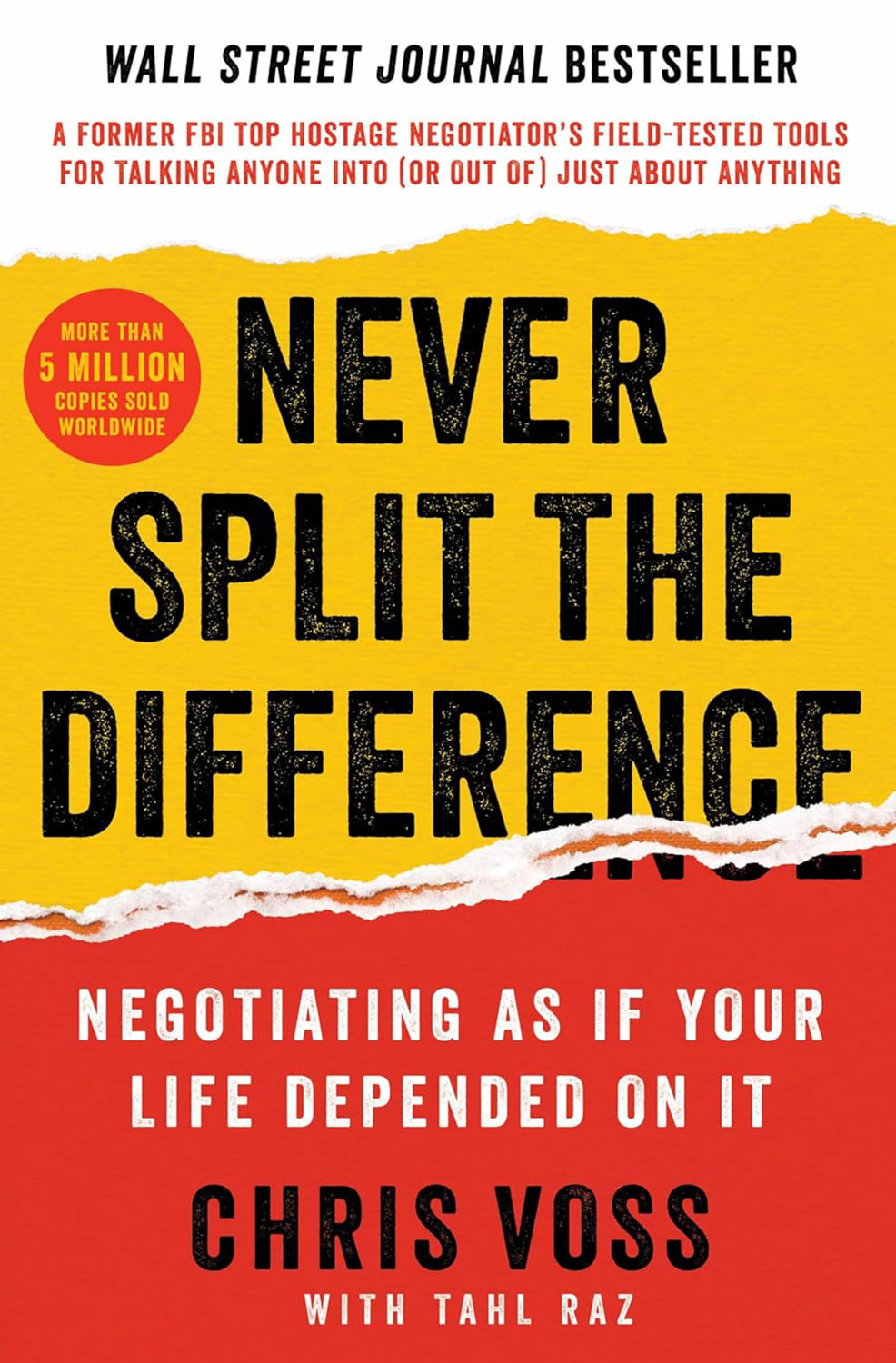
Most people think negotiation is about intelligence, persuasion, leverage, or compromise. They imagine sharp arguments, airtight logic, and the ability to outmaneuver the other person intellectually. In Never Split the Difference, Chris Voss completely dismantles that assumption.
Drawing from decades of experience as an FBI hostage negotiator, Voss argues that human beings are not rational decision-makers first. They are emotional creatures first, rational creatures second. That single idea changes everything.
BUY THIS BOOK
The book is not simply about negotiating business deals or hostage situations. It is really about understanding human behavior under pressure. Every difficult conversation, whether with a spouse, client, employee, child, investor, or friend, is ultimately a negotiation because every interaction involves conflicting desires, uncertainty, emotion, fear, and control.
Voss believes most traditional negotiation advice fails because it assumes people respond primarily to logic. In reality, when emotions rise, logic often disappears. Fear, ego, insecurity, pride, identity, and autonomy become far more influential than facts. The deeper lesson of the book is that successful negotiation is not about overpowering people. It is about understanding them deeply enough to influence them without triggering defensiveness or resistance.
Tactical Empathy Changes Everything
One of the most important concepts in the book is what Voss calls “tactical empathy.” This is not sympathy, agreement, or emotional softness. Tactical empathy is the deliberate effort to understand another person’s emotional state, fears, motivations, and worldview in order to navigate the conversation more effectively.
Voss repeatedly explains that people cannot think clearly until they feel heard. Most negotiators make the mistake of trying to persuade too early. They argue facts while the other person is still emotionally defensive.
Tactical empathy lowers emotional tension. When someone feels understood, their nervous system relaxes. They stop fighting for psychological safety and begin sharing information more openly. That information becomes leverage. This is why Voss considers listening to be the single most powerful negotiation skill. Not speaking. Not dominating. Not presenting. Listening.
The best negotiators create environments where the other person talks freely while unknowingly revealing priorities, insecurities, constraints, fears, and desires. Voss argues that information gathered through emotional trust is far more valuable than information extracted through pressure.
The Power of Mirroring
One of the book’s most famous techniques is “mirroring,” which involves repeating the last one to three key words the other person said in a calm, curious tone.
Someone says: “We’re under a lot of pressure right now.” You respond: “Pressure right now?”
It sounds almost too simple to matter, yet Voss explains that mirroring taps into deep psychological instincts. People naturally elaborate when they hear their own words reflected back to them. It creates a subtle feeling of understanding while encouraging them to continue speaking.
The brilliance of mirroring is that it gathers information without confrontation. Instead of aggressively interrogating someone, you gently invite them to expand. In hostage negotiations, this technique often caused emotionally unstable individuals to reveal critical information. In business settings, it uncovers hidden concerns, political pressures, budget constraints, insecurities, and emotional motivations that otherwise remain concealed. The technique reflects one of the book’s broader truths: people reveal more when they feel psychologically safe than when they feel pressured.
Labeling Emotions Reduces Defensiveness
Another core principle in the book is “labeling,” which means verbally identifying what the other person may be feeling. Statements like: “It seems like you’re frustrated.” “It sounds like this situation has been stressful.” “It looks like you’re worried about risk.”
These statements reduce emotional intensity because they create recognition and validation. Neuroscience research supports this idea. Naming emotions often reduces their neurological grip.
Interestingly, Voss explains that labels do not even need to be perfectly accurate to work effectively. Even imperfect emotional labels encourage people to clarify themselves, which still advances the conversation. The deeper purpose of labeling is emotional disarmament. Human beings become less defensive when they feel emotionally understood. Once defensiveness decreases, influence increases. This idea appears repeatedly throughout the book. Negotiation is not really about forcing agreement. It is about reducing resistance.
Why “No” Is Actually Useful
Traditional negotiation advice treats “no” like failure. Voss argues the exact opposite. “No” often represents the beginning of a productive conversation.
People feel psychologically safe when they can say no. Saying yes too early can create anxiety because yes implies commitment, obligation, or loss of control. Voss strategically designs questions that invite rejection because rejection relaxes people emotionally.
Instead of asking: “Do you agree?” He suggests asking: “Would it be ridiculous to consider this?” “Is now a bad time to talk?” “Are you against exploring this idea?”
These questions intentionally trigger a “no,” which paradoxically makes people more comfortable engaging further. This reflects one of the deepest psychological themes in the book: human beings resist feeling controlled. The more pressure they feel, the more resistance they create. The best negotiators therefore preserve the other person’s sense of autonomy while quietly guiding the direction of the conversation.
“That’s Right” Is the Goal
Voss makes a fascinating distinction between hearing “you’re right” and hearing “that’s right.” “You’re right” is often a conversational escape hatch. It is what people say when they want the discussion to end. “That’s right” is completely different. “That’s right” signals true recognition. It means the other person feels fully understood.
The negotiator’s goal is therefore not to force agreement. It is to summarize the other person’s worldview so accurately that they respond with genuine recognition. When people say “that’s right,” trust begins to form.
This moment matters because human beings cooperate far more willingly once they believe their perspective has been acknowledged. Many negotiations fail because people prioritize winning arguments instead of building emotional connection. Voss argues that emotional alignment is often more important than intellectual persuasion.
Tone of Voice Is a Weapon
The book also emphasizes how profoundly tone affects negotiation outcomes. Voss describes what he calls the “late-night FM DJ voice,” which is calm, slow, downward-toned, and reassuring. It communicates confidence without aggression. He contrasts this with aggressive or overly assertive communication styles that unintentionally trigger resistance.
The psychological principle underneath this is emotional contagion. Human beings subconsciously mirror the emotional states around them. Calmness creates calmness. Anxiety creates anxiety. Aggression creates aggression. In hostage negotiations, emotional regulation was critical because panic spreads rapidly between people. The same principle applies in business, leadership, relationships, and conflict. The person who controls emotional tone often controls the negotiation itself.
The Illusion of Control
One of the book’s most counterintuitive ideas is that successful negotiators often surrender visible control in order to gain real influence. Rather than dominating conversations, Voss asks calibrated questions that force the other side to think.
Questions like: “How am I supposed to do that?” “What’s the biggest challenge here?” “How does this fit into your goals?”
These questions create what Voss calls the “illusion of control.” The other side feels empowered because they are solving problems and generating answers themselves, yet the negotiator is quietly guiding the direction of thought. This works because people trust conclusions they arrive at on their own far more than conclusions imposed on them externally. The lesson extends far beyond negotiation. Leadership, parenting, sales, and influence often work best when people feel ownership over decisions instead of feeling manipulated into them.
Black Swans and Hidden Information
Perhaps the most fascinating idea in the book is the concept of “Black Swans.” Black Swans are hidden pieces of information that dramatically alter negotiation dynamics once uncovered.
These hidden variables can include personal insecurities, organizational politics, career fears, ego needs, financial pressures, unspoken deadlines, or emotional motivations. Voss argues that every negotiation contains hidden information asymmetry. The person who uncovers these invisible drivers gains enormous leverage.
What makes this idea powerful is that Black Swans are rarely discovered through aggressive questioning. They emerge through patience, empathy, listening, observation, and trust-building. Again, the book reinforces the same underlying truth: understanding people matters more than overpowering them.
The Psychology Beneath the Entire Book
What makes Never Split the Difference so compelling is that it functions as far more than a negotiation manual. It is really a study of human psychology. Throughout the book, Voss demonstrates that people crave emotional safety, recognition, autonomy, and validation. Decisions are rarely driven purely by economics or logic. They are shaped by fear, identity, uncertainty, status, emotion, perception, and control.
The book quietly dismantles the myth that influence belongs to the loudest or most aggressive person in the room. According to Voss, influence belongs to the person who regulates emotion best, listens most carefully, understands motivations most deeply, and creates the strongest psychological safety. Negotiation, in this framework, becomes emotional navigation rather than intellectual combat.
Final Takeaway
The deepest lesson in Never Split the Difference is that influence does not come from overpowering people. It comes from understanding them.
Chris Voss transforms negotiation from a mechanical process into something profoundly human. He shows that empathy is not weakness. Listening is not passive. Calmness is not surrender. These are strategic advantages. The book ultimately challenges one of modern culture’s most common assumptions: that success belongs to the most dominant person in the room. Voss argues the opposite. Success often belongs to the person who understands human emotion better than everyone else.