
Listen to this week’s Insights, 30 min, read by Simon
Deep Dives Articles
DEEP DIVES ARTICLE — EMOTIONAL INTELLIGENCE

Why People Don’t Trust Leaders Who Always Sound Confident
This is a sneak peek of this week’s Deep Dives article. Published today!
Confidence is reassuring until it starts to feel dishonest. When leaders always have the answer, always sound certain, and never seem willing to say “I don’t know yet,” teams begin to sense the gap between the tone and the truth. This Deep Dive explores why constant confidence can erode trust, how performed certainty shuts down candor, and why the strongest leaders are not those who sound sure all the time, but those who are honest enough to leave room for reality.
DEEP DIVES ARTICLE — PERSONAL DEVELOPMENT

Toxic Relationships Don’t Just Hurt You, They Reshape You
This is a sneak peek of this week’s Deep Dives article. Published today!
Toxic relationships do more than cause pain in isolated moments. They slowly rewrite what feels normal. You become careful, vigilant, self doubting, over explaining, emotionally smaller, and fluent in someone else’s instability. This Deep Dive examines the deeper cost of toxic relationships, why leaving is not always the end of the work, and how healing requires more than distance. It requires becoming less governed by the version of yourself that harm taught you to become.
DEEP DIVES ARTICLE — LEADERSHIP
Leadership Begins Where Pretending Ends
This is a sneak peek of this week’s Deep Dives article. Published today!
Every organization has an official story and a private reality. The official story says the company is aligned, accountable, transparent, and ready for the next stage. The private reality knows which conversations are being avoided, which leaders are not working, and where the numbers, culture, or customer promise are beginning to fray. This Deep Dive explores why leadership begins the moment pretending stops, and why the strongest leaders are not the ones who perfect the story, but the ones brave enough to tell the truth while there is still time to act.
Deep Dives Book Summary
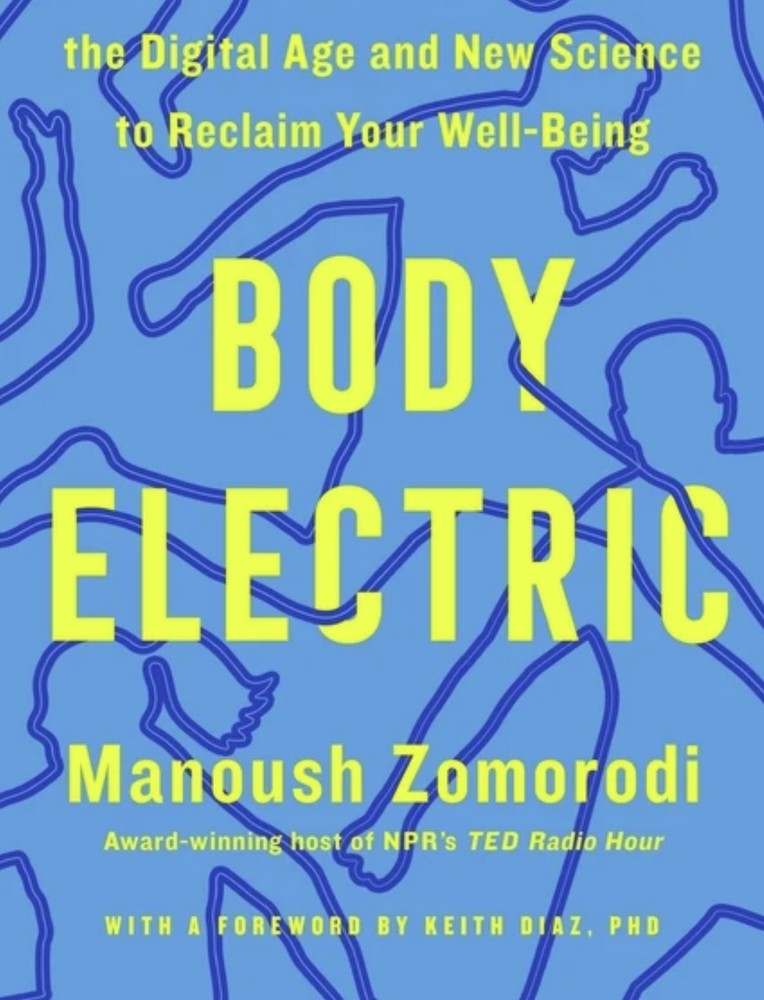
Body Electric: The Hidden Health Costs of the Digital Age and New Science to Reclaim Your Well Being
By Manoush Zomorodi and Keith Diaz PhD
This is a sneak peek of this week’s Deep Dives book summary. Published today!
What if the digital age is not just changing how we think, work, and communicate, but quietly reshaping our bodies? In Body Electric, Manoush Zomorodi and Keith Diaz explore the hidden physical costs of screen life, from prolonged sitting and shallow breathing to eye strain, fatigue, posture, sleep, and metabolic health. This Deep Dive unpacks the science behind why our bodies were not built for uninterrupted digital stillness, and why small, regular movement breaks may be one of the most practical ways to reclaim energy, focus, and well being in a world that keeps pulling us back to the screen.
Quick Reads
QUICK READ — EMOTIONAL INTELLIGENCE
The Emotional Cost of Broken Trust at Work
Trust at work is often discussed as though it were a cultural luxury, something pleasant to have once the business fundamentals are under control. But when pressure rises, trust is often treated as expendable, while revenue, speed, execution, and control are treated as real.
That is a mistake.
Trust is not softness. It is infrastructure. It determines how quickly truth travels, how much judgment people use, how much risk they are willing to take, and whether employees bring their full intelligence to the work or only the safest version of themselves. When trust breaks, the damage is not merely emotional. It becomes operational.
Broken trust rarely announces itself dramatically. People do not always storm out, resign immediately, or confront leadership in public. More often, they adjust. They become careful. They say less. They stop volunteering. The work still gets done. But something essential has changed. People are no longer working from commitment. They are working from calculation.
The Moment People Start Editing Themselves
One of the earliest signs of broken trust is self editing. Employees begin asking not only, “What is true?” but, “What is safe to say?” That shift may sound small, but it changes the whole emotional economy of the organization.
This is how organizations become less intelligent. Not because the people lack insight, but because the environment has taught them to ration honesty.
But when trust breaks, every truth has a political cost. Employees become amateur diplomats, carefully translating reality into language the organization can tolerate.
Broken Trust Turns Work Into Self Protection
In healthy organizations, people spend most of their energy on the mission, the customer, the product, the team, and the work itself. In low trust organizations, a growing share of energy goes into self protection.
The cost is especially high for strong employees because they are often the first to recognize the gap between what leadership says and what the culture actually does. They do not need perfection. What they struggle with is inconsistency.
At that point, cynicism begins to look less like negativity and more like pattern recognition.
The Loss of Generosity
Trust creates generosity. When people trust leadership, they are more willing to give the benefit of the doubt.
When trust breaks, generosity disappears.
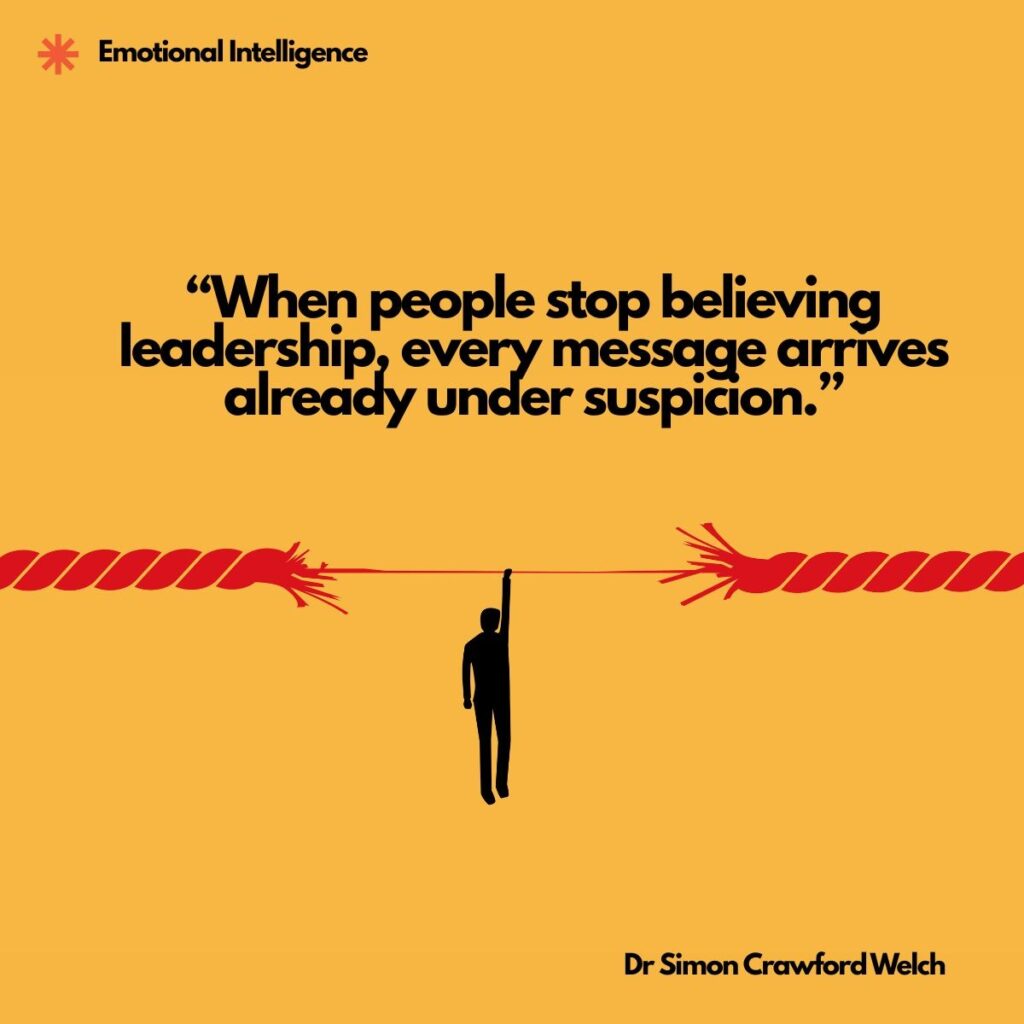
Every decision is interpreted more suspiciously. Every message is read for what is missing. Even reasonable decisions become harder to accept because the emotional account is already overdrawn.
Trust is the lens through which people interpret leadership. When the lens cracks, everything looks distorted.
The Human Cost Behind the Performance
Work is not family, despite the corporate habit of pretending otherwise. But that does not mean work is emotionally neutral.
That is why broken trust hurts.
It is not only that a promise was missed or a leader behaved poorly. It is that people begin questioning their own judgment. Why did I believe them? Why did I give so much? Why did I stay?
This is where disengagement often begins. Not as laziness, but as self preservation. They still perform, but they stop offering the discretionary effort that cannot be demanded.
The company may keep the employee’s labor while losing their belief.
Repair Requires More Than Better Messaging
Organizations often try to repair trust with communication. A new memo. A town hall. A statement of values. These can help, but only if they are attached to changed behavior. Otherwise, they make things worse.
People who have lost trust are not waiting for more polished language. They are waiting for evidence.
The hardest part is that repair usually takes longer than leaders want. Trust can be damaged in a moment, but it is rebuilt through repetition.
Trust returns when people experience enough consistency to believe the old pattern is no longer in charge.
The Leadership Responsibility
Leaders do not control every employee’s feelings, nor should they try. But leaders do have disproportionate influence over the conditions in which people work.
A leader who breaks trust may still get compliance. They may still get activity. But they will not get the same truth, energy, courage, or loyalty.
That is the real cost.
Trust is not built by asking people to believe harder. It is built by behaving in ways that make belief rational. Once broken, it can be repaired, but only by leaders willing to understand that trust is not what people owe the organization. It is what the organization must earn, again and again, especially when pressure makes earning it inconvenient.
QUICK READ — PERSONAL DEVELOPMENT
AI and the Death of Deep Work: Or Just the Death of Discipline?
Artificial intelligence has arrived at the exact moment knowledge workers were already losing the ability to concentrate. That may be the real problem. Not that AI has suddenly destroyed deep work, but that it has entered a professional culture where deep work was already under siege from meetings, notifications, fragmented calendars, performative busyness, and the constant addiction to visible responsiveness.
So the question is not simply whether AI will kill deep work. The better question is whether deep work was healthy enough to survive any powerful new tool.
Cal Newport famously defines deep work as focusing without distraction on a cognitively demanding task. Deep work requires sustained attention, intellectual resistance, and the willingness to remain with a problem after the easy answers have run out.
AI does not automatically threaten that kind of work. Used well, it may protect it. Used poorly, it may become the most elegant excuse yet invented for avoiding it.
The Seduction of Effortless Output
The great appeal of AI is that it reduces friction. Work that once required hours can now begin in seconds.
When output becomes easier, it can start to feel like thinking. But productivity theater did not begin with AI. AI simply gives it better lighting.
There is a difference between using AI to accelerate thinking and using AI to avoid thinking.
This is where discipline becomes the dividing line. AI can help a disciplined mind move faster. It can help an undisciplined mind produce more noise.
Deep Work Was Already in Trouble
But the deeper erosion began long before generative tools became mainstream. The modern workplace has trained people to live in fragments.
Microsoft’s 2025 Work Trend Index reported that 53 percent of leaders said productivity needed to increase, while 80 percent of the global workforce said they lacked the time or energy to do their work. The same report stated that employees were interrupted by a meeting, email, or ping every two minutes on average.
That is not an AI problem. That is an operating model problem.
AI is entering that environment. It may reduce some of the noise, but it may also increase the speed at which noise is produced.
Speed without discernment does not rescue deep work. It buries it under a more impressive pile.
The Discipline AI Cannot Supply
But the highest value work still depends on capabilities AI cannot simply hand over: judgment, taste, moral reasoning, strategic patience, lived experience, courage, and the ability to decide what actually matters.
Deep work has never been only cognitive. It is also ethical. It asks us to give the best of our attention to something that deserves it.
AI cannot do that part for us.
The New Divide
The real divide may be between people who use AI to deepen their work and people who use AI to decorate shallow work.
The first group will use AI as a thinking partner. But they will remain responsible for the final judgment. They will not outsource the hard part of thinking, only the unnecessary friction around it.
The second group will use AI as a substitution engine. They will become more productive in the narrowest sense and less serious in the only sense that matters.
But unless the organization also becomes more disciplined about priorities, decision rights, deep thinking, and actual accountability, AI will not create intelligence. It will create acceleration without direction.
The Leadership Responsibility
The more important question is what the saved time will be used for.
Organizations get the attention systems they design. If leaders reward instant responsiveness over careful judgment, AI will amplify reactivity.
Deep work has to be defended. Not nostalgically, but operationally.
The Real Question
AI is not the enemy of deep work. Indiscipline is.
The tool may be powerful, but the human pattern remains familiar. We reach for the thing that makes us feel productive before we ask whether we are being useful.
The challenge is not to reject AI. That would be sentimental and impractical. The challenge is to use it without becoming intellectually lazier. To let it remove the friction that does not matter while preserving the struggle that does. To remember that the point of technology should not be to free us from thinking, but to give us more capacity for the thinking only humans can do.
Deep work will not die because AI exists. It will die if we use AI to avoid the discipline that deep work always required.
QUICK READ — LEADERSHIP
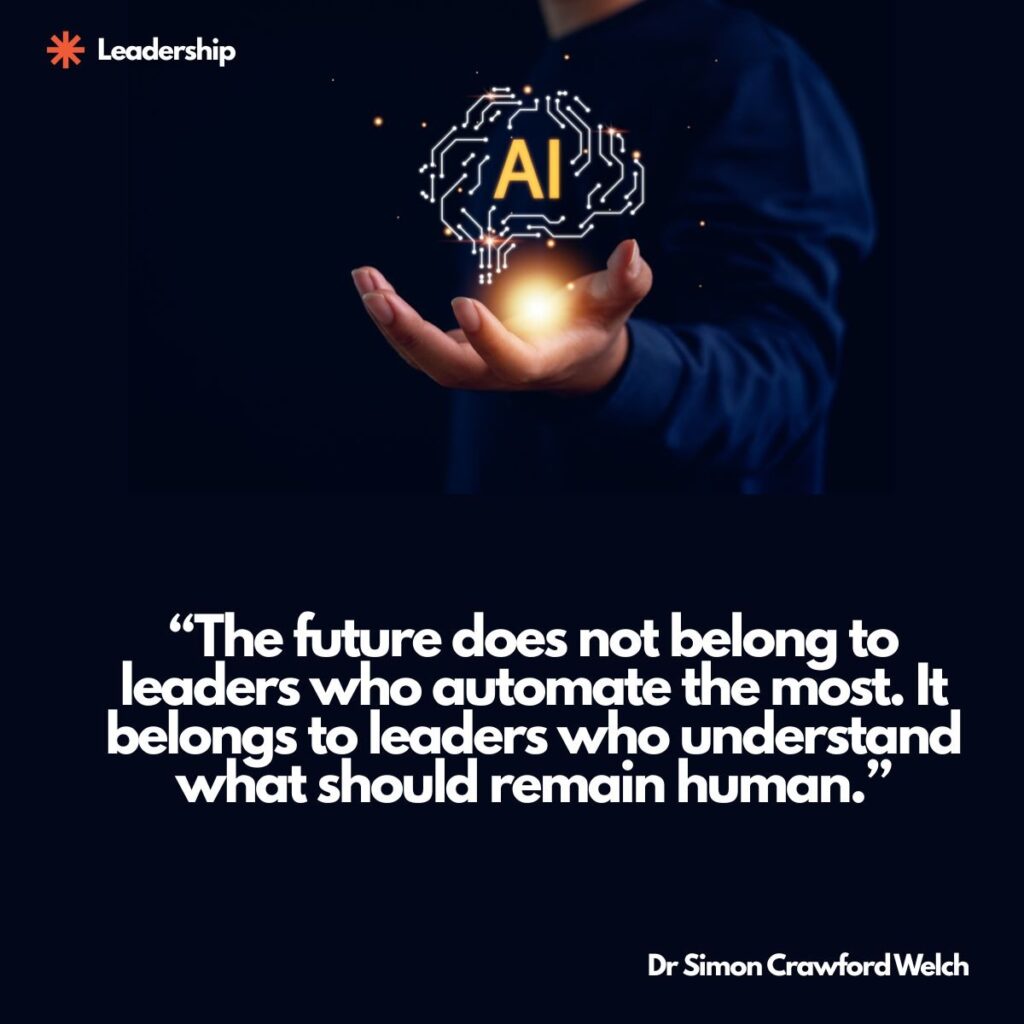
Leading Humans in a Machine Augmented World
The first mistake leaders make with artificial intelligence is assuming the central challenge is technical. Which platform should we buy? Which model is best? These are necessary questions, but they are not the deepest ones.
The deeper question is human.
What happens to people when machines become more capable of doing work that once made them feel useful, intelligent, creative, or necessary? What happens to judgment when output becomes cheap?
We are not simply adopting new technology. We are asking human beings to renegotiate their relationship with work, value, learning, identity, and authority. That is why leading in a machine augmented world requires more than digital fluency. It requires emotional seriousness.
The Human Question Beneath the Technology
AI is often introduced through the language of efficiency.
But technology does not automatically fix a broken operating model. If an organization is already unclear, reactive, meeting heavy, politically cautious, and addicted to urgency, AI may simply help it become unclear faster.
The question is not whether AI can increase output. It can. The question is whether leaders know what output is worth having.
People Do Not Fear Tools. They Fear What Leaders Will Do With Them
Many employees are not afraid of the tool itself. They are afraid of the leadership philosophy behind the tool.
If they believe AI is simply a surveillance device, a headcount reduction strategy, or another way to squeeze more work into the same exhausted week, resistance becomes rational.
Trust determines whether AI feels like leverage or threat.
This is why leaders must be honest about intent. Vague enthusiasm is not enough.
Judgment Becomes More Valuable, Not Less
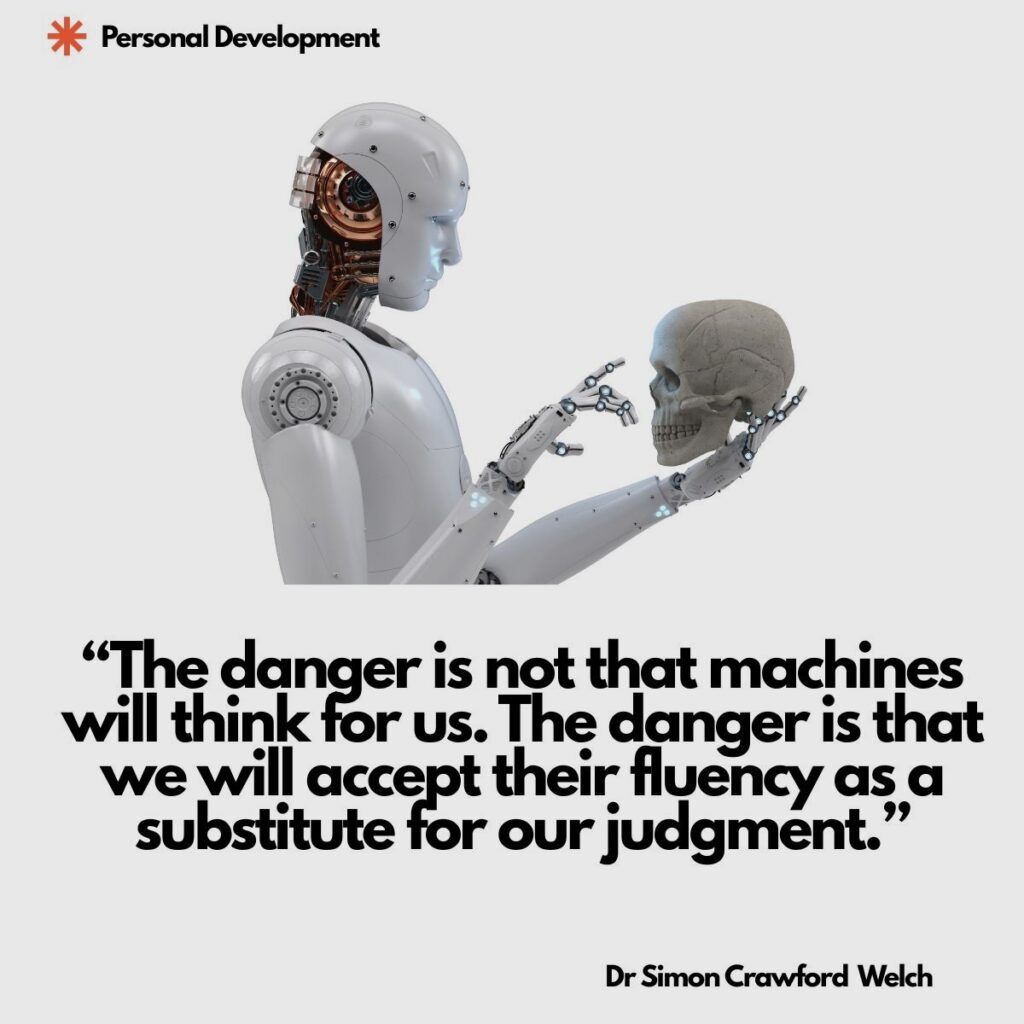
A machine augmented world does not make human judgment obsolete. It makes human judgment more visible. When anyone can generate a polished answer in seconds, the scarce skill becomes knowing whether the answer is any good.
Leaders now need to teach people how to question fluent answers.
AI can accelerate thinking, but it can also disguise the absence of thinking.
The human advantage is not that we can outproduce machines. The human advantage is that we can care what the output means.
The New Leadership Work Is Meaning Making
As machines take on more cognitive tasks, leaders will need to do more meaning making, not less. People want to know where they fit.
A leader who responds only with efficiency metrics will miss the emotional truth of the moment.
Gallup has found that the manager or team leader accounts for 70 percent of the variance in team engagement. The local leader will shape whether employees experience AI as invitation, confusion, threat, or opportunity.
Training Is Not Enough Without Trust
Many organizations will respond to AI with training programs. That is necessary, but insufficient. AI adoption is not a software rollout. It is a behavior change effort.
People need to understand the tools, but they also need permission to use them responsibly. They need leaders who use AI themselves, not as a gimmick, but as a disciplined extension of better work.
Most of all, they need to see that AI is being introduced with adult honesty. If roles will change, say so.
The fastest way to damage trust is to speak about empowerment while behaving like extraction.
Machines Can Scale Output. Leaders Must Scale Maturity.
The machine augmented world will reward organizations that can combine speed with discipline.
The essential human work remains stubbornly human. Building trust. Developing people. Making ethical choices. Naming reality. Repairing harm. Creating meaning. Deciding what matters when everything can move faster.
AI will not absolve leaders of those duties. It will expose whether they were doing them well in the first place.
The Human Future Is Not Automatic
The machine augmented future will not automatically be more humane, creative, or productive. It could be. It could also become more frantic, more surveilled, more shallow, and more emotionally depleted. The difference will not be determined by the technology alone. It will be determined by the quality of leadership around it.
The best leaders will not treat humans as inefficient machines waiting to be optimized. They will treat machines as tools that should help humans become more capable, more focused, more creative, and more useful in ways that matter.
That is the real test. Not whether we can use AI to do more, but whether we can use it to become wiser about what is worth doing.
Quotes of the Week
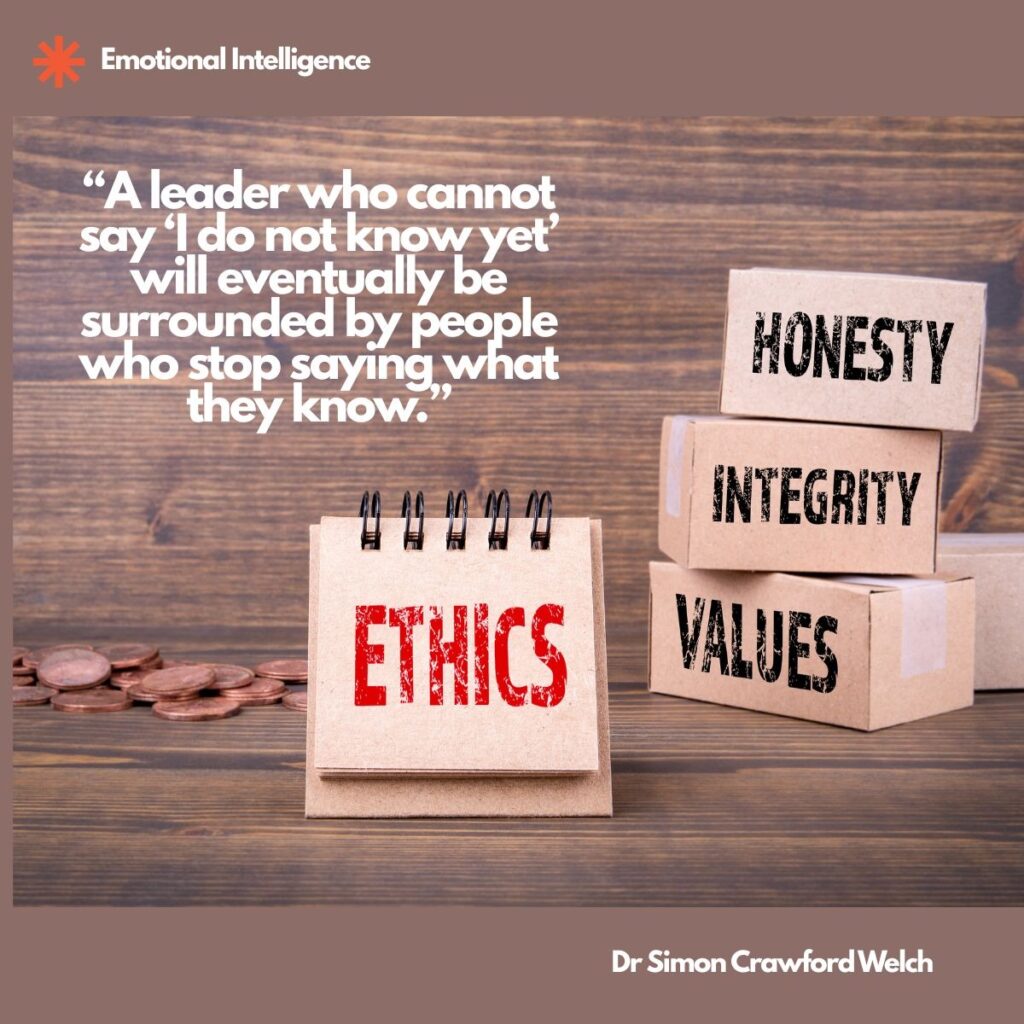
QUOTE — EMOTIONAL INTELLIGENCE
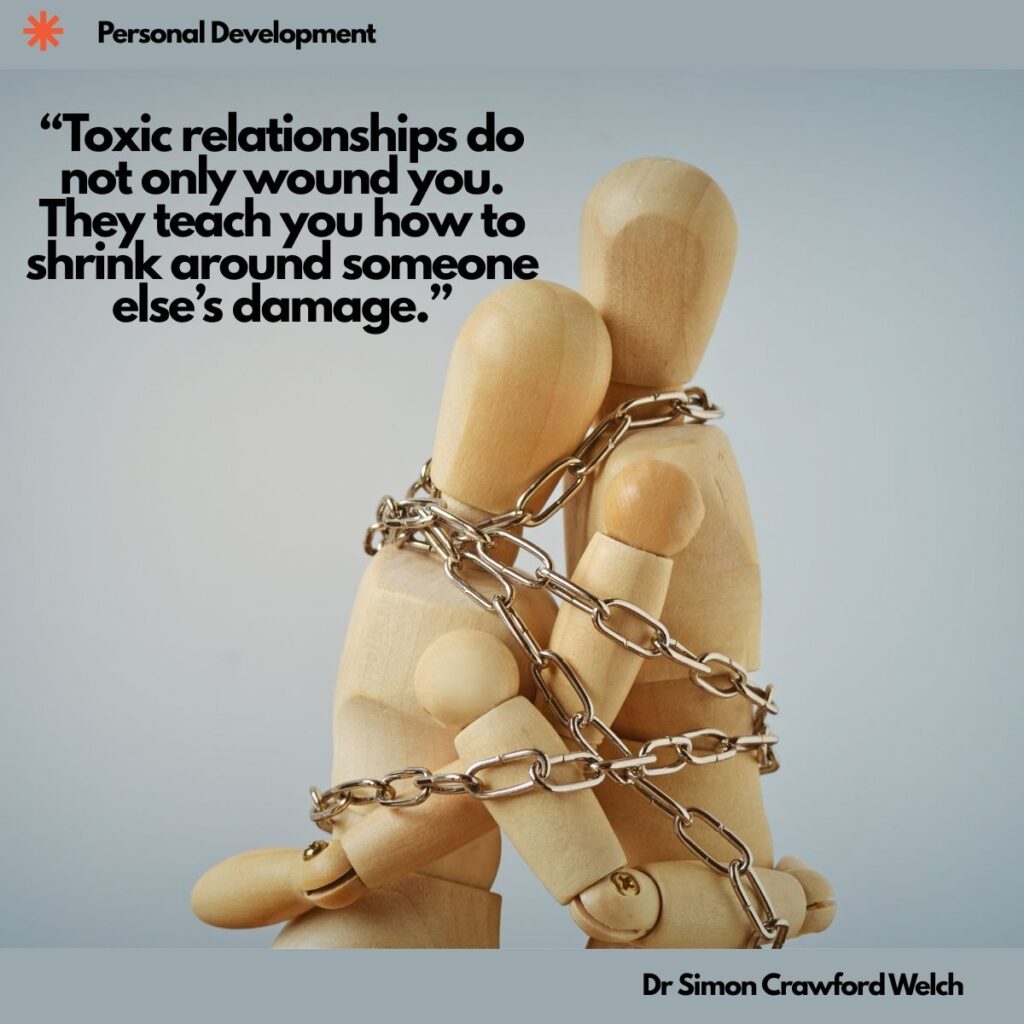
QUOTE — PERSONAL DEVELOPMENT
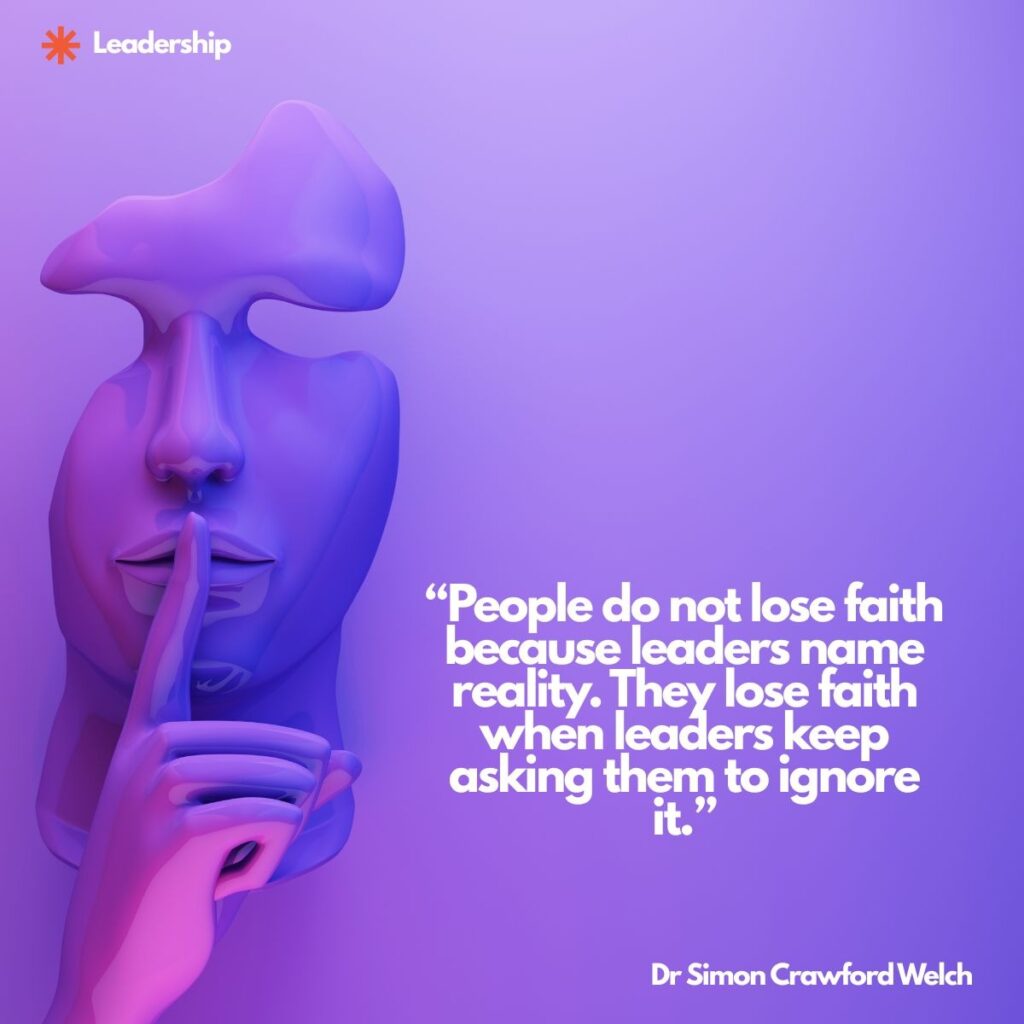
QUOTE — LEADERSHIP
Reframe
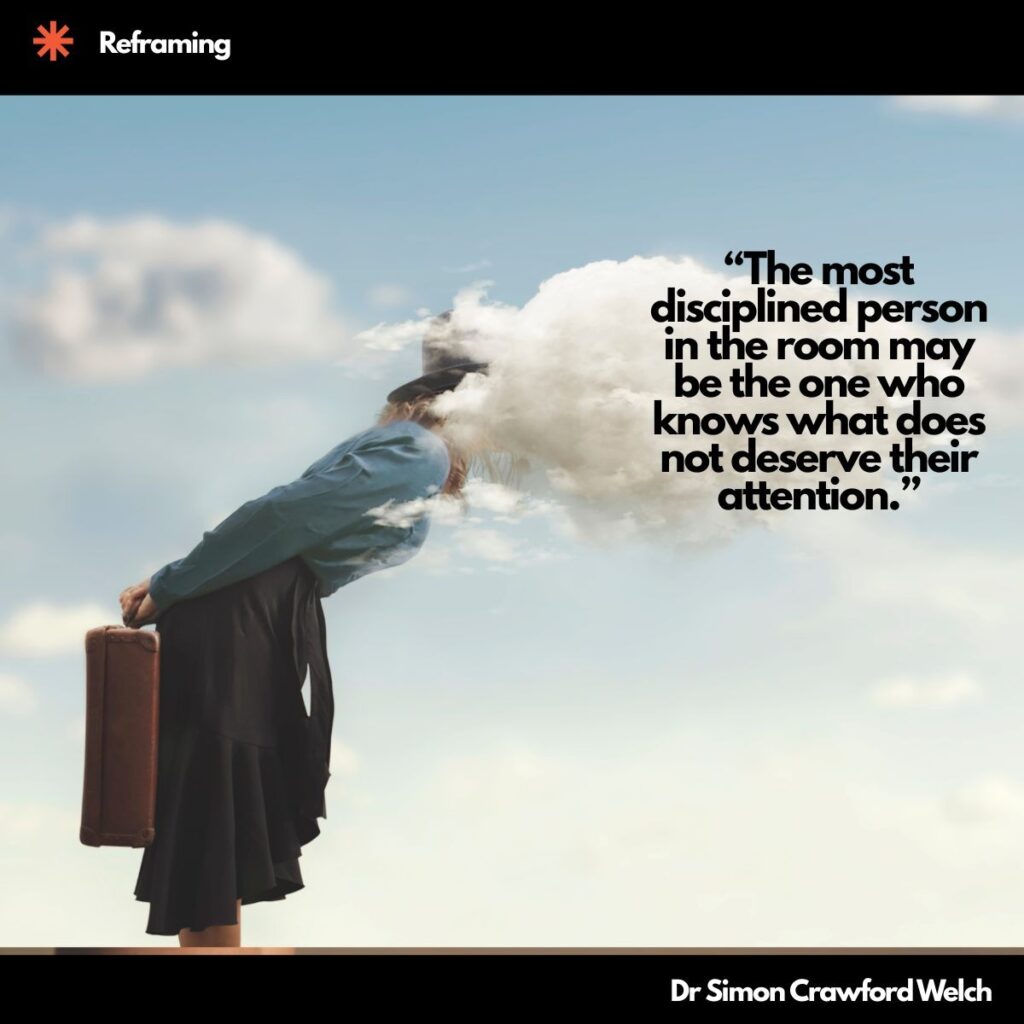
Why Discipline Looks Different in a Distracted World
Discipline used to be easier to recognize. It looked like waking early, keeping promises, working hard, saving money, training the body, mastering a craft, and doing the difficult thing when the easier thing was available. Those forms still matter. They have not become obsolete simply because the world has become more digital, faster, and more distracted.
But discipline now has a quieter and more demanding form. It is no longer only the ability to endure difficulty. It is the ability to protect attention.
That may sound less heroic, but it is increasingly rare. The modern person does not merely have to resist laziness. They have to resist an environment designed to interrupt, stimulate, seduce, and fragment them. The phone is always near. The inbox is always open. The feed always has another story. The workplace rewards responsiveness. The culture celebrates visibility. Even rest is often colonized by scrolling, checking, reacting, and absorbing the emotional noise of other people’s lives.
In that world, discipline is not just about working harder. Many people are already working hard. Discipline is about deciding what deserves access to your mind.
The Old Model of Discipline Is Not Enough
The traditional model of discipline was built around effort. If you wanted a better life, you worked harder, stayed consistent, delayed gratification, and developed habits strong enough to outlast mood. There is still truth in that. No serious achievement happens without repetition, sacrifice, and the willingness to act when motivation is absent.
But effort alone is no longer sufficient if attention is scattered.
A person can work ten hours and still avoid the most important work. A leader can attend meetings all day and never think deeply. A student can sit with a laptop open and absorb almost nothing. A founder can confuse urgency with progress, answering messages while avoiding the strategic decision that would actually change the business.
The distracted world has made activity easier to mistake for discipline. We are busy, available, responsive, and visibly in motion. But motion is not the same as self command. A life full of reaction can feel demanding while requiring very little real discipline.
The harder question is not, “Am I doing a lot?” The harder question is, “Am I doing what matters with the best of my attention?”
Distraction Is Not Always Weakness
It is tempting to moralize distraction as a personal failure. We tell ourselves people are unfocused because they lack willpower, seriousness, or ambition. Sometimes that is true. But the more honest view is that distraction has become environmental.
We are living inside systems built to capture attention. Every notification, algorithm, headline, message, and platform is competing for a piece of the mind. The modern professional is not simply choosing distraction in a neutral environment. They are trying to practice focus inside a marketplace where attention is the commodity being bought and sold.
That distinction matters because it changes the nature of discipline. Discipline is not merely resisting temptation in the moment. It is designing a life where the most important things do not have to fight for oxygen every hour.
This means turning off notifications. Protecting time. Reducing inputs. Choosing fewer priorities. Creating spaces where attention can settle. Refusing the false status of constant availability. Discipline now requires architecture, not just attitude.
The New Status Symbol Is Being Unreachable
For years, professional culture treated responsiveness as a sign of commitment. The person who replied instantly looked dedicated. The person always available looked important. The person with the packed calendar looked central to the business.
But constant availability is often just a more respectable form of captivity.
The most disciplined people in a distracted world are not necessarily those who answer fastest. They are those who know when not to answer. They understand that every yes to interruption is a no to depth. They recognize that the ability to be unreachable for the right reasons is not arrogance. It is stewardship.
This is difficult because being responsive feels good. It gives quick rewards. It creates the sensation of usefulness. It allows us to avoid the discomfort of deeper work while still feeling productive. The message answered, the meeting attended, the small task completed, all of it produces a satisfying sense of motion.
Deep work does not always offer that immediate reward. It can feel slow, uncertain, and emotionally uncomfortable. It asks us to remain with a problem long enough to be changed by it. That is why so many people avoid it while claiming they are too busy.
Often, they are not too busy. They are too fragmented.
Discipline Is Now the Ability to Choose Your Inputs
A distracted world does not only steal time. It shapes desire.
What we repeatedly consume begins to influence what we value, envy, fear, pursue, and resent. If we spend our days absorbing outrage, comparison, vanity, anxiety, and shallow certainty, we should not be surprised when our inner life becomes noisier. Attention is not passive. It is formative.
This is why discipline must now include the discipline of inputs. What do you read? Who do you listen to? What ideas are you allowing to shape your expectations? What emotional climate are you voluntarily entering every day? What are you calling relaxation that is actually agitation in disguise?
The mind is not immune to its diet.
A disciplined person is not one who avoids every distraction forever. That would be unrealistic and joyless. The disciplined person becomes more honest about the cost of repeated exposure. They understand that attention compounds. So does distraction. So does resentment. So does clarity.
Leadership in a Distracted Organization
Organizations have their own attention disorders. Too many priorities. Too many meetings. Too many dashboards. Too many urgent requests. Too many initiatives launched before the previous ones have been absorbed. Leaders then wonder why execution is uneven, accountability is unclear, and people seem exhausted.
Discipline at the organizational level means making choices that reduce noise. It means deciding what will not be done. It means protecting people from unnecessary urgency. It means clarifying which metrics matter, who owns them, and what decisions they are supposed to inform.
A distracted company often looks energetic from the outside. Inside, it feels like confusion wearing running shoes.
Great leaders understand that focus is not created by motivational speeches. It is created by disciplined subtraction. Fewer priorities. Cleaner decision rights. Better meetings. Clearer standards. More honest tradeoffs. Less tolerance for performative busyness.
The leader’s job is not to keep everyone activated at all times. It is to make sure the organization’s best energy is directed toward what matters most.
The Emotional Discipline of Slowness
Perhaps the most countercultural form of discipline now is slowness. Not laziness. Not indecision. Slowness as the refusal to let the pace of the world dictate the quality of your judgment.
A distracted world rewards speed. Quick takes. Fast replies. Immediate opinions. Instant positioning. But many of the things that matter most require a slower intelligence. Strategy requires it. Writing requires it. Leadership requires it. Parenting requires it. Love requires it. Moral judgment requires it.
There is emotional courage in not responding immediately. There is maturity in saying, “I need to think about that.” There is discipline in allowing an idea to develop before turning it into content, a decision, or a public position.
The world will continue to reward speed because speed is visible. Depth will remain quieter. But depth is where better judgment is usually formed.
The Return to Self Command
Discipline in a distracted world is not about becoming severe, joyless, or permanently optimized. It is about reclaiming self command in an environment that profits from your fragmentation.
It is the ability to say, “Not now,” to things that want immediate access to your attention. It is the willingness to be bored long enough for a better thought to arrive. It is the humility to admit that your mind is not infinite, your attention is not indestructible, and your best work will not survive if you keep giving your finest energy to whatever is loudest.
The disciplined life today may look less dramatic than the old heroic model. It may look like a closed laptop, a quiet morning, a phone in another room, a shorter meeting, a clearer no, a walk without headphones, a day organized around one serious piece of work.
But beneath those small acts is something profound. A person is choosing not to be owned by the noise.
That is what discipline looks like now. Not merely doing hard things, but protecting the conditions under which hard things can be done well.