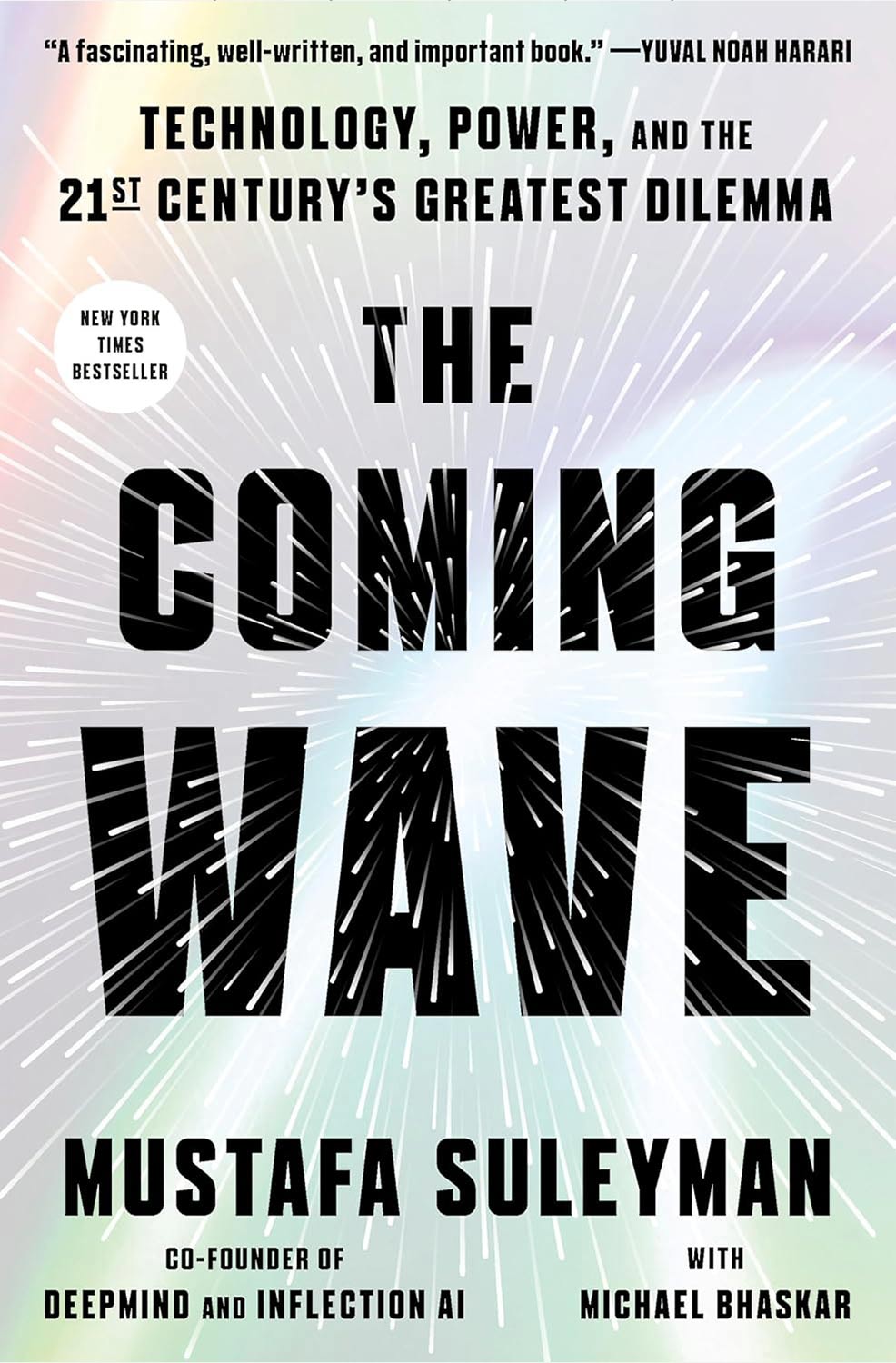
By Mustafa Suleyman and Michael Bhaskar
The Coming Wave by Mustafa Suleyman, co-founder of DeepMind, is one of the most important books written about artificial intelligence and technological power. The central argument is both simple and profound: humanity is entering a new technological era driven by artificial intelligence and synthetic biology, and these technologies will reshape society faster and more radically than previous technological revolutions.
Suleyman calls this transformation “the coming wave.” Like earlier waves of industrial change…. printing, electricity, computing…. this one will spread globally and reshape every institution it touches. But unlike earlier waves, it introduces a new challenge: technologies so powerful and widely accessible that controlling them may be extraordinarily difficult.
The book therefore revolves around a central dilemma: How do we harness the benefits of transformative technology while preventing it from destabilizing society or escaping human control?
BUY THIS BOOK
Technology Arrives in Waves
Suleyman begins by framing history as a series of technological waves that fundamentally alter civilization. Agriculture, the printing press, the industrial revolution, electricity, and digital computing all transformed how humans organize society.
Each wave brought enormous benefits but also disruption, instability, and new concentrations of power.
The coming wave, however, differs from earlier revolutions in several key ways. Previous technological shifts required massive infrastructure and capital investment before they could spread widely. Building railways or electrical grids required large governments or corporations.
Modern technologies like AI and biotechnology operate differently. They are largely software-based and information-driven, which means they can spread extremely quickly and be replicated almost infinitely.
In the past, technology diffused gradually. Today it spreads globally almost instantly.
This acceleration changes the nature of technological power. Instead of being concentrated in a few large institutions, powerful capabilities can increasingly be accessed by small organizations or even individuals.
That shift, Suleyman argues, is the defining characteristic of the coming wave.
Two Technologies Driving the Future
Suleyman identifies two technologies at the core of the coming wave:
No. 1 — Artificial Intelligence
No. 2 — Synthetic Biology
Together they form a powerful combination that could reshape nearly every domain of human activity.
Artificial intelligence represents a major leap in computational capability. Modern AI systems can analyze massive datasets, generate text and images, write code, discover new scientific insights, and increasingly make decisions autonomously.
Synthetic biology, meanwhile, allows scientists to design and manipulate biological systems. This includes engineering new organisms, developing novel medicines, and potentially altering the genetic foundations of life itself.
Individually, each technology is transformative. Together they represent an unprecedented expansion of human capability.
For example, AI can accelerate biological research by rapidly analyzing genetic data, designing drugs, and modeling complex biological systems. Conversely, biological tools can be used to enhance computing, medicine, and environmental engineering.
The fusion of these technologies creates a world in which innovation accelerates dramatically.
Suleyman describes this process as “hyper-evolution,” where technological systems improve themselves faster than previous generations of tools ever could.
The implications are enormous. Advances that once took decades may now occur within years – or even months.
The Four Characteristics of the Coming Wave
Suleyman argues that the technologies of the coming wave share several characteristics that make them uniquely difficult to manage.
No. 1 — Asymmetric Impact
Small groups or even individuals may gain access to capabilities that previously required entire governments.
Just as a single hacker can now disrupt large institutions through cyberattacks, powerful AI or biotechnology tools could enable individuals to cause disproportionate harm.
The balance of power shifts dramatically when advanced tools become widely accessible.
No. 2 — Rapid Development
AI systems improve at extraordinary speed. New models appear every few months, each significantly more capable than the last.
This rapid iteration makes it difficult for regulators, institutions, and societies to keep pace.
By the time rules or safety mechanisms are established, the technology may already have advanced beyond them.
No. 3 — Omni-Use Technologies
The technologies of the coming wave are dual-use – or more accurately, “omni-use.”
They can be used for beneficial purposes such as medical discovery, scientific research, and economic growth. But the same tools can also be used for surveillance, manipulation, cyber warfare, or biological threats.
The very flexibility that makes these technologies powerful also makes them dangerous.
No. 4 — Increasing Autonomy
Modern systems increasingly operate without direct human control.
AI systems already make decisions in finance, logistics, military planning, and online content moderation. As these systems become more sophisticated, the degree of human oversight may decline.
This introduces new risks because autonomous systems may behave in unpredictable ways.
The Containment Problem
The central concept of the book is what Suleyman calls the containment problem.
In previous technological eras, powerful technologies could be controlled through physical infrastructure, regulatory frameworks, or centralized institutions.
But the coming wave introduces technologies that are:
• Easy to replicate
• Difficult to track
• Widely accessible
• Rapidly evolving
This makes containment extraordinarily difficult.
Suleyman compares the challenge to nuclear weapons but notes a crucial difference.
Nuclear technology required enormous industrial infrastructure and rare materials. Only governments could realistically develop nuclear weapons.
AI and biotechnology, by contrast, rely primarily on knowledge and software, which can spread easily across borders and institutions.
This means the technologies of the coming wave cannot simply be locked away.
They will inevitably proliferate.
The challenge, therefore, is not stopping the wave… but learning how to navigate it.
The Risks of Technological Expansion
Suleyman explores several potential risks associated with uncontrolled technological growth.
Economic Disruption
AI has the potential to automate large numbers of cognitive tasks, affecting professions that previously seemed safe from automation.
This could reshape labor markets and create significant economic inequality if societies fail to adapt.
Political Instability
AI technologies can amplify misinformation, enable mass surveillance, and influence democratic processes.
Governments may increasingly rely on AI tools to monitor populations, while malicious actors may use them to manipulate public discourse.
Security Threats
The combination of AI and biotechnology raises concerns about bioengineering and weaponization.
As technological capabilities spread, the barrier to creating dangerous tools may decline.
Loss of Human Control
Perhaps the most widely discussed risk is the possibility that highly autonomous AI systems could behave in ways that humans cannot fully predict or control.
While Suleyman does not present this as an imminent catastrophe, he argues that the trajectory of technological development demands careful governance.
The Narrow Path Forward
Despite the risks, Suleyman does not advocate halting technological progress.
Instead, he argues for a balanced approach that preserves innovation while establishing strong governance mechanisms.
He proposes a number of strategies that governments, companies, and institutions should pursue.
Global Cooperation
AI and biotechnology are global technologies.
Effective governance therefore requires cooperation between nations rather than purely national regulatory frameworks.
Without coordination, countries may enter an arms race in which safety measures are sacrificed for technological advantage.
Stronger Institutions
Governments must develop institutions capable of understanding and regulating complex technologies.
This may include specialized regulatory bodies, international agreements, and stronger oversight mechanisms.
Technical Safety Research
Just as aerospace engineering developed safety standards over decades, AI systems require significant investment in safety research.
This includes work on interpretability, alignment, and fail-safe mechanisms.
Corporate Responsibility
Technology companies play a central role in shaping the development of AI.
Suleyman argues that these companies must adopt stronger internal governance and ethical frameworks to ensure that their technologies are used responsibly.
Technology as Both Opportunity and Risk
One of the most striking aspects of The Coming Wave is its balanced tone.
Suleyman is not anti-technology. In fact, he strongly believes that technological progress can solve many of humanity’s greatest challenges.
Artificial intelligence may accelerate scientific discovery, improve healthcare, reduce poverty, and help address climate change.
Biotechnology may produce new medicines, cure genetic diseases, and enhance agricultural productivity.
The coming wave therefore represents an enormous opportunity.
But it also demands new forms of responsibility and governance.
Humanity must learn how to manage technologies that are both incredibly powerful and widely accessible.
The Future of Human Agency
Ultimately, the book raises a deeper philosophical question:
Who controls the future when technology becomes extraordinarily powerful?
Throughout history, technological change has always reshaped power structures.
The printing press empowered new forms of knowledge distribution. Industrial machines transformed labor markets. The internet reshaped communication and commerce.
Artificial intelligence may represent the next stage in this evolution.
As machines become capable of performing increasingly complex cognitive tasks, the nature of human work, leadership, and decision-making may change dramatically.
Suleyman suggests that the future will not simply be defined by technological capability but by how societies choose to govern and guide that capability.
The Central Message of the Book
The core message of The Coming Wave can be summarized in a single idea:
The technological future is inevitable, but its consequences are not.
Artificial intelligence and biotechnology will continue advancing. Attempting to stop them entirely would likely be impossible.
But the direction these technologies take… and the risks they pose… will depend on the decisions made by governments, companies, and citizens in the coming decades.
Humanity must therefore confront the containment problem directly.
Not with fear or denial, but with thoughtful governance, international cooperation, and responsible innovation.
The Bottom Line
The Coming Wave is not simply a book about artificial intelligence.
It is a book about power.
It explores how technological capability reshapes societies, redistributes influence, and creates new ethical dilemmas.
The technologies of the coming wave will affect everything from economic systems and national security to medicine and culture.
Understanding these dynamics is essential for leaders, policymakers, entrepreneurs, and anyone interested in the future of civilization.
As Suleyman argues, humanity is entering a period of extraordinary technological transformation.
The challenge of the twenty-first century is not merely inventing powerful tools.
It is learning how to live with them responsibly.